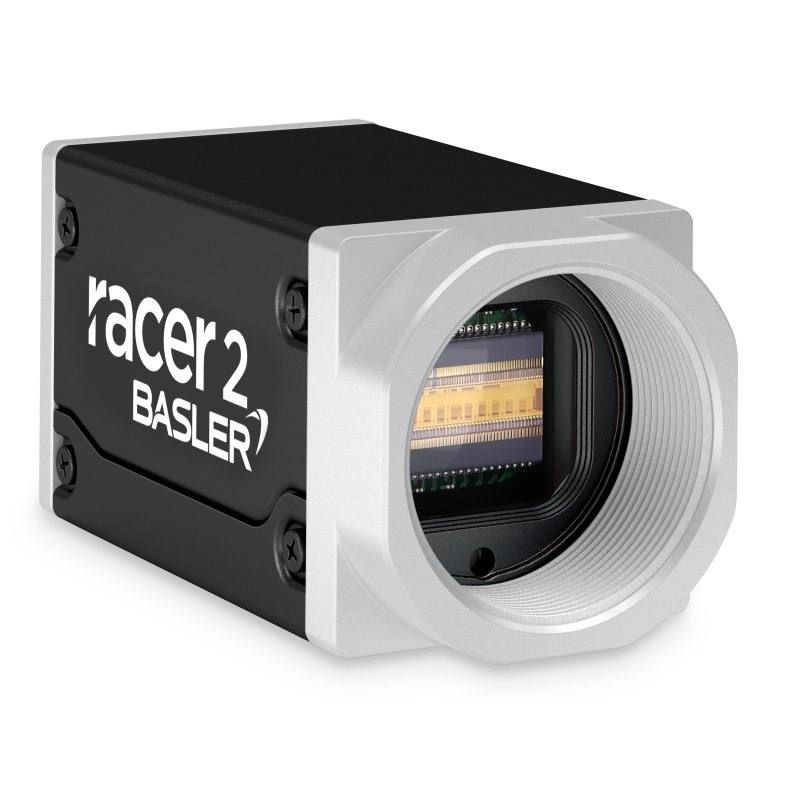
The r2L2048-58gm belongs to Basler's racer 2 S GigE family and uses the Gpixel GL3504 global-shutter linear CMOS sensor with 2048 × 1 active pixels at 7 µm × 7 µm pitch, giving a 14.34 mm sensor length. It transmits image data over GigE Vision 2.0 with PoE (IEEE 802.3af) or 12–24 VDC power, consuming approximately 5 W via PoE or 3.5 W via DC. The camera supports 8/10/12-bit output, hardware and software triggering, PTP synchronization, and GenICam compliance, housed in a 55.5 × 29 × 29 mm IP30-rated enclosure with a C-mount lens interface.
The Basler racer 2 r2L2048-58gm is a GigE line scan camera built around the Gpixel GL3504 global-shutter linear CMOS sensor, delivering 2048 active pixels across a 14.34 mm sensor length at 7 × 7 µm pixel pitch. The global-shutter architecture is a significant practical advantage in line scan applications: unlike rolling-shutter designs, every pixel in the line integrates simultaneously, which eliminates the motion-induced smear artifacts that appear when illumination pulses or encoder-triggered exposures are used at high transport speeds. At 58 kHz maximum line rate, the camera can sustain sharp imaging of web or conveyor material moving at substantial velocity — at native 7 µm ground sampling distance the sensor can follow a web moving at 406 mm/s (58,000 lines/s × 0.007 mm) while delivering full 2048-pixel lines. The 12-bit output depth preserves fine radiometric gradations that assist in distinguishing subtle surface texture or density variations before any downstream processing compresses the dynamic range.
Data transport uses GigE Vision 2.0, which means the camera integrates directly into standard Ethernet infrastructure without specialized frame grabbers or proprietary cabling. Power over Ethernet (IEEE 802.3af) draws approximately 5 W and simplifies wiring to a single Cat-5e/Cat-6 cable; the alternative 12–24 VDC supply (tolerance range 10.8–30 VDC) draws approximately 3.5 W and accommodates installations where PoE switches are unavailable or where a shared DC rail is already present. PTP synchronization support allows multiple cameras on the same network to share a common time base, which is essential when building multi-camera line arrays or correlating scan data with external process sensors. Hardware and software triggering, combined with full GenICam compliance, means the camera slots cleanly into any compliant SDK — Basler's pylon or open-source GenICam consumers — with no custom driver work.
The physical package measures 55.5 × 29 × 29 mm and weighs 100 g, placing it in a genuinely compact class for a 2 k-pixel GigE line scan camera. The C-mount lens interface is widely supported and gives installers access to a deep catalogue of line scan optics at various focal lengths and f-numbers, including telecentric lenses for accurate dimensional gauging. The IP30 rating covers internal electronic components against solid-body ingress but does not seal against liquids, so enclosure design must provide additional protection in wash-down or high-particulate environments. The operating temperature range of −10 to 60 °C is consistent with most factory floors, though thermally challenging enclosures or outdoor installations with solar loading should be evaluated against the 60 °C upper limit. The 100 g mass keeps vibration-induced resonance manageable on camera brackets mounted above moving machinery.
Best for
Continuous web and sheet inspection — printed, coated, or laminated materials moving at high speed where the global shutter eliminates exposure artifacts and 58 kHz line rate sustains ground resolution at production velocity.
Surface defect detection on flat panels, metal strip, or textile fabric, where 2048-pixel width provides sufficient cross-web coverage and 12-bit depth captures subtle gloss, density, or texture anomalies.
Pharmaceutical and packaging label inspection requiring traceability code reading (1D/2D barcode, OCR) combined with print quality verification in a single scan pass.
Electronics PCB or flex-circuit inspection on pick-and-place or SMT lines, where the compact 29 × 29 mm cross-section fits tight machine envelopes and PoE simplifies integration into existing network infrastructure.
Logistics sortation and dimensional measurement on conveyor lines, leveraging encoder-triggered line acquisition and PTP synchronization to correlate scan data accurately with package position.
Selection notes
Line rate versus transport speed: at 58 kHz the camera produces square pixels (1:1 aspect ratio) only when surface transport speed equals 58,000 lines/s × pixel-pitch-in-mm = 406 mm/s for the native 7 µm ground sampling distance. At higher speeds the image compresses in the scan direction; at lower speeds it stretches. Encoder-based line triggering is the standard remedy — confirm your motion controller can supply an encoder pulse at the required frequency.
C-mount flange distance and sensor length: the 14.34 mm linear sensor requires a lens image circle of at least 14.34 mm at the chosen magnification. Many standard C-mount lenses cover this, but verify the lens datasheet image circle at the working f-stop, particularly for short-focal-length, wide-field configurations where vignetting at the sensor ends can degrade uniformity.
GigE bandwidth ceiling: a single GigE link provides approximately 125 MB/s theoretical throughput. At 58 kHz with 2048 pixels and 8-bit depth, the raw data rate is approximately 118 MB/s — approaching the GigE ceiling. Operating at 10 or 12-bit depth or using pixel binning may require reducing line rate or enabling on-camera data compression; confirm with Basler pylon bandwidth calculator before committing to a design.
IP30 is not wash-down rated: the enclosure protects against incidental dust contact but provides no liquid ingress protection. Installations in food processing, wet grinding, or chemical environments must house the camera in an appropriate sealed enclosure with a flat optical window; factor window transmission and any focal-length shift into the optical design.
PoE injector / switch selection: IEEE 802.3af delivers up to 15.4 W at the switch port (12.95 W guaranteed at the device). At approximately 5 W the camera is well within Class 2 budget, but verify that the PoE switch or injector is 802.3af compliant — proprietary passive PoE can damage the camera.
Specifications: General
Brand
Basler
Camera type
Line Scan
Specifications: Sensor
Horizontal resolution
2048 px
Mono / color
Monochrome
Sensor manufacturer
Gpixel
Sensor model
Gpixel GL3504
Shutter
Global Shutter
Sensor size
14.34 mm (linear)
Pixel size
7 × 7 µm
Specifications: Performance
Line rate
58 kHz
Specifications: Interface
Interface
GigE (GigE Vision 2.0)
Protocols
GigE Vision 2.0, GenICam, PTP
Specifications: Optics
Mount
C-Mount
Specifications: Electrical
Power
PoE (IEEE 802.3af) or 12–24 VDC
Power consumption
5 W
Supply voltage
12–24 (nominal), 10.8–30 (max) VDC
Specifications: Environment
IP rating
IP30
Operating temperature
-10 to 60 °C
Specifications: Mechanical
Dimensions
55.5 × 29 × 29 mm
Weight
100 g
Applications this camera is commonly selected for. Open one to see the full recommended hardware and approach.
Matched automatically by: lens mount fits the camera mount · lens image circle covers the camera sensor — this camera: C-Mount · 14.34 mm (linear) sensor.
By category
All 90C-mount lenses 66Telecentric lenses 24
By brand
All 90Basler 34iRAYPLE 26Omron / Sentech 24Datalogic / Datasensing 6
Get a first image quickly with the pylon Viewer, then move into the pylon SDK for your application. These cameras are GenICam/GenTL-compliant, so any compliant vision software can drive them as well.
Download and install the pylon Camera Software Suite for your OS from Basler. This provides the pylon Viewer, the GenTL transport-layer producers and the pylon SDK (C/C++/.NET/Python). On Windows the installer adds the needed drivers; on Linux follow the included setup notes for USB and network permissions.
2. Connect the camera and check the link
Cable the camera to its matching interface: GigE Vision to a GigE port (use a quality cable and, ideally, a dedicated NIC with jumbo frames enabled), USB3 Vision to a USB 3.x port with the supplied cable, or CoaXPress to the frame grabber. Provide power where required (PoE, USB bus power, or PoCXP). Open the pylon Viewer and confirm the camera appears in the device list; for GigE, make sure the camera and NIC are on the same subnet.
3. Grab a first image and set exposure, gain and pixel format
Select the camera in the pylon Viewer and start a continuous grab. Adjust exposure time and gain until the image is well exposed (avoid clipped highlights), set the pixel format (e.g. Mono8 or a Bayer/RGB format), and focus the lens. Use a test pattern if the lens or scene is not ready yet.
4. Configure triggering and acquisition
Decide between free-run and triggered acquisition. For synchronized capture, set the trigger source (software or a hardware line on the I/O connector), trigger mode and any debounce or exposure mode, then verify timing. Note the parameter names you change in the Viewer feature tree, as you will reuse them in code.
5. Move to the SDK or a GenICam-compliant library
Recreate your settings in code with the pylon SDK (C, C++, .NET or Python) to open the device, apply the same features and pull frames into your pipeline; pylon vTools and pylon AI can add processing blocks. Because the cameras are GenICam/GenTL standard, third-party vision libraries work too. Once the image stream is stable, you can route frames to a deep-learning inspection such as Rosepetal for automated defect detection.
Frequently asked questions
The camera's maximum line rate is 58 kHz. The achievable web speed for a given ground sampling distance (GSD) is: web speed (mm/s) = line rate (lines/s) × GSD (mm/line). At the native 7 µm pixel pitch and 1:1 magnification the speed is 58,000 × 0.007 = 406 mm/s; at a coarser 14 µm GSD (achieved by reducing magnification) the speed doubles to 812 mm/s. Encoder triggering below maximum line rate allows the same camera to run slower lines at finer GSD without image stretch.
Yes. Although line scan cameras capture one line at a time, a rolling-shutter linear sensor reads out pixel sub-rows sequentially within each line period. Under strobe illumination this can cause partial-line exposure and intensity banding. The Gpixel GL3504 global shutter integrates all 2048 pixels simultaneously, so strobe pulses — even sub-microsecond ones — illuminate the full line uniformly, enabling high-contrast defect detection without banding artifacts.
Yes. The camera accepts Power over Ethernet per IEEE 802.3af, drawing approximately 5 W — well within the Class 2 (up to 6.49 W at device) budget. A compliant 802.3af switch port or midspan injector is sufficient. The alternative 12–24 VDC supply (tolerance 10.8–30 VDC) draws approximately 3.5 W and is available via the I/O connector when PoE infrastructure is unavailable.
The camera supports 8, 10, and 12-bit pixel output. Eight-bit is sufficient for binary defect segmentation and barcode reading. Ten or twelve-bit output is recommended when downstream algorithms must distinguish subtle grey-level differences — for example, detecting thin coatings, print density variation, or surface haze — because it preserves the sensor's full dynamic range before any look-up table or contrast stretch is applied. Note that 10/12-bit output increases per-line data volume and may require line-rate reduction to stay within GigE bandwidth limits.
The camera uses a standard C-mount (1-inch thread, 17.526 mm flange focal distance). Telecentric lenses with C-mount are commercially available and compatible, provided the lens image circle covers the 14.34 mm sensor length. Telecentric lenses are recommended for dimensional measurement tasks because they eliminate perspective error across the full sensor width, ensuring that edge positions are not influenced by part height variation or slight camera-to-object distance changes.