HT025 High Temperature Linear Polarizing Film .025"
HT025
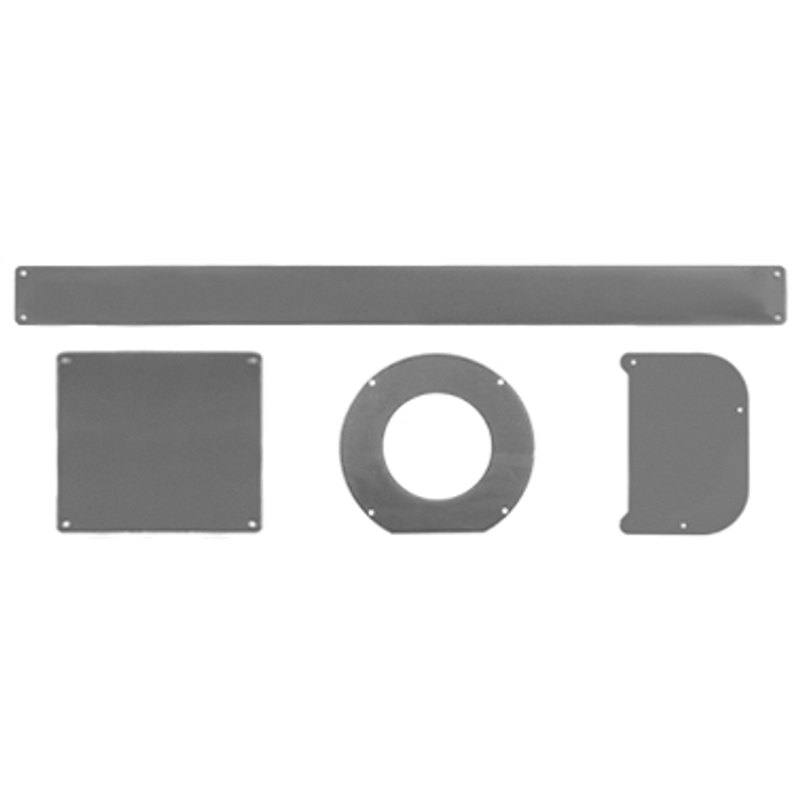
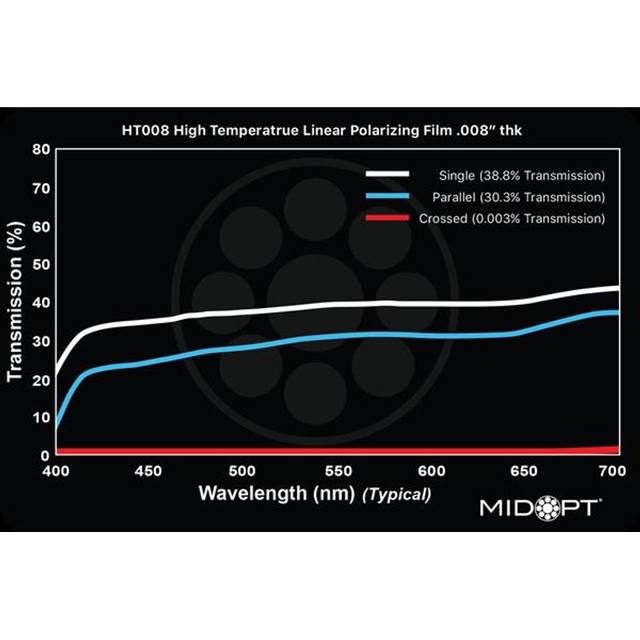
MidOpt HT025 High Temperature Linear Polarizing Film .025" — Polarizing filter (Polarizing Film): useful range 400-700nm, contrast ratio 5000:1, thickness 0.025". Available as unmounted/custom sizes.
The MidOpt HT025 is a high temperature linear polarizing film, listed at .025" thick, with a useful range of 400-700nm and a contrast ratio of 5000:1. The manufacturer describes it as resistant to high temperature illumination. As a linear polarizer, it passes light of one polarization orientation and suppresses the perpendicular component, so the effect depends on how the film is set in the light path.
The 5000:1 contrast ratio describes how well the film separates the two polarization states. In a crossed-polarizer arrangement, that separation determines how much light of the unwanted orientation is suppressed, and therefore how strong the polarization effect is at the camera. Because the film is .025" thick, it should be held flat and in a fixed orientation so the effect stays repeatable from one setup to the next.
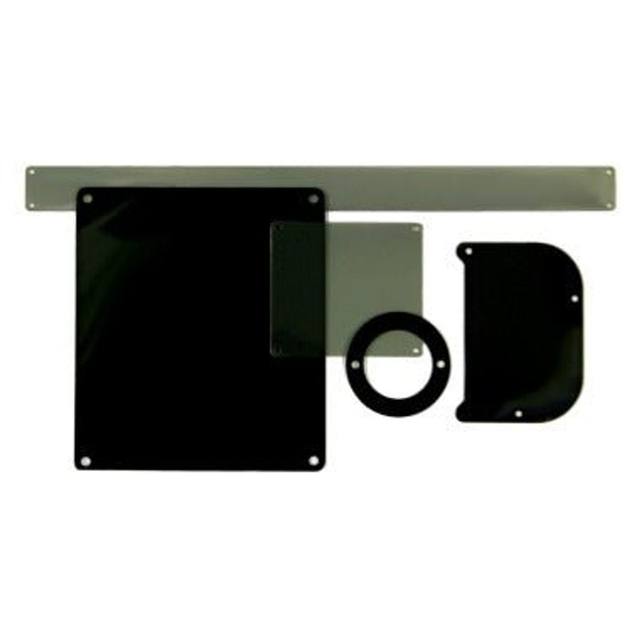
The film is listed as available as unmounted/custom sizes, so it can be supplied to fit a fixture or holder. Its 400-700nm useful range covers the visible band, and work outside that band falls beyond the listed range. Resistance to high temperature illumination is the property the manufacturer highlights, which makes the film a fit for lighting that runs hot.
Best for
Crossed-polarizer lighting arrangements that need controlled polarization in the visible band.
Visible-light arrangements that pair the film with a second polarizer.
Lighting setups near hot light sources, where the film must resist high temperature illumination.
Holder-based fixtures that take a custom-size film sheet.
Visible-light imaging with sources inside 400-700nm.
Selection notes
Set the film's orientation deliberately, since the polarization effect depends on how the sheet sits in the light path.
Use the 5000:1 contrast ratio as the performance figure when judging how deep the polarization effect can go.
Account for the .025" thickness in the holder, keeping the film flat and at a fixed position.
Keep the 400-700nm useful range in mind: sources or sensors that operate beyond this band fall outside the listed figures.