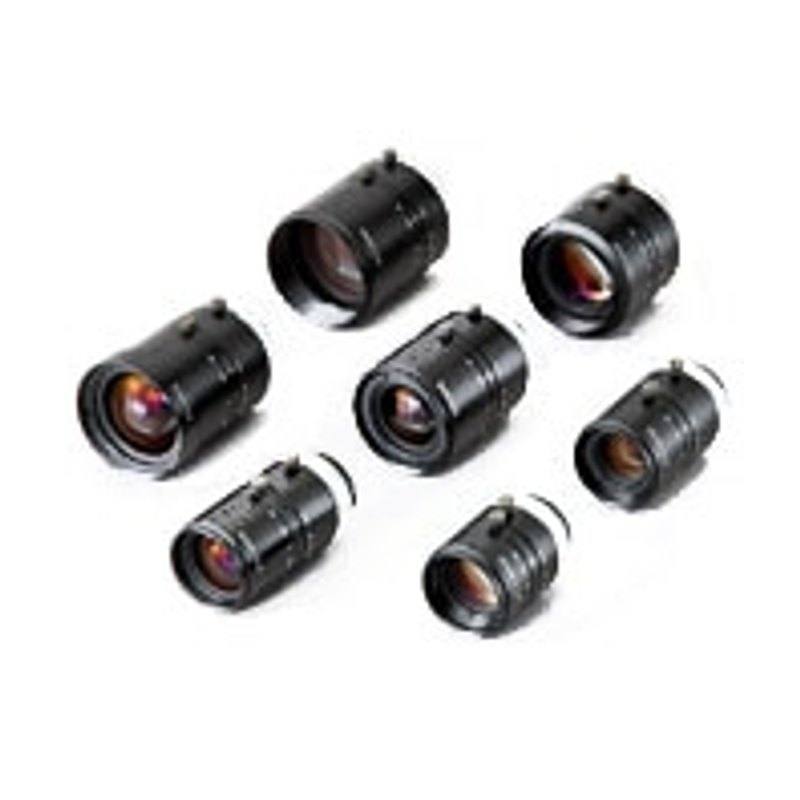
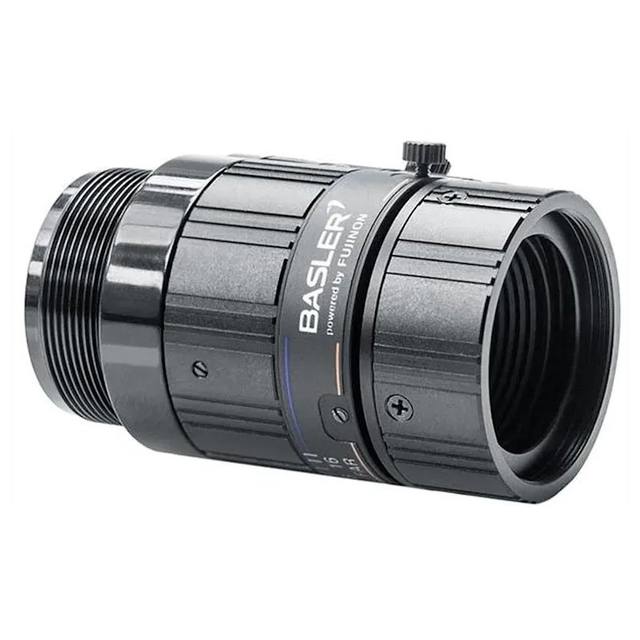
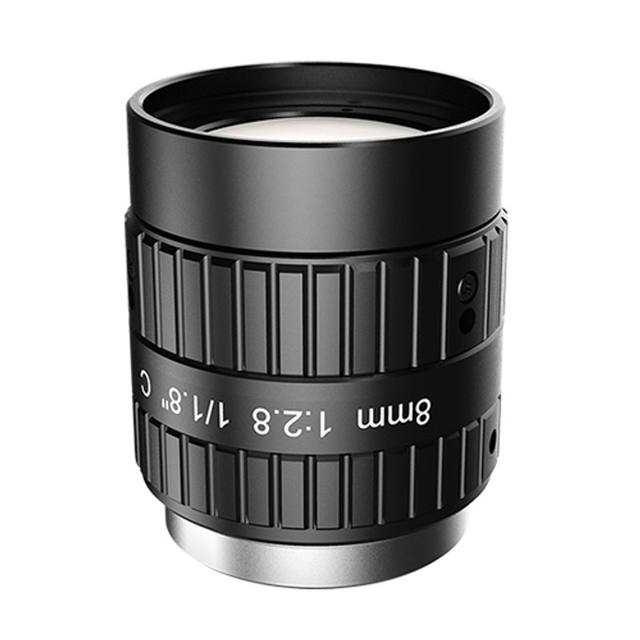
The 3Z4S-LE SV-1214H is a member of Omron's SV-H series — high-resolution, low-distortion fixed-focal lenses for 2/3-inch C-mount megapixel cameras. With a bright maximum aperture of F1.4 it enables short exposure times on high-speed CMOS sensors. The 12mm focal length delivers a 30.2° (V) × 39.6° (H) field of view from a minimum working distance of 100mm. Lock screws on both focus and iris rings ensure stable settings in vibration-prone machine-vision environments.
The Omron 3Z4S-LE SV-1214H is a 12 mm fixed-focal-length C-mount lens designed for demanding machine-vision applications where image quality cannot be compromised. Its 12 mm focal length is a mid-wide choice that, on a 2/3-inch sensor, produces a horizontal field of view of 39.6° and a vertical field of view of 30.2°. At the 100 mm minimum working distance, that translates to a compact but usable inspection field — useful for close-range part inspection on conveyors or fixtures. Longer working distances expand the field proportionally, making this lens equally suitable for benchtop inspection stations mounted farther from the target. The image circle covers the full 2/3-inch (approximately 11 mm diagonal) format, so it pairs directly with the most common high-resolution machine-vision sensors without vignetting.
The SV-1214H's F1.4 maximum aperture is the defining optical characteristic for high-speed machine vision. A bright F1.4 aperture gathers roughly four times more light than F2.8, enabling proportionally shorter exposure times on fast CMOS sensors — critical for freezing motion on high-speed lines or suppressing motion blur on moving parts. Stopping down toward F8–F16 increases depth of field, which is useful when parts have height variation or when the lens is used at shorter working distances where depth of field is shallowest. The F1.4–F16 range gives operators practical control over this exposure-versus-depth-of-field trade-off. The lens is engineered for megapixel resolving power and low distortion, ensuring that edge positions and dimensional measurements remain accurate across the full image frame — particularly important in OCR, dimensional gauging, and code-reading tasks where geometric fidelity matters. Lock screws on both the focus ring and iris ring allow settings to be fixed after commissioning, preventing drift in vibration-prone factory environments.
As a non-telecentric (entocentric) lens, the SV-1214H exhibits perspective projection: objects closer to the lens appear larger, and the magnification changes with working distance. This is the normal behavior for a fixed-focal lens and is well-suited to applications where the target-to-lens distance is tightly controlled, such as inline conveyors with fixed part height. For applications requiring measurement invariance to part height variation, a true telecentric lens would be needed instead. The C-mount interface is universally supported by area-scan cameras from Omron and virtually all other machine-vision manufacturers, and the 85 g weight keeps the lens practical for compact housings and standard lens tube assemblies. The 0–50°C operating temperature range suits typical factory and cleanroom environments without special thermal management.
Best for
High-speed inspection lines where an F1.4 aperture minimizes required exposure time and allows the camera to freeze fast-moving parts without motion blur
Megapixel camera systems on 2/3-inch sensors requiring a mid-wide 12 mm focal length with full-frame image circle coverage and no vignetting
OCR, OCV, and 1D/2D code reading tasks that demand low distortion and consistent geometric accuracy across the entire image field
Dimensional measurement and surface inspection at controlled working distances of 100 mm and above, where the fixed focal length and lockable iris ensure stable, repeatable framing
Vibration-prone factory and packaging line environments where the focus and iris lock screws prevent setting drift after initial commissioning
Selection notes
Match the image circle to your sensor size before purchasing: the SV-1214H covers up to 2/3-inch (approximately 11 mm diagonal). Using it on a camera with a larger sensor will result in visible vignetting at the image corners and wasted sensor area.
At a working distance of 100 mm, the 12 mm focal length produces a relatively wide field relative to the sensor. Calculate your required field of view and working distance together: if you need a narrow field at a long working distance, a longer focal length will serve better; if you need a wider field at close range, a shorter focal length is more appropriate.
Use F1.4 when light is limited or line speed is high, and stop down when you need greater depth of field to accommodate part height variation — but expect to compensate with brighter lighting or a longer exposure if the line speed allows it.
This is an entocentric (non-telecentric) lens: magnification varies with working distance. If parts vary in height by more than a few millimeters and you are measuring lateral dimensions, the perspective error introduced by this height variation will produce measurement uncertainty. Quantify this error for your application before assuming the lens is suitable for high-accuracy dimensional gauging.
The C-mount thread is compatible with standard filter adapters for adding bandpass, polarizing, or IR-cut filters to the front of the lens — confirm the front thread diameter against filter options if supplementary filtering is needed for your lighting setup.
Specifications: General
Brand
Omron / Sentech
Specifications: Optical
Focal length
12 mm
Lens mount
C-mount
Aperture (f-number)
F1.4–F16
Image circle / max sensor
2/3" (≈ 11 mm diagonal)
Telecentric
No
Specifications: Environment
Operating temperature
0 to 50°C
Specifications: Mechanical
Weight
85 g
Applications this camera is commonly selected for. Open one to see the full recommended hardware and approach.
Matched automatically by: camera mount fits the lens mount · camera sensor is covered by the lens image circle — this lens: C-mount · 2/3" (≈ 11 mm diagonal) image circle.
By category
All 758Area scan cameras 622High-speed cameras 108High-resolution cameras 28
By brand
All 758Omron / Sentech 297Basler 242iRAYPLE 200Datalogic / Datasensing 19
These steps take an Omron Sentech (STC) camera from the box to a stable first image and on to your own application. They apply across the GigE Vision, USB3 Vision and CoaXPress STC families; the interface only changes how you cable and power the camera.
Download and install the Sentech SDK on the host PC. The package provides StViewer, the viewing and configuration software you use to bring the camera up, and StApi, the programming SDK you integrate later. Because the cameras are GenICam/GenTL-compliant, StApi also registers a GenTL producer, so any GenICam-compliant third-party vision software can discover and drive the camera as an alternative front end.
2. Cable, power and connect the camera
Connect according to the interface. GigE Vision: link to a Gigabit NIC (use PoE or the separate power input) and put the camera and host on the same subnet; for USB3 Vision use a USB 3.x port and a certified cable; for CoaXPress (STC) connect to a CoaXPress frame grabber, which also supplies Power-over-Coax. Then open StViewer and let it enumerate the camera. If a GigE camera does not appear, check the IP configuration and firewall, and on USB3 confirm the host bandwidth and driver.
3. Configure exposure, gain and white balance
Open the device in StViewer and start a live stream. Set exposure and gain for a well-exposed, low-noise image: raise exposure first and only add gain when more light or a faster shutter is not an option, keeping exposure short enough to freeze motion on global-shutter models. On colour cameras, run white balance under your actual production lighting. Adjust the lens aperture and focus on a representative target before tuning anything else.
4. Set the trigger and grab a first image
Start in free-run (continuous) acquisition to confirm a clean, stable image. For inline inspection switch to hardware or software triggering: select the trigger source, set the active edge and any delay, and wire the strobe or illumination to the camera's I/O so lighting fires with each exposure. Acquire and save a frame in StViewer; this saved image is your reference for the SDK stage and for downstream inspection.
5. Move to the StApi SDK (or any GenICam software)
Once the image is stable, reproduce the same settings in code. Use StApi to open the device, apply the GenICam features you validated in StViewer (exposure, gain, trigger, pixel format) and grab frames into your application via the bundled C++, C, C#/.NET or Python interfaces; the included samples are the fastest starting point. Prefer a different stack? The same GenICam/GenTL camera works with third-party vision libraries. With a reliable feed, you can route it into a deep-learning inspection such as Rosepetal for AI-based defect detection.
Frequently asked questions
On a 2/3-inch sensor, the SV-1214H produces a 39.6° horizontal by 30.2° vertical field of view. The field size scales linearly with working distance: at 200 mm it doubles relative to 100 mm, and so on. You can scale these angles to any working distance relevant to your application.
F1.4 is one of the brightest apertures available in machine-vision lenses and gives you maximum light throughput. Whether it is sufficient depends on your camera's sensor sensitivity, the required exposure time (set by line speed), and the amount of light your illumination delivers. An F1.4 aperture collects about 4x more light than F2.8 and 16x more than F5.6 — which in practice translates to proportionally shorter achievable exposure times at the same lighting level. Pairing this lens with a high-sensitivity monochrome sensor and a strobe-capable LED illuminator gives the best chance of achieving adequate signal at very short exposures.
The SV-1214H is rated for a maximum image circle of 2/3-inch (approximately 11 mm diagonal). Using the lens on a camera with a larger sensor format will produce vignetting toward the image corners. You would need a lens rated for a larger image circle to cover those formats.
Yes. The SV-1214H includes dedicated lock screws on both the focus ring and the iris ring. Once focus is set for the working distance and the aperture is chosen for the desired depth-of-field and exposure balance, tightening these screws prevents any movement during operation — even in high-vibration conveyor or press environments.
The SV-1214H is an entocentric (non-telecentric) lens, meaning magnification changes with object distance. For parts that lie at a consistent, fixed depth relative to the lens, measurement accuracy is stable and the lens performs well in dimensional tasks. However, if measured parts vary in height, the perspective projection of an entocentric lens introduces a proportional measurement error. For high-accuracy gauging of parts with height variation, a telecentric lens is the correct choice. For controlled, flat-plane measurement or when height variation is negligible, the SV-1214H is well suited.