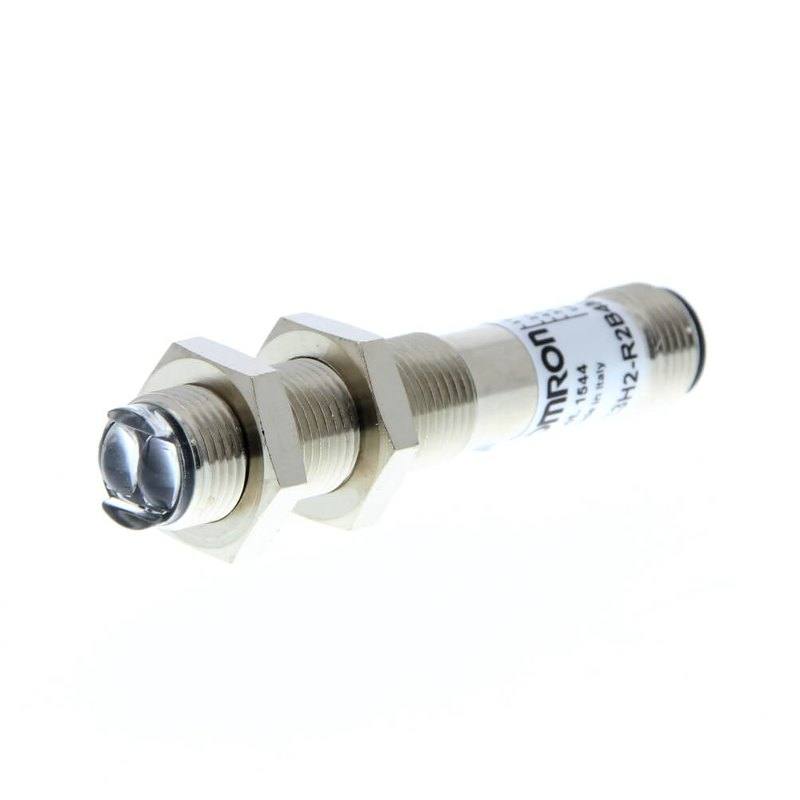
The Omron E3H2 is a family of compact photoelectric sensors built into M8x1 stainless-steel or M12x1 nickel-plated-brass cylindrical housings for space-constrained mounting. Through-beam models reach 4 m (E3H2-T4, adjustable) or 2 m (E3H2-T2), the retro-reflective MSR model reaches 2 m (teachable, with E39-R1S reflector) using polarized red LED light at 660 nm, and diffuse-reflective models sense 300 mm (E3H2-DS30, teachable) or 100 mm (E3H2-DS10, fixed) with an 880 nm infrared LED. All run on 10-30 VDC (45 mA max), deliver a 100 mA NPN (E3H2-_C_) or PNP (E3H2-_B_) output with selectable light-on/dark-on operation, and are rated IP67 for operating temperatures of -25 to +55 C. Connection is via 2 m pre-wired cable or M8/M12 connector, with response times from 1 ms to 2.5 ms depending on model.
Brand
Omron / Sentech
Sensor type
Photoelectric
Sensing method
Through-beam, retro-reflective (MSR) and diffuse-reflective versions
Light source
Infrared LED 880 nm (through-beam/diffuse); red LED 660 nm / polarized red (retro-reflective)
Range / distance
Up to 4000 mm (through-beam E3H2-T4); 2000 mm retro-reflective; 300/100 mm diffuse
Response time
1.0-2.5 ms (T2: 1 ms, R/DS: 1.1 ms, T4: 2.5 ms)
Output type
PNP (E3H2-_B_) or NPN (E3H2-_C_), 100 mA max load, 2 V residual
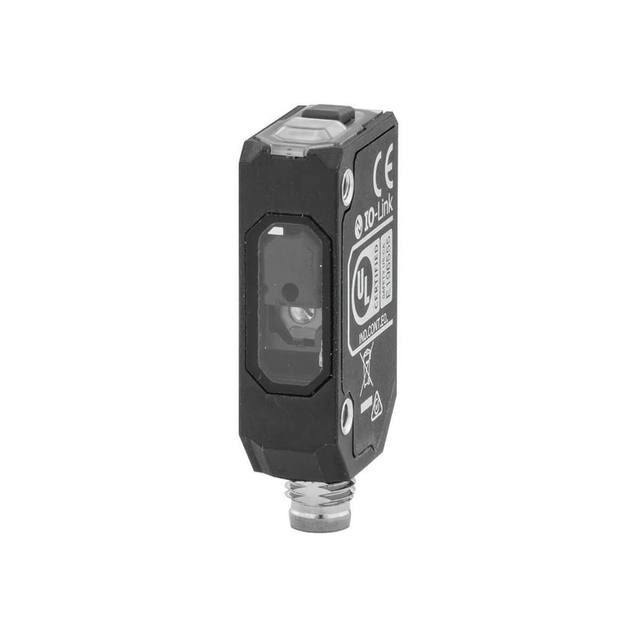
The Omron E3H2 is a family of miniature cylindrical photoelectric sensors built into M8x1 or M12x1 threaded metal housings, designed to drop into space-constrained fixtures where a larger block sensor will not fit. Within the family you choose your sensing principle to match the detection task: through-beam models (separate emitter and receiver) reach 4 m with the adjustable E3H2-T4 or 2 m with the E3H2-T2 and give reliable, target-color-independent detection because the part simply interrupts a fixed beam; the retro-reflective MSR version reaches 2 m using a polarized red LED at 660 nm and an E39-R1S reflector, which lets a single sensor head do the work of two devices and handle shiny targets thanks to its polarizing filter; and the diffuse-reflective models (E3H2-DS30 at 300 mm teachable, E3H2-DS10 at 100 mm fixed) sense the target directly with an 880 nm infrared LED, needing no opposing reflector or receiver. In machine-vision terms, this is a trigger and presence-detection device, not a measurement sensor: it tells your camera or PLC that a part has arrived at a known position so an image can be captured at the right moment.
Electrically the whole family is consistent and easy to wire into a vision cell. All models run on 10 to 30 VDC (10% ripple) at a maximum of 45 mA and deliver a switched discrete output rated 100 mA: choose PNP (E3H2-_B_) or NPN (E3H2-_C_) part numbers to match your controller's input card, with light-on/dark-on operation selectable so you can define whether 'beam blocked' or 'beam clear' drives the output. Residual voltage is 2 V. Response times run from 1 ms on the fast E3H2-T2 to 1.1 ms on the retro-reflective and diffuse models and 2.5 ms on the long-range T4, which sets how tightly the sensor can resolve closely spaced parts on a moving conveyor and how precisely its edge can gate a camera trigger.
Mechanically the E3H2 is built for the factory floor. Housings are nickel-plated brass on the M12 versions or stainless steel on the M8 and E3H2-T2 models, with a plastic lens, and the family is rated IP67 to EN 60529 for washdown and dusty environments over an operating range of -25 to +55 C (the T2 is rated to +50 C). Connection is by 2 m pre-wired cable or an M8/M12 connector, so you can hard-wire fixed installations or use a quick-disconnect for serviceable stations. Weight ranges from roughly 110 g for a pre-wired T4 down to about 20 g for a connectorized diffuse model, light enough to mount on moving arms or tight tooling. The threaded barrel body means the sensor mounts and aligns with nuts through a single drilled hole, which is what makes it practical to install many of these around a packaging or sortation line.
Best for
Triggering a machine-vision camera at a fixed station: detecting that a part, carton or label has reached the inspection position so the image is captured at the correct instant
Presence/absence and part-counting on packaging lines, where the IP67 rating and -25 to +55 C range suit washdown and ambient factory conditions
Logistics sortation and conveyor edge detection, using the 4 m through-beam (E3H2-T4) to span wide conveyors or detect packages across a gap
Detecting shiny or specular targets with the polarized retro-reflective MSR model (2 m, E39-R1S reflector), where a single head replaces a separate emitter and receiver
Tight, space-constrained tooling and small machines, where the M8/M12 cylindrical barrel and ~20 g connectorized diffuse models fit through a single drilled hole
Selection notes
Pick the sensing principle by task: through-beam (T4 4 m / T2 2 m) for the most robust, target-color-independent detection; retro-reflective MSR (2 m, teachable) when you want one head plus a reflector and need to handle shiny parts via its polarizing filter; diffuse (DS30 300 mm teachable / DS10 100 mm fixed) when you cannot place anything on the far side of the part
Match the output to your controller's input card before ordering: PNP is the E3H2-_B_ suffix and NPN is the E3H2-_C_ suffix, both 100 mA max with 2 V residual voltage; the device also offers selectable light-on/dark-on operation
Budget the supply and load: 10-30 VDC at up to 45 mA consumption and a 100 mA switched output mean it drives a PLC input or relay directly, but confirm your sink/source wiring matches the chosen polarity
Use response time to size for line speed: the T2 (1 ms) and retro/diffuse models (1.1 ms) resolve closely spaced parts and give a tight trigger edge, while the long-range T4 is slower at 2.5 ms, a trade-off against its 4 m reach
Choose the housing and connection for the environment: nickel-plated brass (M12) or stainless steel (M8/T2) with IP67 sealing for washdown; select the 2 m pre-wired cable for fixed installs or the M8/M12 connector for quick-disconnect serviceability, and note the operating limit of -25 to +55 C (T2 to +50 C)
Specifications: General
Brand
Omron / Sentech
Sensor type
Photoelectric
Specifications: Performance
Range / distance
Up to 4000 mm (through-beam E3H2-T4); 2000 mm retro-reflective; 300/100 mm diffuse
Response time
1.0-2.5 ms (T2: 1 ms, R/DS: 1.1 ms, T4: 2.5 ms)
Specifications: Interface
Connection
2 m pre-wired cable or M8/M12 connector
Specifications: Electrical
Supply voltage
10 to 30 VDC, 10% ripple (45 mA max consumption)
Specifications: Environment
Operating temperature
-25 to +55 C (E3H2-T2: -25 to +50 C)
IP rating
IP67 (EN 60529)
Specifications: Sensing
Sensing method
Through-beam, retro-reflective (MSR) and diffuse-reflective versions
Light source
Infrared LED 880 nm (through-beam/diffuse); red LED 660 nm / polarized red (retro-reflective)
Specifications: Output
Output type
PNP (E3H2-_B_) or NPN (E3H2-_C_), 100 mA max load, 2 V residual
These steps take an Omron Sentech (STC) camera from the box to a stable first image and on to your own application. They apply across the GigE Vision, USB3 Vision and CoaXPress STC families; the interface only changes how you cable and power the camera.
Download and install the Sentech SDK on the host PC. The package provides StViewer, the viewing and configuration software you use to bring the camera up, and StApi, the programming SDK you integrate later. Because the cameras are GenICam/GenTL-compliant, StApi also registers a GenTL producer, so any GenICam-compliant third-party vision software can discover and drive the camera as an alternative front end.
2. Cable, power and connect the camera
Connect according to the interface. GigE Vision: link to a Gigabit NIC (use PoE or the separate power input) and put the camera and host on the same subnet; for USB3 Vision use a USB 3.x port and a certified cable; for CoaXPress (STC) connect to a CoaXPress frame grabber, which also supplies Power-over-Coax. Then open StViewer and let it enumerate the camera. If a GigE camera does not appear, check the IP configuration and firewall, and on USB3 confirm the host bandwidth and driver.
3. Configure exposure, gain and white balance
Open the device in StViewer and start a live stream. Set exposure and gain for a well-exposed, low-noise image: raise exposure first and only add gain when more light or a faster shutter is not an option, keeping exposure short enough to freeze motion on global-shutter models. On colour cameras, run white balance under your actual production lighting. Adjust the lens aperture and focus on a representative target before tuning anything else.
4. Set the trigger and grab a first image
Start in free-run (continuous) acquisition to confirm a clean, stable image. For inline inspection switch to hardware or software triggering: select the trigger source, set the active edge and any delay, and wire the strobe or illumination to the camera's I/O so lighting fires with each exposure. Acquire and save a frame in StViewer; this saved image is your reference for the SDK stage and for downstream inspection.
5. Move to the StApi SDK (or any GenICam software)
Once the image is stable, reproduce the same settings in code. Use StApi to open the device, apply the GenICam features you validated in StViewer (exposure, gain, trigger, pixel format) and grab frames into your application via the bundled C++, C, C#/.NET or Python interfaces; the included samples are the fastest starting point. Prefer a different stack? The same GenICam/GenTL camera works with third-party vision libraries. With a reliable feed, you can route it into a deep-learning inspection such as Rosepetal for AI-based defect detection.
Frequently asked questions
It is a switching photoelectric sensor that detects presence/absence, not a measurement device. It delivers a discrete 100 mA PNP or NPN output (selectable light-on/dark-on), which makes it well suited to triggering a camera or signaling a PLC when a part reaches a position, rather than reporting a distance value.
It depends on the model. Through-beam reaches 4 m with the adjustable E3H2-T4 or 2 m with the E3H2-T2; the retro-reflective MSR model reaches 2 m with an E39-R1S reflector; and diffuse-reflective models sense 300 mm (E3H2-DS30, teachable) or 100 mm (E3H2-DS10, fixed).
Both are available: PNP on the E3H2-_B_ part numbers and NPN on the E3H2-_C_ part numbers, each rated 100 mA max with 2 V residual voltage. All models run on 10 to 30 VDC and consume up to 45 mA.
Yes. The housing is nickel-plated brass (M12) or stainless steel (M8/T2) with a plastic lens, rated IP67 to EN 60529, and rated for operating temperatures from -25 to +55 C (the E3H2-T2 is rated to +50 C).
Connection is by a 2 m pre-wired cable or an M8/M12 connector. Response time ranges from 1 ms on the E3H2-T2, 1.1 ms on the retro-reflective and diffuse models, up to 2.5 ms on the long-range T4, which determines how closely spaced parts can be reliably resolved at the line speed.

 Omron / SentechOmron / Sentech E3Z-LL Series (Laser BGS Distance-Settable Photoelectric Sensor)E3Z-LL61