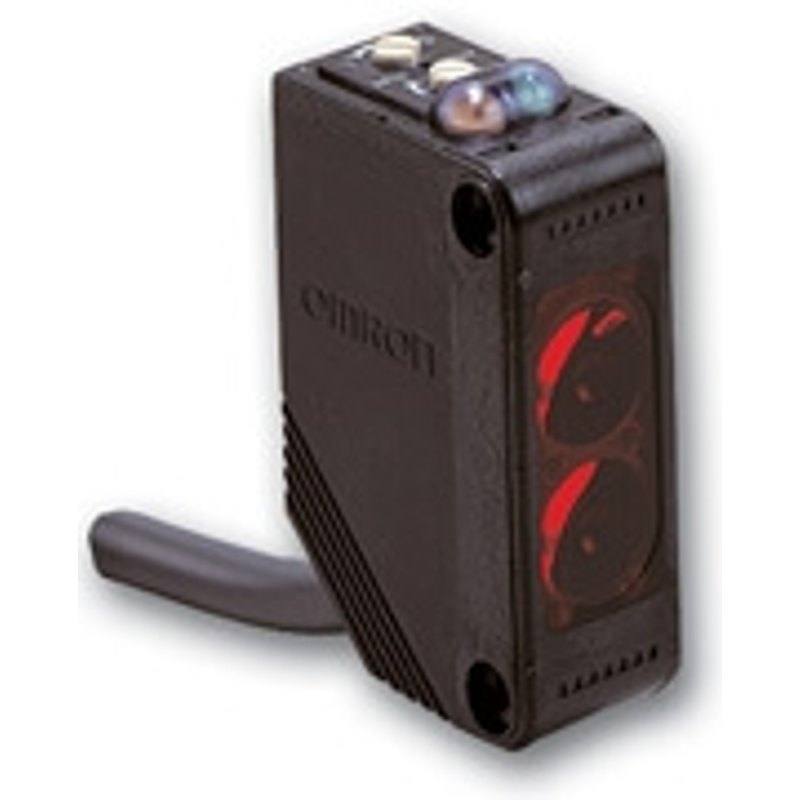
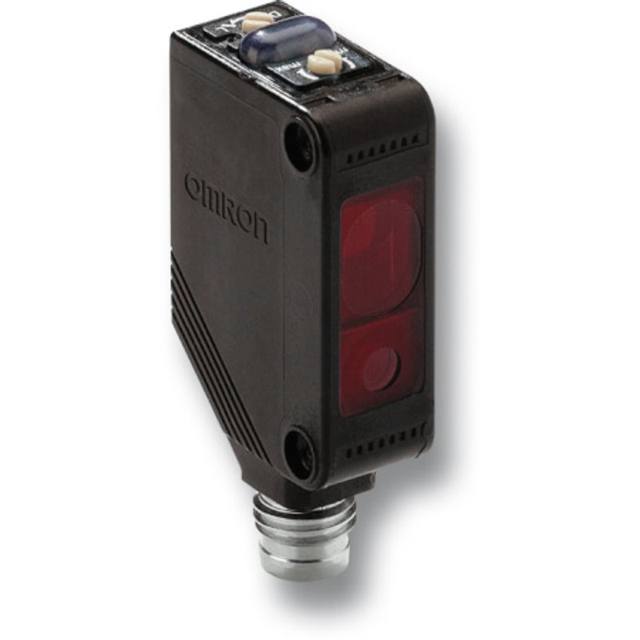
The E3Z-L is the narrow-beam member of Omron's E3Z compact photoelectric sensor family, housed in a PBT plastic body with a built-in amplifier and IP67 protection. Diffuse-reflective models (E3Z-L61/L66 NPN, E3Z-L81/L86 PNP) sense at 90 +/- 30 mm with a 2.5 mm-diameter spot of 650 nm red light, resolving objects as small as a 0.1 mm copper wire. Limited-reflective transparent-glass models (E3Z-L63/L68 NPN, E3Z-L83/L88 PNP) detect clear glass at 30 +/- 20 mm using 660 nm red LED. All models run on 12 to 24 VDC, give a 1 ms operate/reset response with selectable Light-ON/Dark-ON open-collector output, and are available pre-wired (2 m / 0.5 m cable) or with an M8 connector.
Brand
Omron / Sentech
Sensor type
Photoelectric
Sensing method
Diffuse-reflective (narrow-beam); limited-reflective on L63/L68/L83/L88
Light source
Red LED (650 nm; 660 nm on transparent-glass models)
Range / distance
90 +/- 30 mm (diffuse); 30 +/- 20 mm transparent glass (L63/L68/L83/L88)
Response time
1 ms max. (operate or reset)
Output type
NPN (L61/L63/L66/L68) or PNP (L81/L83/L86/L88) open-collector
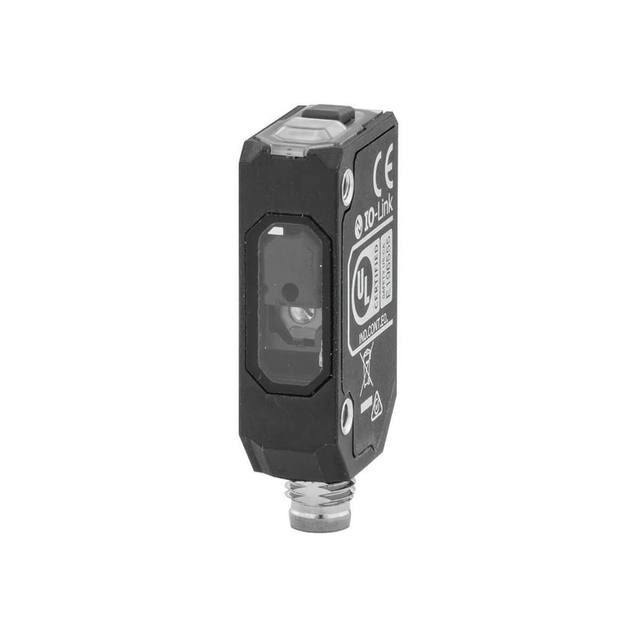
The Omron E3Z-L61 is the narrow-beam member of the E3Z compact photoelectric family, configured as a diffuse-reflective sensor with a built-in amplifier in a single self-contained PBT housing measuring approximately 31 x 11.2 x 20 mm. As a diffuse sensor it both emits and receives, so the target itself provides the return reflection and no separate reflector or receiver needs to be mounted opposite the part. The defining feature is the tight 2.5 mm-diameter spot of 650 nm red light projected at a nominal 90 +/- 30 mm working distance. That small, visible red spot is what lets the L61 resolve very small features, down to a 0.1 mm copper wire per Omron's own figure, where a wide-beam diffuse sensor would simply wash the target out. Because the beam and distance are fixed by model rather than freely adjustable optics, you design the mechanics around that 90 mm standoff window rather than the other way around.
Electrically the L61 is a discrete on/off device, not a measurement sensor: it produces a single open-collector switching output rather than an analog or networked value. This specific part number is the NPN sinking variant (the L66 is the other NPN diffuse sibling, while the PNP-sourcing equivalents are the L81/L86, and the L63/L68/L83/L88 are limited-reflective models tuned to catch transparent glass at 30 +/- 20 mm with a 660 nm red LED). Output is selectable Light-ON or Dark-ON, so you can wire it to assert either on presence or on absence to match your PLC logic. It runs on a 12 to 24 VDC rail (+/-10%, ripple p-p 10% max) and switches in 1 ms maximum for both operate and reset, which bounds how fast a part can move through the beam before edges blur. Connection is either pre-wired cable (2 m or 0.5 m) or an M8 connector; the connector version drops the weight from about 65 g to roughly 20 g and makes field replacement a plug swap rather than a re-termination.
For a machine-vision integrator the most useful role of this sensor is as a hard-wired presence detector or trigger source rather than as part of the imaging chain. Sitting upstream of a camera, its 1 ms response and clean single-output edge make it a natural part-in-position trigger to fire a strobe or capture, and the narrow spot means it triggers on the part itself rather than on surrounding fixturing. The IP67 rating and the -25 to 55 C operating range let it sit on conveyors, infeeds and washdown-adjacent lines that would be hostile to unsealed hardware, and the PBT case with methacrylic-resin lens (modified polyarylate on the transparent-glass variants) is a standard chemical-tolerant plastic build rather than a stainless body. Treat it as a robust, low-cost digital eye whose job is to say 'a small part is here, now' to the controller or vision system that does the actual decision-making.
Best for
Detecting small parts, pins or thin wires (down to a 0.1 mm copper wire) on a conveyor or feeder using the 2.5 mm narrow red spot at the ~90 mm standoff
Part-in-position triggering for a vision camera or strobe, exploiting the 1 ms response and clean open-collector edge
Presence/absence and count verification in packaging and food-and-beverage lines where IP67 sealing is required near washdown
Logistics sortation and infeed gating where a compact, self-contained diffuse sensor must confirm an item without a facing reflector or receiver
Catching clear/transparent glass at ~30 mm by selecting the limited-reflective L63/L68/L83/L88 sibling instead of this diffuse L61
Selection notes
Confirm the mechanics put the target inside the 90 +/- 30 mm diffuse window; this is a fixed-distance optic, so the standoff is a design constraint, not a field adjustment.
Match the output polarity to your input card: the L61 is NPN (sinking) open-collector. If your PLC or vision I/O needs sourcing logic, specify the PNP L81/L86 instead.
Decide Light-ON vs Dark-ON up front; the output mode is selectable but determines whether the sensor asserts on part presence or on a gap/clear condition.
Choose the termination deliberately: pre-wired (2 m / 0.5 m) is cheaper to install but heavier (~65 g) and harder to swap, while the M8 connector version is ~20 g and enables tool-free replacement.
If the target is transparent glass rather than an opaque part, this diffuse L61 is the wrong member of the family; use the limited-reflective transparent-glass variants (30 +/- 20 mm, 660 nm red LED).
Keep the application within -25 to 55 C operating (storage -40 to 70 C) and free of icing/condensation; the IP67 case handles dust and washdown spray but the rating does not extend the temperature envelope.
Specifications: General
Brand
Omron / Sentech
Sensor type
Photoelectric
Specifications: Performance
Range / distance
90 +/- 30 mm (diffuse); 30 +/- 20 mm transparent glass (L63/L68/L83/L88)
Response time
1 ms max. (operate or reset)
Specifications: Interface
Communication
Discrete I/O (open-collector switching output)
Connection
Pre-wired cable (2 m / 0.5 m) or M8 connector
Specifications: Electrical
Supply voltage
12 to 24 VDC +/-10%, ripple (p-p) 10% max.
Specifications: Environment
Operating temperature
Operating -25 to 55 C, storage -40 to 70 C (no icing/condensation)
IP rating
IEC IP67
Specifications: Sensing
Sensing method
Diffuse-reflective (narrow-beam); limited-reflective on L63/L68/L83/L88
Light source
Red LED (650 nm; 660 nm on transparent-glass models)
Specifications: Output
Output type
NPN (L61/L63/L66/L68) or PNP (L81/L83/L86/L88) open-collector
These steps take an Omron Sentech (STC) camera from the box to a stable first image and on to your own application. They apply across the GigE Vision, USB3 Vision and CoaXPress STC families; the interface only changes how you cable and power the camera.
Download and install the Sentech SDK on the host PC. The package provides StViewer, the viewing and configuration software you use to bring the camera up, and StApi, the programming SDK you integrate later. Because the cameras are GenICam/GenTL-compliant, StApi also registers a GenTL producer, so any GenICam-compliant third-party vision software can discover and drive the camera as an alternative front end.
2. Cable, power and connect the camera
Connect according to the interface. GigE Vision: link to a Gigabit NIC (use PoE or the separate power input) and put the camera and host on the same subnet; for USB3 Vision use a USB 3.x port and a certified cable; for CoaXPress (STC) connect to a CoaXPress frame grabber, which also supplies Power-over-Coax. Then open StViewer and let it enumerate the camera. If a GigE camera does not appear, check the IP configuration and firewall, and on USB3 confirm the host bandwidth and driver.
3. Configure exposure, gain and white balance
Open the device in StViewer and start a live stream. Set exposure and gain for a well-exposed, low-noise image: raise exposure first and only add gain when more light or a faster shutter is not an option, keeping exposure short enough to freeze motion on global-shutter models. On colour cameras, run white balance under your actual production lighting. Adjust the lens aperture and focus on a representative target before tuning anything else.
4. Set the trigger and grab a first image
Start in free-run (continuous) acquisition to confirm a clean, stable image. For inline inspection switch to hardware or software triggering: select the trigger source, set the active edge and any delay, and wire the strobe or illumination to the camera's I/O so lighting fires with each exposure. Acquire and save a frame in StViewer; this saved image is your reference for the SDK stage and for downstream inspection.
5. Move to the StApi SDK (or any GenICam software)
Once the image is stable, reproduce the same settings in code. Use StApi to open the device, apply the GenICam features you validated in StViewer (exposure, gain, trigger, pixel format) and grab frames into your application via the bundled C++, C, C#/.NET or Python interfaces; the included samples are the fastest starting point. Prefer a different stack? The same GenICam/GenTL camera works with third-party vision libraries. With a reliable feed, you can route it into a deep-learning inspection such as Rosepetal for AI-based defect detection.
Frequently asked questions
The diffuse E3Z-L61 senses at 90 +/- 30 mm using a narrow 2.5 mm-diameter spot of 650 nm red light. The related transparent-glass limited-reflective models (L63/L68/L83/L88) instead detect clear glass at 30 +/- 20 mm with a 660 nm red LED.
Thanks to the narrow 2.5 mm spot, the diffuse models can resolve objects as small as a 0.1 mm copper wire, per Omron's specification, making it suited to small-part and thin-feature detection.
This L61 is an NPN open-collector switching output, so it is a digital on/off (presence) signal, not an analog measurement. Output mode is selectable Light-ON or Dark-ON. The PNP-sourcing equivalents are the L81/L86 part numbers.
Response time is 1 ms maximum for both operate and reset, and it runs on 12 to 24 VDC (+/-10%, with ripple p-p of 10% max). That 1 ms edge is fast enough to act as a part-in-position trigger for a camera or strobe.
It carries an IEC IP67 rating in a PBT plastic case with a methacrylic-resin lens, and operates from -25 to 55 C (storage -40 to 70 C, no icing or condensation), so it tolerates dust and washdown spray within that temperature range.
It is available either pre-wired with a 2 m or 0.5 m cable, or with an M8 connector. The connector version weighs about 20 g versus roughly 65 g for the 2 m pre-wired model, and allows replacement as a plug swap.

 Omron / SentechOmron / Sentech E3Z-LL Series (Laser BGS Distance-Settable Photoelectric Sensor)E3Z-LL61
 Omron / SentechOmron / Sentech E3ZM-C Oil-Resistant Compact Stainless-Steel Photoelectric SensorE3ZM-C