
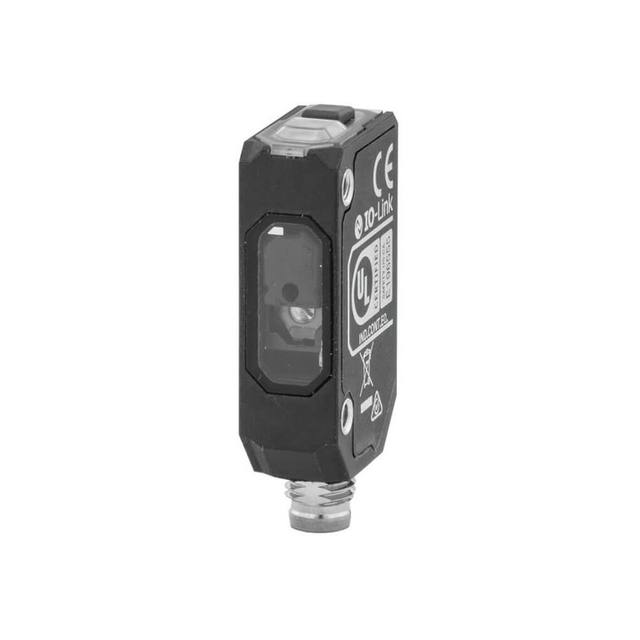
Omron / SentechOmron / Sentech E3AS-F1000I TOF Laser Distance-Settable Photoelectric SensorE3AS-F1000I
- Recommended by AIS Vision
On request
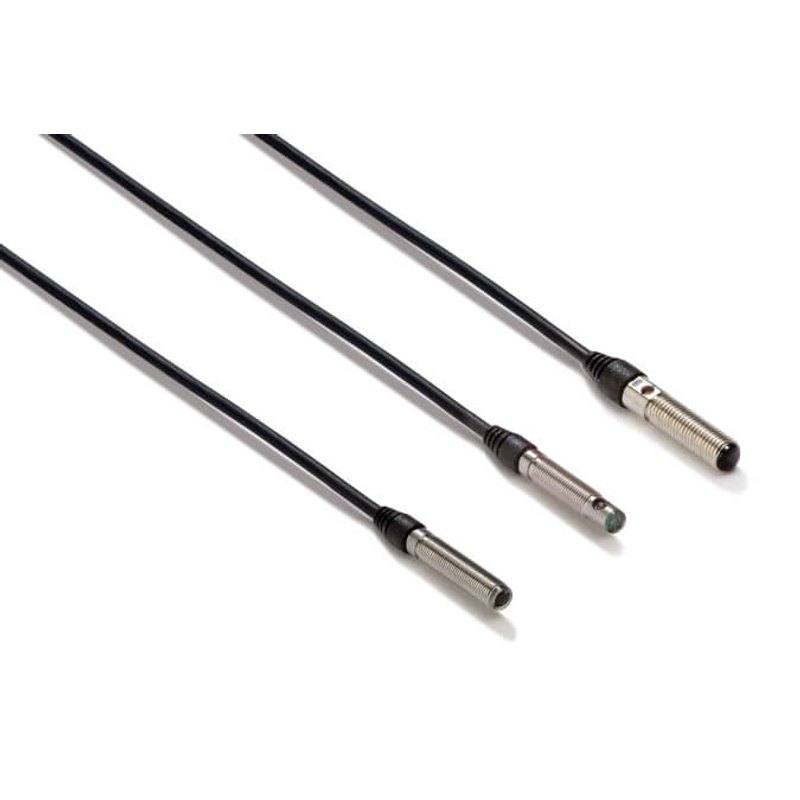
E3T-C
The E3T-C family covers axial and radial M5 through-beam sensors (1 m and 500 mm sensing distances) and axial M6 diffuse-reflective sensors (3 to 50 mm), each available with NPN or PNP open-collector output. Light sources are red LED (630 nm axial / 625 nm radial) for through-beam models and infrared LED (870 nm) for diffuse-reflective models, with a maximum response time of 0.5 ms. All models run on 12 to 24 VDC, are pre-wired with a 2 m cable, use a SUS303 stainless-steel case, and carry an IP65 degree of protection. Operating temperature range is -25 to +55 degC with reverse-polarity and output short-circuit protection built in.
The Omron E3T-C is a family of miniature self-contained photoelectric sensors with the amplifier built into the head, packaged in slim cylindrical stainless-steel (SUS303) bodies of roughly 10 mm (M5) and 11 mm (M6) diameter. It splits into two sensing principles. The M5 through-beam variants use a separate emitter and receiver facing each other across the gap; the beam is broken when an object passes between them, giving a clean, position-independent detection over 1 m (axial) or 500 mm (radial). The M6 diffuse-reflective variant integrates emitter and receiver in one body and detects light bounced back off the target itself, working at very short range from 3 to 50 mm where you only have access from one side. Through-beam models use a visible red LED (630 nm axial, 625 nm radial) that makes alignment easy to eyeball, while the diffuse model uses an 870 nm infrared LED. With a 0.5 ms maximum response time, the E3T-C is fast enough to gate fairly quick part flow on a conveyor or to trigger a camera as a leading edge passes.
| Brand | Omron / Sentech |
|---|---|
| Sensor type | Photoelectric sensor |
| Range / distance | 1 m (axial through-beam); 500 mm (radial through-beam); 3 to 50 mm (diffuse-reflective) |
|---|---|
| Response time | 0.5 ms max. (operate or reset) |
| Connection | Pre-wired, 2 m standard cable length |
|---|
| Supply voltage | 12 to 24 VDC +/-10%, ripple 10% max. (26.4 VDC max.) |
|---|
| Operating temperature | Operating: -25 to +55 degC; Storage: -30 to +70 degC (no icing or condensation) |
|---|---|
| IP rating | IP65 (IEC 60529) |
| Sensing method | Through-beam (M5) and diffuse-reflective (M6) variants |
|---|---|
| Light source | Red LED 630 nm (axial through-beam) / 625 nm (radial); Infrared LED 870 nm (diffuse-reflective) |
| Output type | NPN or PNP open-collector (load current 80 mA max., residual voltage 1 V max.) |
|---|
| Housing material | SUS303 stainless-steel case; polysulfone display window/lens (through-beam), epoxy window (diffuse) |
|---|---|
| Dimensions | M6 diffuse body approx. 29.1 mm long x 11 mm dia.; M5 through-beam body approx. 26.2 mm (axial) / 27.2 mm (radial) x 10 mm dia. |
| Weight | Approx. 60 g (through-beam) / Approx. 40 g (diffuse-reflective), packed state |
A practical guide to selecting discrete sensors that trigger cameras, index parts and gate inspection on a vision station. Covers sensing principle, range, target, PNP/NPN/IO-Link outputs, response time and IP rating, plus wiring the trigger to the camera.
A practical guide to the core photoelectric sensing principles, through-beam, retroreflective, diffuse and background suppression, covering range, reliability, target and surface dependence, light source choice, output options and how to pick the right one for your application.
A field checklist to de-risk a machine vision project before you buy hardware: define defects and tolerances, collect representative samples, prove the imaging, budget resolution and field of view, lock motion and triggers, then run a structured proof of concept against measurable acceptance criteria.
AIS Vision · Integration
AIS Vision defines and tests the optimal combination of camera, optics and lighting for your application before you buy.