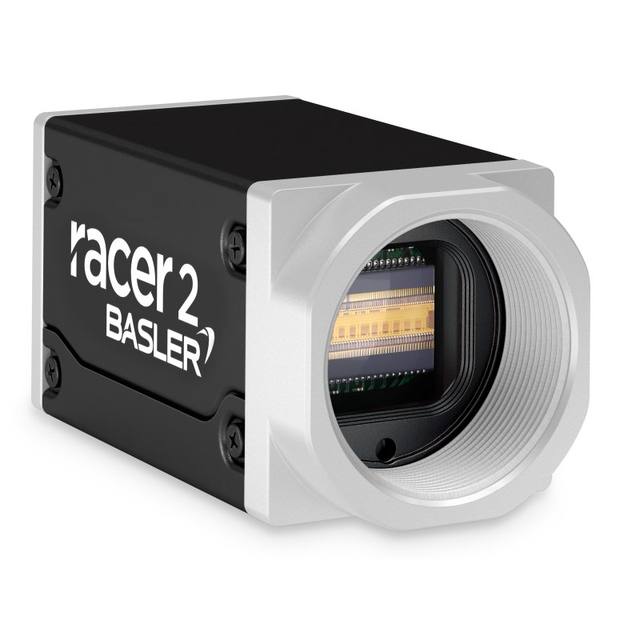
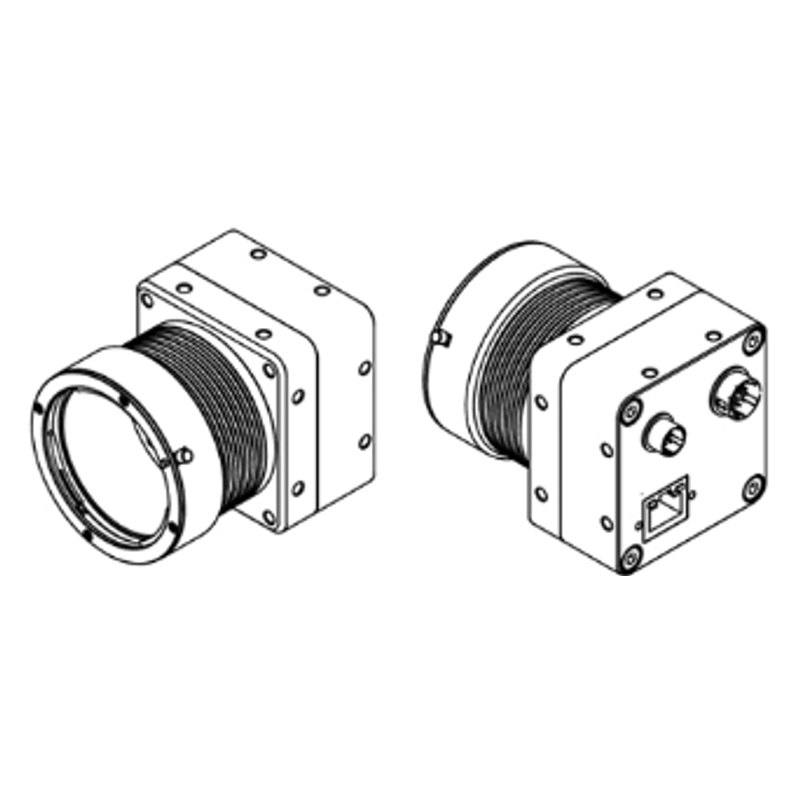
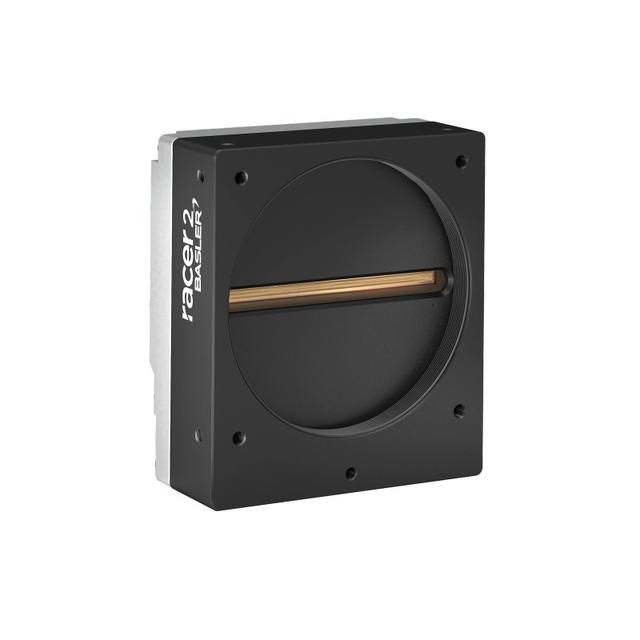
The FS-B8KU35GES-F is a single-line monochrome CMOS line scan camera from Omron Sentech featuring an ams OSRAM DR-8K-3.5 sensor with 8,192 effective pixels and 3.5 µm square pixel pitch. It communicates over GigE Vision 2.1 (1000BASE-T) and supports Power over Ethernet (IEEE 802.3af CLASS1) or external DC power, with a compact 56 x 58 x 73.6 mm body weighing approximately 290 g. The camera outputs up to Mono12 pixel formats and operates at up to 13 kHz line rate with a global shutter, supporting edge-preset, pulse-width, and free-run trigger modes. It includes PTP (IEEE 1588), FFC, chunk, and event features, and is compliant with GenICam.
Brand
Omron / Sentech
Camera type
Line Scan
Interface
GigE Vision 2.1 (1000BASE-T)
Horizontal resolution
8,192 px (8K)
Mono / color
Monochrome
Sensor manufacturer
ams OSRAM
Sensor model
ams OSRAM DR-8K-3.5
Shutter
Global Shutter
Line rate
13 kHz (max)
Mount
F-Mount
Pixel size
3.5 × 3.5 µm
Power
PoE (IEEE 802.3af CLASS1) or External +10.8 to +26.4 Vdc
The FS-B8KU35GES-F is built around the ams OSRAM DR-8K-3.5 single-line CMOS sensor, delivering 8,192 effective pixels at a 3.5 x 3.5 µm pixel pitch. That combination yields an exceptionally fine spatial sampling grid: with an F-mount lens covering a 100 mm web, each pixel resolves approximately 12 µm of scene detail, making the camera well-suited to detection of fine surface defects, narrow scratches, or sub-millimetre print register errors that would alias on lower-resolution platforms. The global shutter architecture means every pixel integrates simultaneously, eliminating the motion smear that rolling-shutter designs impose on fast-moving material. At up to 13 kHz line rate the camera can sustain throughput on production lines moving at speeds that would otherwise require a TDI or multi-tap solution, while keeping cabling simple.
The interface is GigE Vision 2.1 over standard 1000BASE-T Ethernet, with full GenICam compliance and Power over Ethernet (IEEE 802.3af CLASS1) support. The camera also accepts a wide-range external supply of +10.8 to +26.4 Vdc, covering 12 V and 24 V panel rails without a dedicated regulator. However, the camera's rated consumption of 6.5 W exceeds the IEEE 802.3af CLASS1 budget (3.84 W at the powered device), so external DC power is the reliable primary supply and PoE CLASS1 alone cannot be assumed sufficient. The camera body is compact at 56 x 58 x 73.6 mm and weighs 290 g, facilitating mounting even on constrained scan heads or gantries. PTP (IEEE 1588) is included for multi-camera synchronisation, and built-in FFC (Flat Field Correction), chunk data, and event signalling round out the feature set needed for production-grade integration.
The F-mount lens interface gives integrators access to a broad catalogue of high-resolution line-scan lenses. The 8,192-pixel row spans 28.67 mm at the sensor (8192 × 3.5 µm), so lens selection must confirm image circle coverage for that dimension. Trigger modes include edge-preset, pulse-width, and free-run, giving flexibility to synchronise acquisition to an encoder pulse (standard for web or conveyor applications), to a strobe controller, or to an internal clock for static or slow-moving targets. Mono8 and Mono12 pixel formats are supported; Mono12 is preferred where downstream grading algorithms need fine grey-level discrimination, for example differentiating haze levels on glass or subtle coating non-uniformity on battery electrodes.
Best for
Continuous web and sheet inspection — printed packaging, textile, film, or metal strip — where 8K resolution captures the full web width in a single pass and 13 kHz line rate keeps pace with production speeds without requiring line doubling.
Flat panel and flexible electronics surface inspection where fine-pitch scratch, mura, or particle detection demands the 3.5 µm pixel pitch and global shutter to avoid positional uncertainty in reported defect coordinates.
Battery electrode and separator inspection in cell manufacturing, where monochrome sensitivity and Mono12 dynamic range support coating-thickness uniformity and pinhole detection at high throughput.
Multi-camera synchronised scanning rigs using PTP (IEEE 1588), where multiple FS-B8KU35GES-F units must produce time-aligned line data across a wide format such as a solar panel or display substrate.
Installations where routing data and power over separate runs is acceptable; external +10.8 to +26.4 Vdc supply covers both 12 V and 24 V panel rails, and the F-mount interface provides access to a wide range of compatible line-scan optics.
Selection notes
Lens image circle: the 8,192-pixel sensor row spans approximately 28.67 mm. Verify that the chosen F-mount line-scan lens explicitly covers this image circle with adequate corner illumination uniformity before committing to a lens SKU.
GigE bandwidth budget: at 13 kHz, Mono12 data from 8,192 pixels generates approximately 1.6 Gbit/s raw — exceeding a single 1000BASE-T link. Plan for hardware ROI reduction, binning, or pixel format selection (Mono8) to keep sustained throughput within the GigE envelope, or accept that 13 kHz is only achievable with narrow ROI.
Power supply: the camera draws 6.5 W while IEEE 802.3af CLASS1 is rated to deliver only 3.84 W at the powered device. PoE CLASS1 is insufficient for this camera's consumption; plan for an external DC supply in the +10.8 to +26.4 Vdc range or a higher-class PoE port that can meet the 6.5 W requirement.
Operating temperature ceiling of +40 °C must be respected in the enclosure design. Line-scan cameras used in printing or laminating environments can face elevated ambient temperatures; forced-air cooling or heat-sinking of the camera body should be planned where ambient exceeds 35 °C.
Flat Field Correction (FFC) is built in and should be calibrated with the installed lens and illuminator in place before system commissioning. FFC compensates for lens vignetting and illumination non-uniformity across the 8K row, which is critical for threshold-based defect detection at the ends of wide-web fields of view.
Specifications: General
Brand
Omron / Sentech
Camera type
Line Scan
Specifications: Sensor
Horizontal resolution
8,192 px (8K)
Mono / color
Monochrome
Sensor manufacturer
ams OSRAM
Sensor model
ams OSRAM DR-8K-3.5
Shutter
Global Shutter
Pixel size
3.5 × 3.5 µm
Specifications: Performance
Line rate
13 kHz (max)
Specifications: Interface
Interface
GigE Vision 2.1 (1000BASE-T)
Protocols
GigE Vision 2.1, GenICam
Specifications: Optics
Mount
F-Mount
Specifications: Electrical
Power
PoE (IEEE 802.3af CLASS1) or External +10.8 to +26.4 Vdc
Power consumption
6.5 W
Supply voltage
+10.8 to +26.4 Vdc
Specifications: Environment
Operating temperature
0 to +40 °C
Specifications: Mechanical
Dimensions
56 x 58 x 73.6 mm
Weight
290 g
Applications this camera is commonly selected for. Open one to see the full recommended hardware and approach.
These steps take an Omron Sentech (STC) camera from the box to a stable first image and on to your own application. They apply across the GigE Vision, USB3 Vision and CoaXPress STC families; the interface only changes how you cable and power the camera.
Download and install the Sentech SDK on the host PC. The package provides StViewer, the viewing and configuration software you use to bring the camera up, and StApi, the programming SDK you integrate later. Because the cameras are GenICam/GenTL-compliant, StApi also registers a GenTL producer, so any GenICam-compliant third-party vision software can discover and drive the camera as an alternative front end.
2. Cable, power and connect the camera
Connect according to the interface. GigE Vision: link to a Gigabit NIC (use PoE or the separate power input) and put the camera and host on the same subnet; for USB3 Vision use a USB 3.x port and a certified cable; for CoaXPress (STC) connect to a CoaXPress frame grabber, which also supplies Power-over-Coax. Then open StViewer and let it enumerate the camera. If a GigE camera does not appear, check the IP configuration and firewall, and on USB3 confirm the host bandwidth and driver.
3. Configure exposure, gain and white balance
Open the device in StViewer and start a live stream. Set exposure and gain for a well-exposed, low-noise image: raise exposure first and only add gain when more light or a faster shutter is not an option, keeping exposure short enough to freeze motion on global-shutter models. On colour cameras, run white balance under your actual production lighting. Adjust the lens aperture and focus on a representative target before tuning anything else.
4. Set the trigger and grab a first image
Start in free-run (continuous) acquisition to confirm a clean, stable image. For inline inspection switch to hardware or software triggering: select the trigger source, set the active edge and any delay, and wire the strobe or illumination to the camera's I/O so lighting fires with each exposure. Acquire and save a frame in StViewer; this saved image is your reference for the SDK stage and for downstream inspection.
5. Move to the StApi SDK (or any GenICam software)
Once the image is stable, reproduce the same settings in code. Use StApi to open the device, apply the GenICam features you validated in StViewer (exposure, gain, trigger, pixel format) and grab frames into your application via the bundled C++, C, C#/.NET or Python interfaces; the included samples are the fastest starting point. Prefer a different stack? The same GenICam/GenTL camera works with third-party vision libraries. With a reliable feed, you can route it into a deep-learning inspection such as Rosepetal for AI-based defect detection.
Frequently asked questions
The camera supports a maximum of 13 kHz. Required line rate equals web speed divided by desired along-web pixel pitch; for example, a 500 mm/s web inspected at 0.05 mm along-web resolution needs 10,000 lines/second (10 kHz), which is within the camera's capability.
In practice, no. The camera lists PoE (IEEE 802.3af CLASS1) as a power option, but IEEE 802.3af CLASS1 delivers only 3.84 W at the powered device, while the camera's rated consumption is 6.5 W. External DC power in the +10.8 to +26.4 Vdc range is the reliable supply option; PoE CLASS1 cannot meet the camera's power budget.
The camera outputs Mono8 and Mono12. Mono12 provides 4,096 grey levels versus 256 for Mono8, which benefits applications requiring fine discrimination of surface reflectance variation — such as coating uniformity on battery electrodes or haze grading on glass. Mono8 halves bandwidth consumption and is appropriate where binary defect/no-defect discrimination at higher contrast is sufficient.
The camera supports PTP (IEEE 1588) for clock synchronisation across multiple units on the same network. The number of cameras in a rig is limited by host processing and network bandwidth rather than a camera-imposed maximum. PTP enables sub-microsecond timestamp alignment of line data across cameras.
The camera supports edge-preset, pulse-width, and free-run trigger modes. Edge-preset and pulse-width modes accept external trigger signals, making them directly compatible with incremental encoder outputs via a trigger converter, which is the standard approach for conveyor or web synchronisation to ensure constant along-web pixel pitch regardless of speed variation.