Skip to content
Omron / Sentech ZW-S7010 machine vision sensor
  • Rosepetal compatible
  • Recommended by AIS Vision

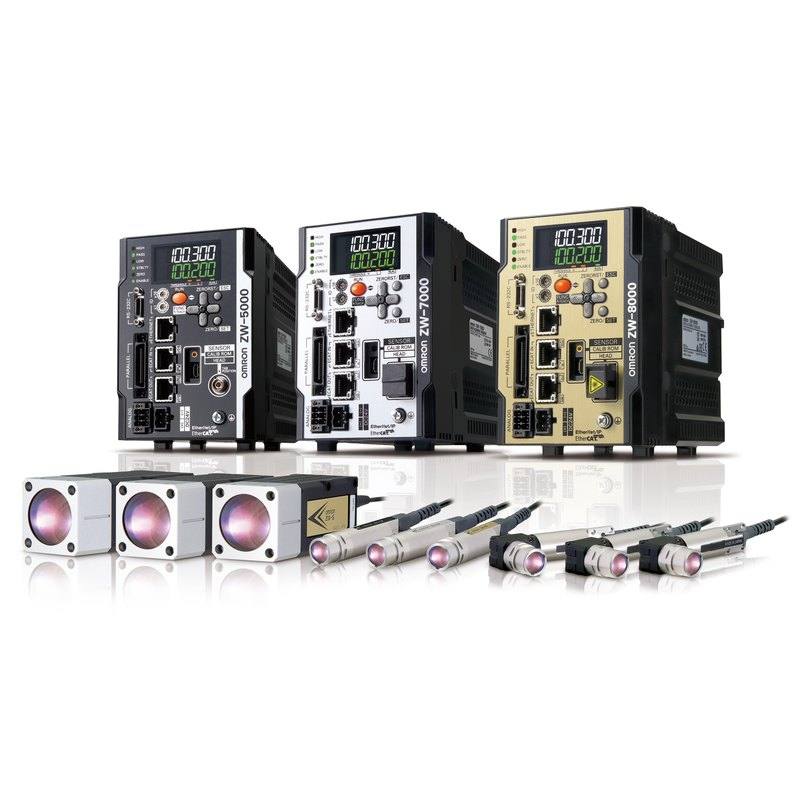
Omron / Sentech ZW-S7010 Confocal Fiber Displacement Sensor Head (ZW-7000)

ZW-S7010

The ZW-S7010 is a square-shaped straight confocal fiber displacement sensor head (ZW-7000 series) with a 10 mm measurement center distance and +/-0.5 mm measuring range, 0.25 um static resolution and +/-0.45 um linearity. Its confocal white-LED optics form an approx. 50 um diameter spot and support measurement cycles from 20 us to 400 us, with the IP40 head weighing about 170 g. Connected to the ZW-7000T sensor controller it provides EtherCAT, EtherNet/IP, Ethernet and RS-232C communication plus analog +/-10 V / 4-20 mA outputs, running on a 21.6-26.4 VDC supply, and can measure shiny inclined surfaces up to +/-25 degrees.

Brand
OMRON
Sensor type
Confocal fiber displacement (distance) sensor
Range / distance
10 mm center distance, +/-0.5 mm measuring range (9.5-10.5 mm)
Response time
Measurement cycle 20 us to 400 us (min 0.02 ms) with ZW-7000T controller
Communication
EtherCAT, EtherNet/IP, Ethernet (100BASE-TX), RS-232C (max 115,200 bps), analog +/-10 V / 4-20 mA (via ZW-7000T controller)
IP rating
IP40 (IEC 60529) sensor head; ZW-7000T controller IP20
Resolution
0.25 um
Linearity
+/-0.45 um
Operating temperature
0 to 50 degC
Housing material
Chassis aluminum die cast; fiber cable sheath PVC; calibration ROM PC
Weight
180 g
Supply voltage
21.6 to 26.4 VDC (incl. ripple)

Technical overview

The ZW-S7010 is a confocal fiber displacement sensor head from Omron's ZW-7000 series, and it measures distance on a confocal optical principle rather than triangulation. A white LED projects light through the head's optics, and chromatic/confocal focusing means only light reflected from the precise focus plane returns sharply through the confocal aperture. The head is built around a 10 mm measurement center distance, and its working window is the +/-0.5 mm band from 9.5 to 10.5 mm. Within that window it resolves height changes down to a 0.25 um static resolution with +/-0.45 um linearity, forming an approximately 50 um diameter measurement spot. The practical consequence of the confocal method is that it stays accurate on the surfaces that defeat conventional laser-triangulation sensors: glossy, mirror-like and transparent targets, and shiny surfaces inclined up to +/-25 degrees. You position it so the target sits at the 10 mm nominal stand-off and let the part's height vary only inside the half-millimetre range; outside that band there is no valid reading.

Because this is a sensor head, not a self-contained sensor, it does its measuring optically but has no electrical output of its own. The head connects by fiber cable to the ZW-7000T sensor controller, and that controller is where measurement and I/O actually live. The controller supports measurement cycles from 20 us up to 400 us (minimum 0.02 ms), so a shorter cycle suits fast height or thickness sampling and a longer cycle suits more demanding surfaces. Through the controller you get the full output set: discrete PNP or NPN switching for go/no-go or threshold signaling, and analog +/-10 V or 4-20 mA for streaming a continuous height value into a PLC or motion system. For networked lines the controller adds EtherCAT, EtherNet/IP, Ethernet (100BASE-TX) and RS-232C up to 115,200 bps, which is how the displacement value or pass/fail result reaches a controller or vision system. In a machine-vision cell this device typically acts as a precise non-contact height/thickness gauge or a presence/position reference alongside a camera, rather than the imaging device itself.

Environmentally the head is rated IP40 and the ZW-7000T controller IP20, so this is an instrument for clean, dry, indoor production environments such as electronics, semiconductor and battery lines rather than washdown or heavy-spray areas. It operates from 0 to 50 degC and runs on a 21.6 to 26.4 VDC supply (24 VDC nominal, including ripple). The head chassis is aluminum die cast with a PVC fiber-cable sheath and a PC calibration ROM, and it weighs about 180 g, light enough to mount on a gantry, robot wrist or fine Z-axis. Its small footprint and fiber connection let the optical head sit close to the part while the controller stays in the cabinet, which is useful where space at the measurement point is tight.

Best for

  • Non-contact thickness and height measurement of glass, films and other transparent or glossy parts in electronics manufacturing, where laser-triangulation sensors struggle with specular reflection.
  • Sub-micron dimensional measurement of semiconductor wafers, substrates and small components, using the 0.25 um resolution and +/-0.45 um linearity within the +/-0.5 mm range.
  • Surface and step-height inspection of battery components such as electrode coatings and cell surfaces, including shiny inclined faces up to +/-25 degrees.
  • Defect and warpage inspection where a precise height reference is fed alongside an AI/vision camera to confirm part position or coplanarity.
  • High-speed inline gauging on a moving stage or conveyor using the 20 us minimum measurement cycle to sample height as parts pass the 10 mm focus point.

Selection notes

  • Mount the target at the 10 mm center distance and design the fixture so part height varies only within the +/-0.5 mm window (9.5-10.5 mm); anything outside this band falls outside the measuring range, so this head suits small height variation, not large stand-off ranges.
  • This is a sensor head only. You must pair it with the ZW-7000T controller to obtain any output, including the EtherCAT/EtherNet/IP/Ethernet/RS-232C interfaces and the PNP/NPN switching or +/-10 V / 4-20 mA analog signals.
  • Choose the measurement cycle within the 20 us to 400 us range: shorter cycles for moving parts, longer cycles for more demanding surfaces. For triggering against a camera, wire the controller's switching or network output to the camera or PLC.
  • Verify the surface fits the confocal strength: it excels on glossy, mirror-like and transparent targets and on shiny surfaces tilted up to +/-25 degrees, but the ~50 um spot sets the smallest feature it can resolve. Note this is a single-point distance sensor, not a 2D profiler.
  • Plan for a clean indoor environment; the IP40 head and IP20 controller are not suited to washdown or heavy contamination, and the head needs 0-50 degC operation and a regulated 24 VDC (21.6-26.4 V) supply. If you need a longer range, a larger stand-off or higher ingress protection, select a different head or sensor family.

Specifications: General
BrandOMRON
Sensor typeConfocal fiber displacement (distance) sensor

Specifications: Performance
Range / distance10 mm center distance, +/-0.5 mm measuring range (9.5-10.5 mm)
Response timeMeasurement cycle 20 us to 400 us (min 0.02 ms) with ZW-7000T controller
Resolution0.25 um
Linearity+/-0.45 um

Specifications: Interface
CommunicationEtherCAT, EtherNet/IP, Ethernet (100BASE-TX), RS-232C (max 115,200 bps), analog +/-10 V / 4-20 mA (via ZW-7000T controller)
ConnectionCable

Specifications: Electrical
Supply voltage21.6 to 26.4 VDC (incl. ripple)

Specifications: Environment
IP ratingIP40 (IEC 60529) sensor head; ZW-7000T controller IP20
Operating temperature0 to 50 degC

Specifications: Mechanical
Housing materialChassis aluminum die cast; fiber cable sheath PVC; calibration ROM PC
Weight180 g

Specifications: Sensing
Sensing methodConfocal
Light sourceWhite LED (confocal)

Specifications: Output
Output typePNP / NPN / Analog

Frequently asked questions

Related technical guides

Rosepetal · AI

Test this camera with Rosepetal

Validate your visual inspection with AI: send us sample images and we evaluate the case on your hardware.

AIS Vision · Integration

We validate camera + lens + lighting

AIS Vision defines and tests the optimal combination of camera, optics and lighting for your application before you buy.