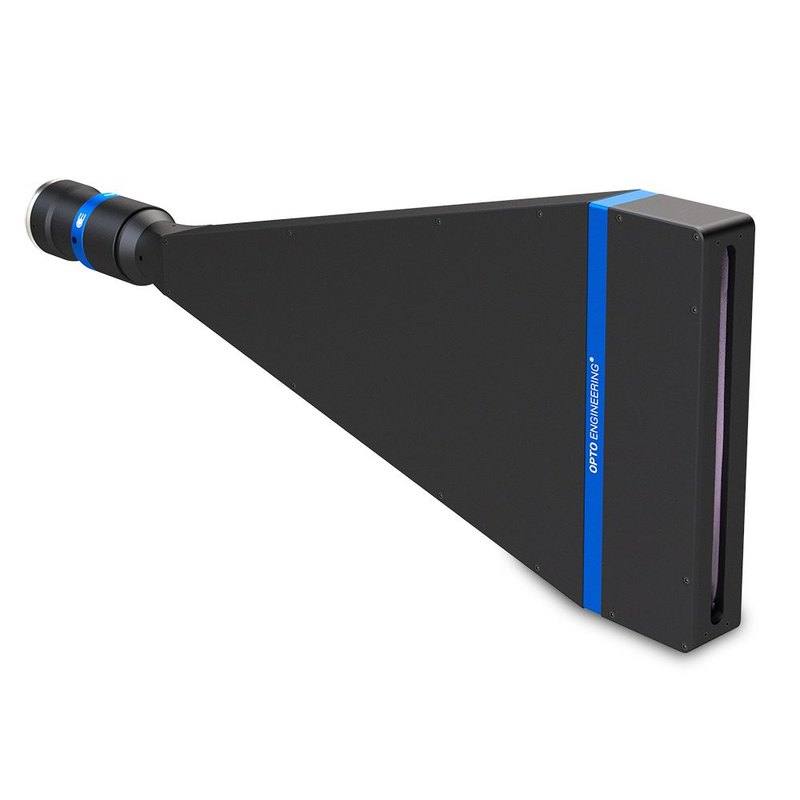
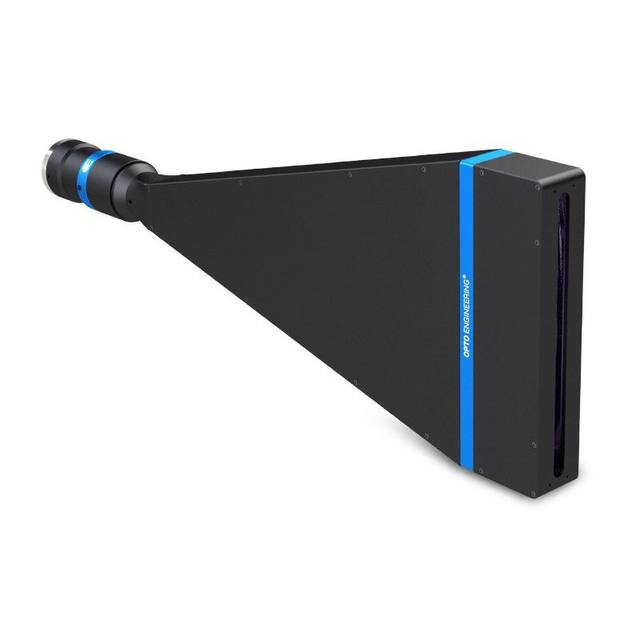
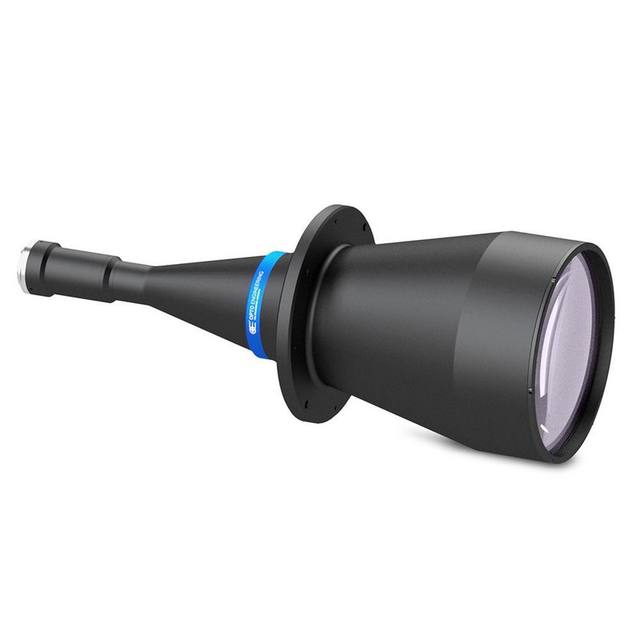
The Opto Engineering TC4K180-J is a telecentric lens for 4k line scan cameras from the TC4K series of flat telecentric lenses for 4k line scan sensors. It images at 0.159× magnification with a working distance of 254.0 mm and a working f-number of wF/# 16, and it attaches through an M42x1 FD 12 mount. Camera compatibility is the first check, since the lens needs a camera body that accepts that mount. The 254.0 mm working distance then sets the mechanical layout, because the object has to sit at that distance for the 0.159× scale to hold.
Telecentricity keeps the chief rays close to parallel with the optical axis, so the image scale stays steady when the object moves nearer to or further from the lens. For this model distortion is typically below 0.08 %, with a maximum of 0.10 %, and telecentricity is typically below 0.08 deg, with a maximum of 0.10 deg. That combination suits dimensional checks where the same feature has to read the same size wherever it sits across the scan line.
At 0.159× the field on the object is large for a given sensor, which fits larger parts, with the trade-off that fine detail is resolved at a coarser scale. The wF/# 16 aperture adds depth of field but reduces the light reaching the sensor, so the illumination and the line exposure should be designed together, with the exposure kept short enough for the speed of the part.
Best for
Line scan inspection of larger parts at 0.159× magnification
Installations that need 254.0 mm of working distance between the lens and the moving object
Dimensional checks where telecentric imaging keeps the scale steady across the scan line
Machine builders using an M42x1 FD 12 mounted 4k line scan camera
Selection notes
Confirm that the camera accepts an M42x1 FD 12 mount before ordering.
Fix the object plane at 254.0 mm from the lens with a bracket or stop to keep the 0.159× scale.
Work out the field of view per scan line from magnification and camera line length during design so the full part width is covered.
Plan bright, stable illumination for wF/# 16 and keep the exposure short enough for the part speed.
Specifications: General
Brand
Opto Engineering
Specifications: Optical
Lens mount
M42x1 FD 12
Magnification
0.159×
Working distance
254.0 mm
Telecentric
Yes
Applications this product is commonly selected for. Open one to see the full recommended hardware and approach.