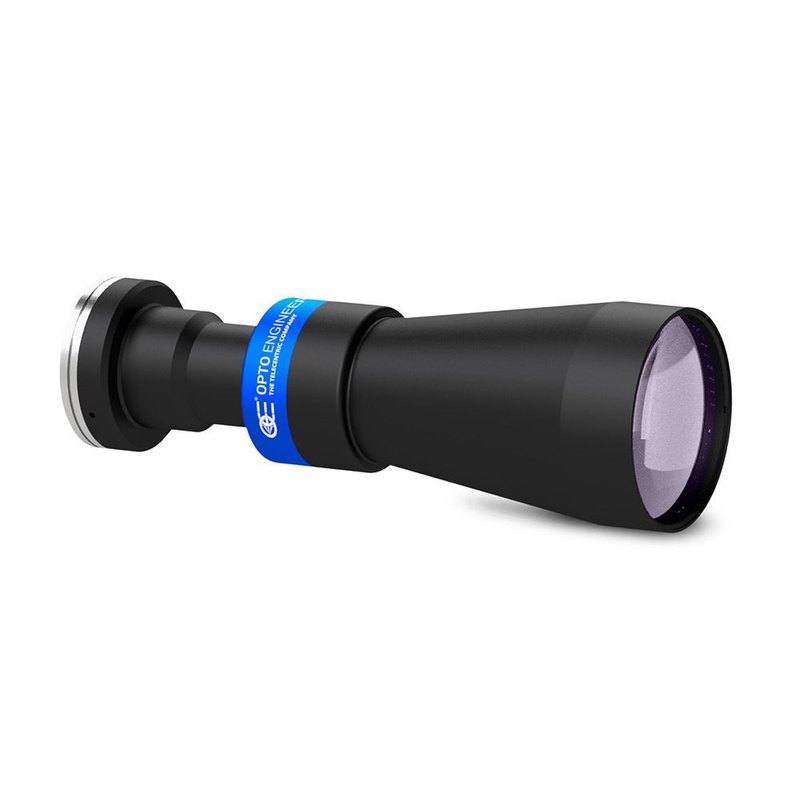
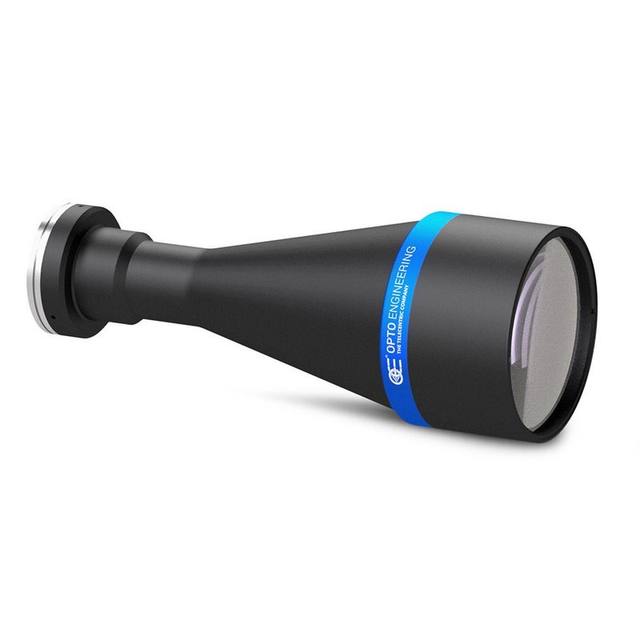
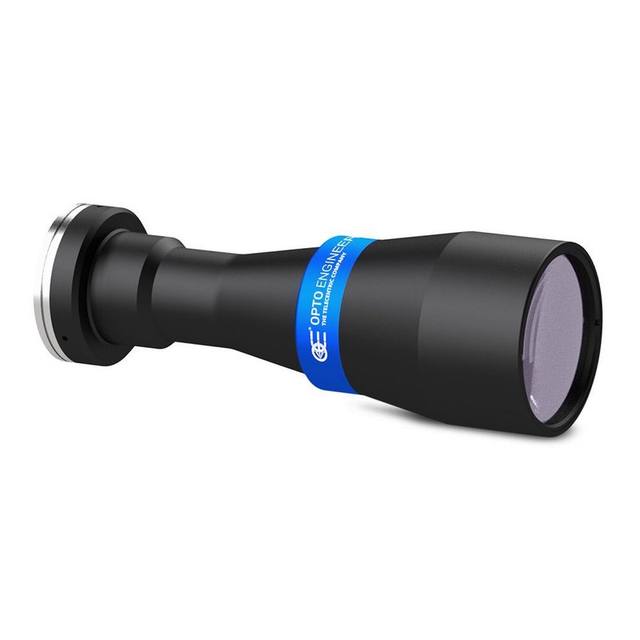
The Opto Engineering TC4MHRP056-F is a high resolution telecentric lens with an F-mount, a 0.313× magnification and a 157.8 mm working distance. Its Ø 22.0 mm image circle is rated for sensors up to 4/3″, and at 0.313× the lens images a wide object area onto the sensor. That suits gauging of larger parts or assemblies within one field of view. The wF/# 8 working aperture defines the depth of field and the light budget at the 157.8 mm working distance.
Telecentricity is what the lens is chosen for in measurement work. The figure is <0.05° typical with a 0.10° maximum, so the chief rays remain nearly parallel to the optical axis and the image scale stays steady through the depth of field. Distortion is <0.07 % typical with a 0.10 % maximum, and that residual belongs in the measurement uncertainty budget alongside the sensor and pixel size of the chosen camera.
Design the fixture, the camera position and any backlight around the 157.8 mm standoff so the object stays sharp and inside the depth of field during production. The F-mount attaches to cameras with a matching F-mount interface. Select lighting and exposure after the working distance is fixed, because the wF/# 8 aperture and the standoff together set how much light reaches the sensor.
Best for
Dimensional gauging of larger parts or assemblies within a wide object field at 0.313× magnification
Measurement setups that need a 157.8 mm standoff for clearance around fixtures or handling equipment
Telecentric inspection where part height varies within the depth of field
Metrology with a 4/3″ camera where distortion must be bounded at 0.10 % maximum
Selection notes
Keep the camera sensor within the Ø 22.0 mm image circle, which is rated for sensors up to 4/3″.
Place the object plane at 157.8 mm; the stated 0.313× magnification applies at that working distance.
Include the <0.07 % typical and 0.10 % maximum distortion in the measurement uncertainty budget.
For tight angular tolerances, design to the 0.10° telecentricity maximum rather than the <0.05° typical figure.
Confirm the camera has an F-mount interface before ordering.
Specifications: General
Brand
Opto Engineering
Specifications: Optical
Lens mount
F-mount
Image circle / max sensor
Ø 22.0 mm (max sensor 4/3″)
Magnification
0.313×
Working distance
157.8 mm
Telecentric
Yes
Applications this product is commonly selected for. Open one to see the full recommended hardware and approach.
Matched automatically by: camera mount fits the lens mount · camera sensor is covered by the lens image circle — this lens: F-mount · Ø 22.0 mm (max sensor 4/3″) image circle.