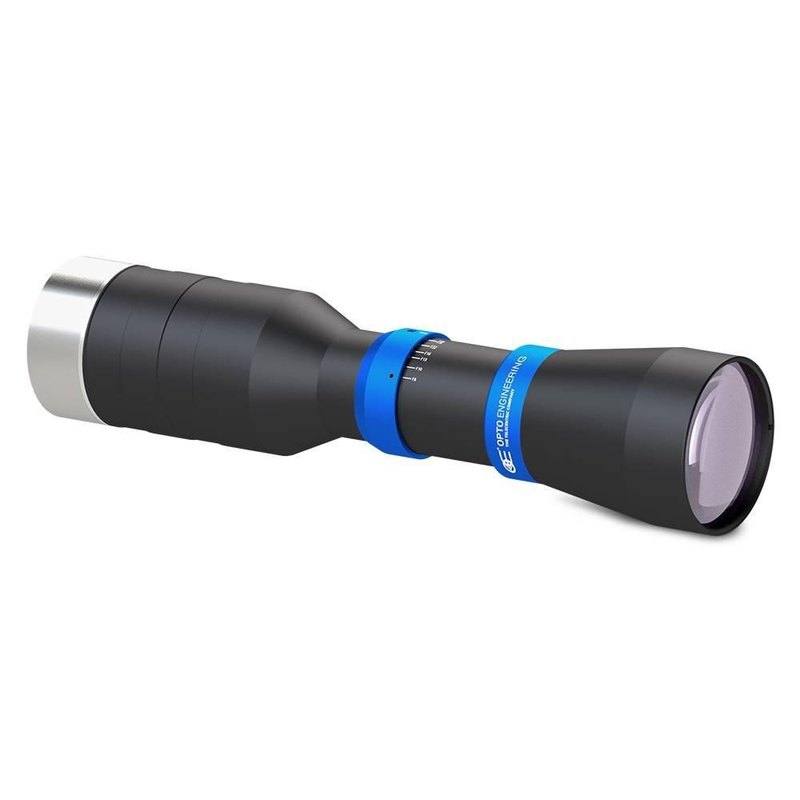
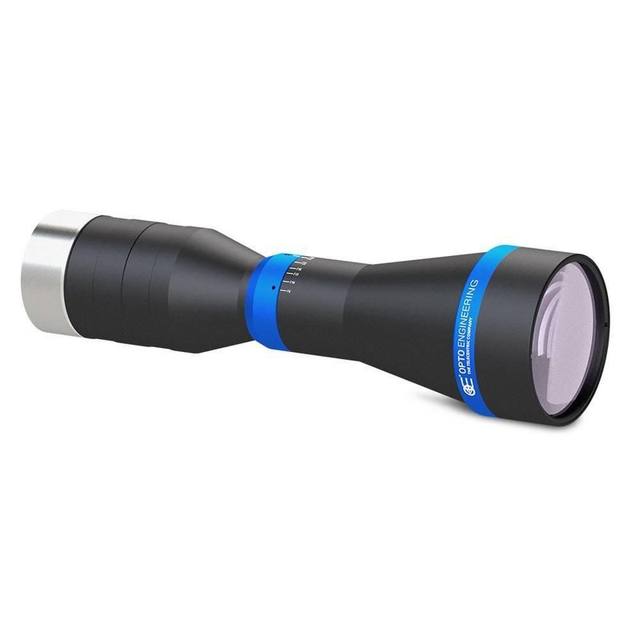
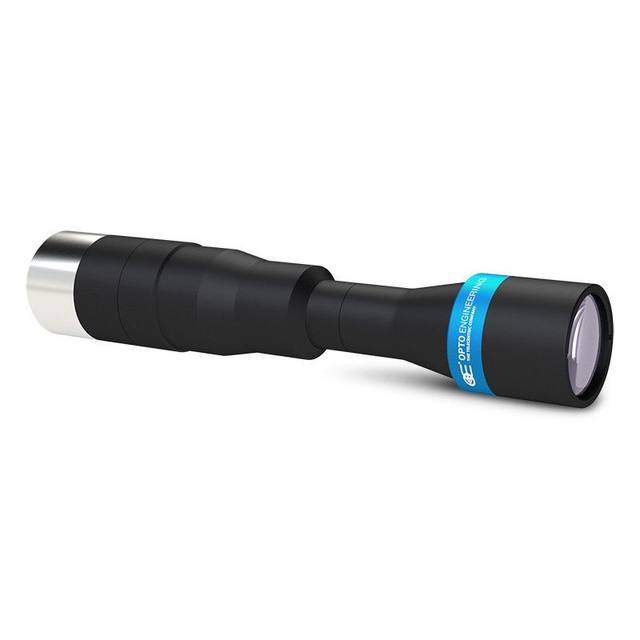
The Opto Engineering TCSE16M036-I is a telecentric lens with 0.920× magnification, a 240.0 mm working distance and an M58x0.75 FD 11.48 mount. Its image circle is listed as Ø 45.7 mm, with the maximum sensor given as FF. At 0.920× the lens images a wide area of the part, which suits larger components. The TCSE series is described as high-resolution telecentric lenses for 4/3”, APS-C, APS-H and full frame sensors.
The accuracy figures are distortion <0.08 (0.10) % typ. (max) and telecentricity <0.08 (0.10) deg typ. (max). Telecentric imaging keeps the chief rays close to parallel, so the imaged size of a feature changes little as the part moves through the working range. The wF/# span of 8-16 sets the aperture: lower f-numbers pass more light and give shallower depth of field, while higher f-numbers do the reverse.
The M58x0.75 FD 11.48 mount requires a matching adapter or camera body. The 240.0 mm working distance gives space for fixtures, lighting and part handling, and the wF/# span lets you trade brightness against depth of field within the working range.
Best for
Telecentric gauging of larger parts at 0.920× magnification with a Ø 45.7 mm image circle.
Full-frame sensor setups using the M58x0.75 FD 11.48 mount.
Inspection cells that need 240.0 mm of working-distance clearance for fixtures and lighting.
Measurement of parts whose position varies within the working distance, where telecentric imaging keeps size readings stable.
Selection notes
Confirm the M58x0.75 FD 11.48 mount matches the camera adapter or body before ordering.
Check that the chosen sensor, including full-frame formats, fits within the Ø 45.7 mm image circle.
Set the aperture within the wF/# 8-16 span together with the lighting plan to balance brightness and depth of field.
Plan the 240.0 mm working distance into the cell layout, including lighting and fixture clearance.
Specifications: General
Brand
Opto Engineering
Specifications: Optical
Lens mount
M58x0.75 FD 11.48
Image circle / max sensor
Ø 45.7 mm (max sensor FF)
Magnification
0.920×
Working distance
240.0 mm
Telecentric
Yes
Applications this product is commonly selected for. Open one to see the full recommended hardware and approach.
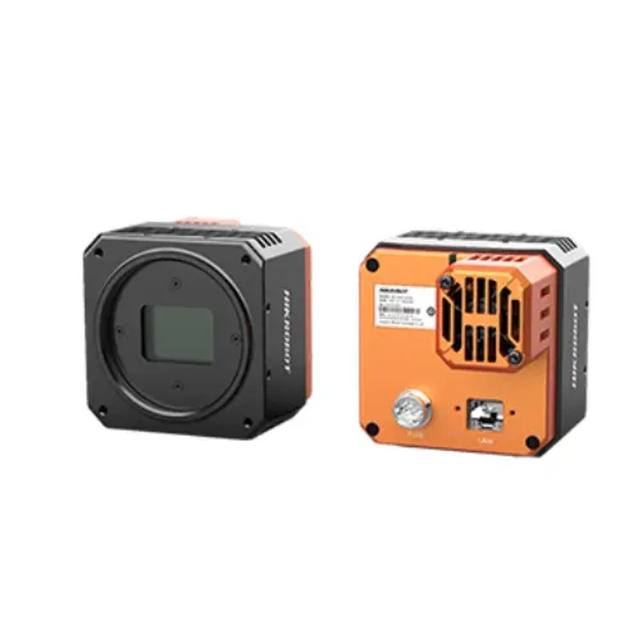
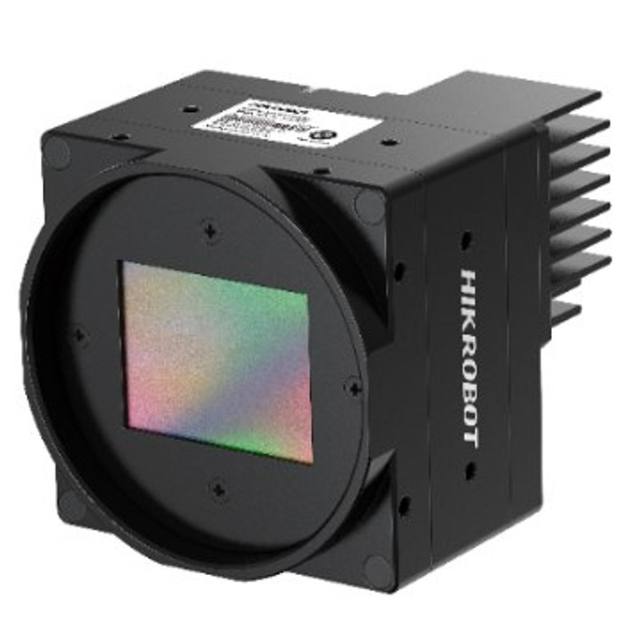
Matched automatically by: camera mount fits the lens mount · camera sensor is covered by the lens image circle — this lens: M58x0.75 FD 11.48 · Ø 45.7 mm (max sensor FF) image circle.
By category
All 72High-resolution cameras 42Area scan cameras 23High-speed cameras 7