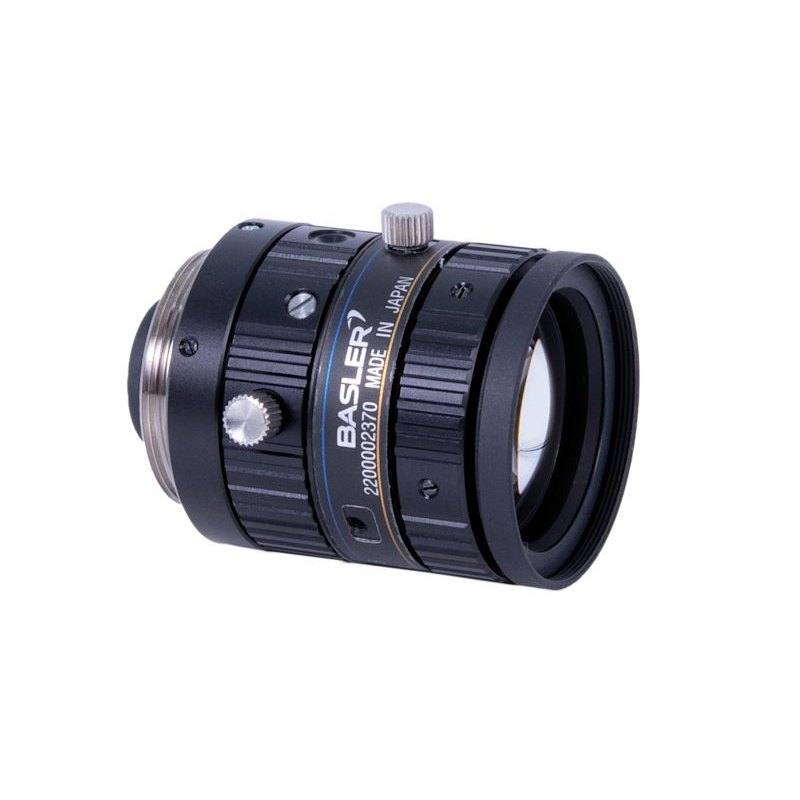
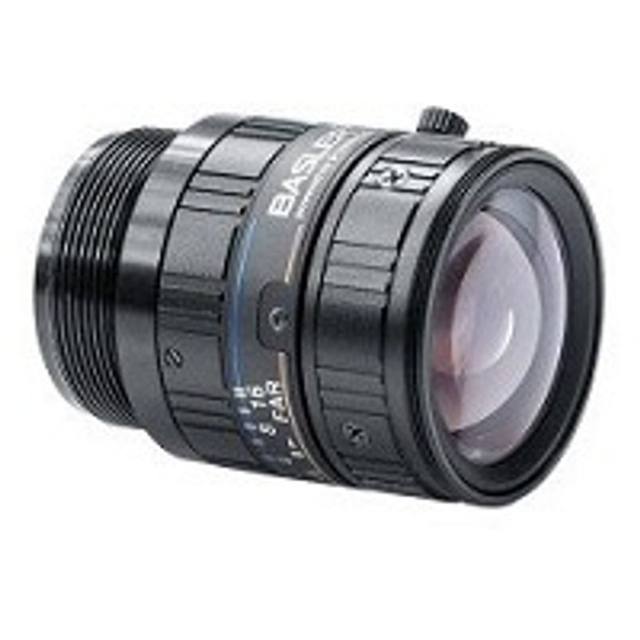
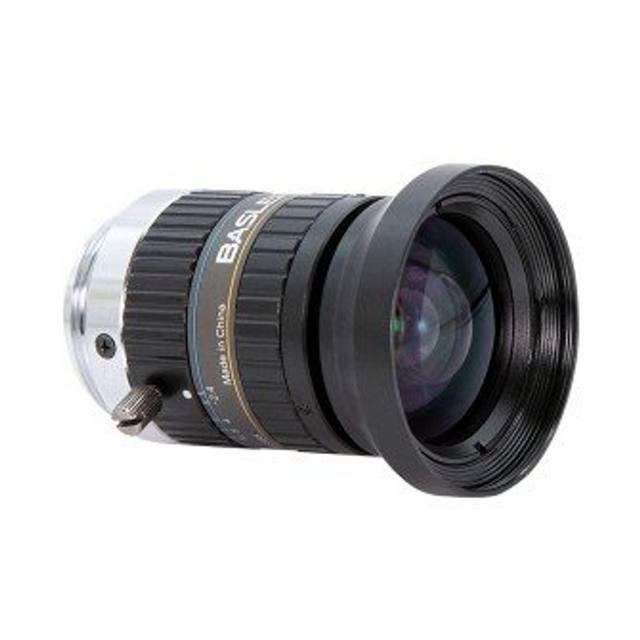
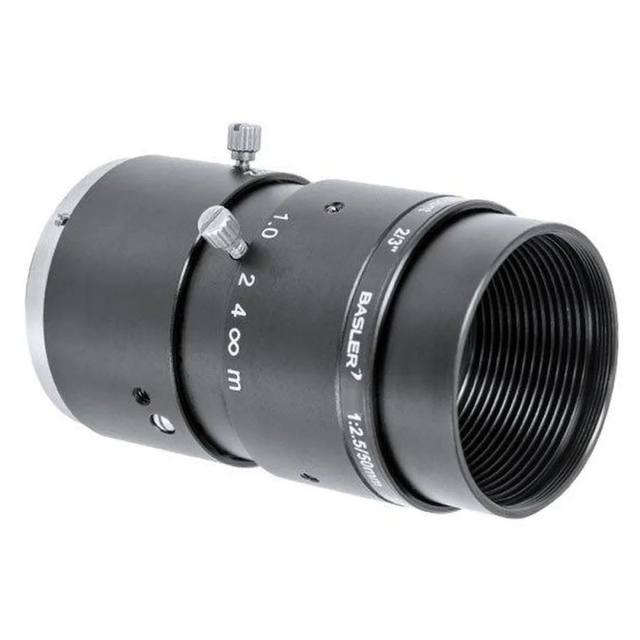
The Basler C23-1628-16M is a fixed 16 mm C-mount lens built around one specific design brief: extracting full performance from 16 MP sensors that use a 2 µm pixel pitch and a 2/3" format chip. Its 11.8 mm image circle covers the entire 2/3" sensor diagonal without vignetting, so installers can pair it directly with high-resolution area-scan cameras in that format class without worrying about corner fall-off. The F2.8 maximum aperture provides genuine light-gathering capability for applications that need faster exposure times under fixed illumination budgets, while the F2.8–F16 iris range gives the integrator control over depth of field without swapping optics. Manual focus and iris with locking screws are the right choice here: once the lens is dialled in for a fixed station, vibration and mechanical perturbation should not shift the settings, and both controls lock positively to prevent drift.
Resolution is where this lens earns its 16 MP rating. At full aperture and centre field, the MTF reaches 0.56 at 180 LP/mm and 0.44 at 250 LP/mm — figures that match the Nyquist demands of a 2 µm pixel camera and confirm that the lens, not the sensor, will not be the resolution bottleneck. Optical distortion of 0.07% and TV distortion of 0.014% are exceptionally low for a non-telecentric design at this focal length. These figures matter directly for dimensional measurement and for any inspection task where a pixel-to-mm calibration must remain stable across the frame. The floating optical design — where at least one element group shifts as the focus ring moves — preserves MTF and distortion correction from the 100 mm minimum working distance all the way to infinity, so the distortion spec is valid across the working-distance range, not only at a single calibrated distance.
For installation planning, the 100 mm minimum working distance sets the closest-approach constraint. With a 16 mm focal length and a 2/3" sensor (8.8 mm × 6.6 mm active area), the magnification at 100 mm working distance is approximately 0.19×, yielding a field of view of roughly 46 mm × 35 mm — sized for component-level inspection of PCB sub-assemblies, connector arrays, or small packaged parts. Increasing working distance opens the field proportionally; for example, at 200 mm the field grows to approximately 101 mm × 76 mm, covering a full small PCB or a pharmaceutical blister strip while still utilising the full 16 MP resolution for fine-detail discrimination. The lens weighs 74 g and operates between -10 and 50 °C, and its 10 G vibration and shock rating means it is safe to mount on automated gantries, rotary indexing tables, or robot end-effectors where mechanical shock is routine.
Best for
- High-resolution PCB and semiconductor inspection with 16 MP cameras at working distances from 100 mm upward, where the 0.07% optical distortion keeps measurement error negligible across the full frame.
- Pharmaceutical tablet and blister-pack surface inspection requiring consistent MTF from centre to edge, paired with diffuse or dome lighting and a 2/3" monochrome camera.
- Dimensional gauging of small precision parts (electronic connectors, metal stampings, machined features) where sub-pixel measurement accuracy depends on maintaining low TV distortion of 0.014% after calibration.
- Automotive electronics and EV battery cell inspection on fixed-station conveyors, benefiting from the locking focus and iris screws that prevent setting drift under machine vibration.
- OCR and 2D/DPM code reading on dense, small-character labels or laser-marked surfaces, where the 16 MP resolving power separates closely spaced characters or data matrix cells clearly.
Selection notes
- Sensor format and pixel size must match: the lens is rated for sensors up to 2/3" with 2 µm pixel pitch. Using it on a larger sensor format (e.g. 1" or 4/3") will produce corner vignetting because the 11.8 mm image circle will not cover the larger diagonal. Using it on sensors with larger pixels (e.g. 3.45 µm) will not damage image quality but wastes the lens's resolving power — a less expensive optic may deliver the same effective result.
- Working distance minimum is 100 mm. Applications requiring focus closer than 100 mm (e.g. very small micro-component inspection) need extension rings or a macro-capable optic instead; the floating design does not extend to macro ratios.
- This lens is non-telecentric (telecentric: No). For dimensional measurement applications where perspective error across the field height must be eliminated — particularly when parts vary in height — a telecentric lens should be evaluated instead. The very low distortion (0.07%) means planar measurement on a flat part is highly accurate, but depth-induced parallax error on tall features is not corrected.
- Aperture selection trades depth of field against diffraction. At F2.8 the lens resolves 250 LP/mm at MTF 0.44, suitable for full 16 MP performance. Stopping down to F8–F11 increases depth of field for parts with surface relief but begins to introduce diffraction softening at 2 µm pixel sizes; keep this in mind when selecting working aperture for the specific inspection task.
- The C-mount thread is the universal interface here, but back focal distance and flange-to-sensor distance must be verified against the target camera body. C-mount cameras with sensor protectors or optical low-pass filters may require a small spacer adjustment to achieve sharp focus at the desired working distance; confirm the exact flange focal distance with the camera datasheet before finalising the mechanical design.