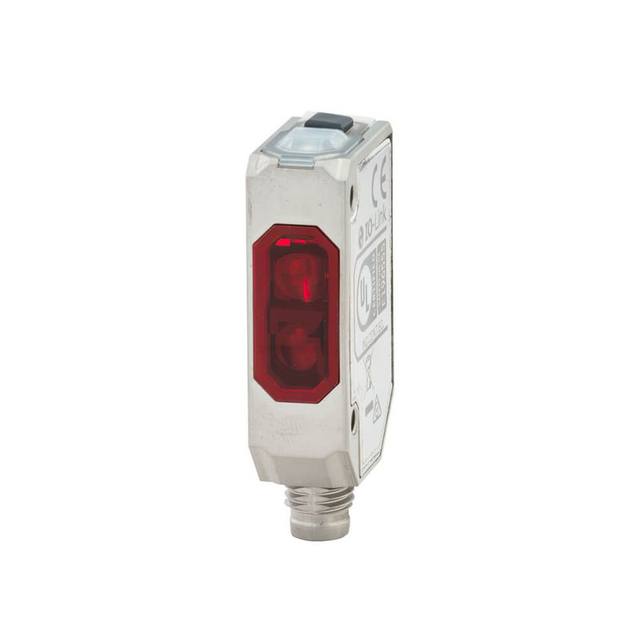
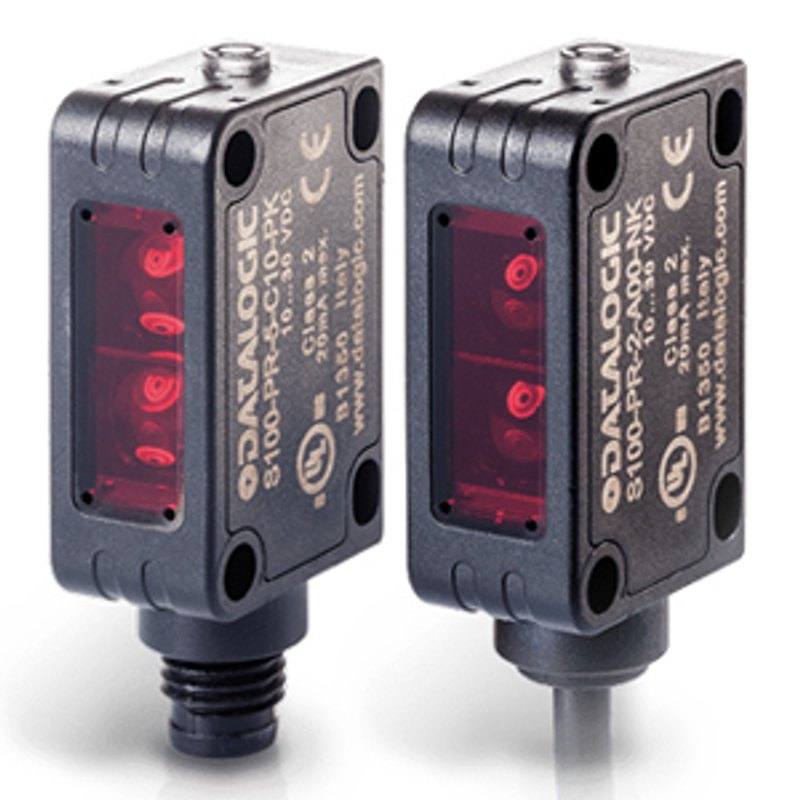
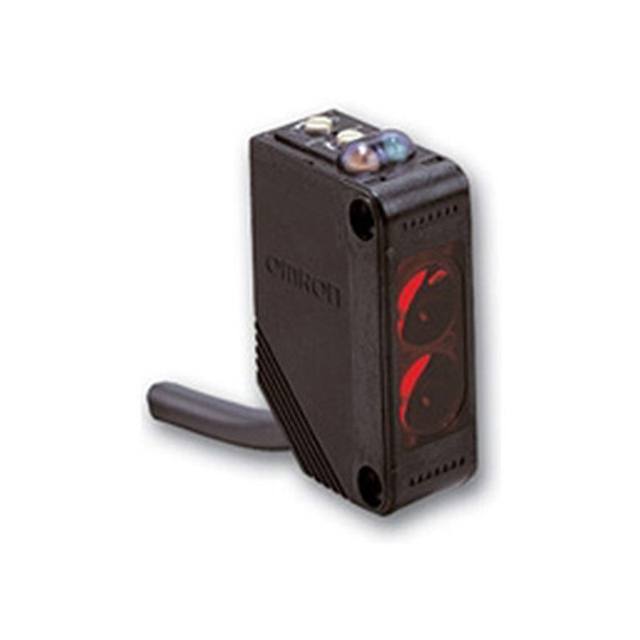
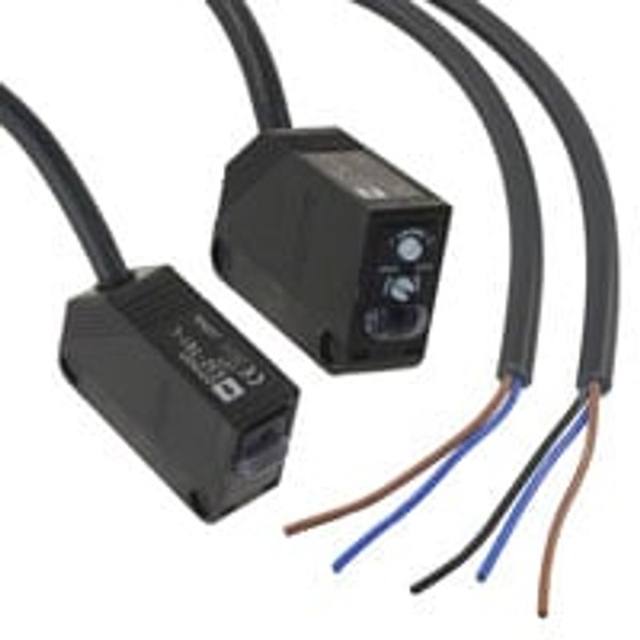
Datasensing S100 Series Miniature Photoelectric Sensor
S100 series
The S100 series covers eight sensing functions: through-beam (12 m), infrared retroreflective (8 m), polarized retroreflective short/long range (3 m / 5.5 m on R5 reflector), diffuse proximity short/long range (300 mm / 500 mm), fixed focus (70 mm), and background suppression (30–100 mm). All variants share a 10–30 VDC supply, PNP or NPN output selectable, 1 ms response time, and 500 Hz switching frequency. The housing is ABS plastic with PMMA optics cover and PC lens, rated IP67, and supports remote Light/Dark selection or External Teach-In via the white wire/pin 2. An IO-Link COM2 (V1.1.2) variant is available for parametrisation and condition monitoring; cable (2 m, 4-wire) and M8 4-pole connector versions are offered.
The Datasensing S100 is a multi-function photoelectric sensor family that packs eight distinct sensing modes into a single 32 x 20 x 12 mm ABS housing — an unusually broad range for a miniature device. Sensing principle and operating range vary substantially across the family: through-beam reaches 12 m using an 860 nm IR LED and is the right choice wherever a reliable emitter-receiver pair can be mounted opposite each other, such as a conveyor entry gate or an aisle-wide presence check. Infrared retroreflective extends to 8 m, while the polarized retroreflective variants offer 3 m (short) or 5.5 m on an R5 reflector (long), with the polarizing filter discriminating against specular returns from glossy or film-wrapped products. For close-range detection, diffuse proximity covers 300 mm (short) or 500 mm (long), fixed-focus locks onto a 70 mm working distance for consistent detection of objects at a defined depth, and background suppression operates from 30 to 100 mm — useful wherever the mounting surface or conveyor belt would otherwise trigger a diffuse sensor. All variants run on a 10–30 VDC supply, so they are compatible with both 12 V and 24 V control cabinets without separate power conversion.
Switching frequency is 500 Hz on standard models and 1 kHz on IO-Link variants. Response time is 1 ms for standard diffuse, retroreflective, fixed-focus, and background-suppression models, 2 ms for through-beam variants, and 0.5 ms on IO-Link versions. At 500 Hz a standard non-through-beam sensor can resolve objects separated by gaps as short as 1 mm at 500 mm/s, making these specifications credible for moderate-speed packaging lines and sorter divert points. The output is model-dependent PNP or NPN, with Light/Dark polarity or External Teach-In selectable by applying voltage to the white wire (pin 2) in the field or via IO-Link parametrisation — eliminating the need to stock two separate SKUs for light-on versus dark-on applications. The IO-Link COM2 V1.1.2 interface goes beyond simple switching: it allows remote threshold adjustment, access to signal quality metrics, and condition monitoring data, which integrates naturally into IIoT dashboards or a Profinet/EtherNet-IP gateway. The M8 4-pole connector version (≤10 g) suits installations where space and weight budgets are tight, while the 2 m pre-wired cable version (≤50 g) removes the need for a separate connector assembly step.
The housing is rated IP67, so temporary immersion and wash-down splash are tolerated, though the operating temperature range of -25 °C to +55 °C (without freeze) defines the thermal envelope for installation planning — condensing cold-store environments or locations near the upper limit are outside specification. The housing is ABS plastic with a PC sensing lens; a PMMA indicator cover protects the status LED window. The compact footprint means the sensor can be bracket-mounted in locations that preclude a standard 50 mm rectangular housing: inside a machine frame, at the end of a pneumatic arm, or under a conveyor belt profile. The combination of short-range background-suppression and fixed-focus variants makes the S100 particularly effective on production lines where parts of varying reflectivity arrive against a near background, because the sensing cutoff distance can be set to exclude the conveyor surface entirely.
Best for
Conveyor presence detection and jam sensing on packaging and logistics lines, where the through-beam (12 m) or retroreflective (8 m) variants provide reliable detection across wide conveyor spans without requiring beam alignment tighter than the mounting tolerances allow.
Object counting and gap detection on moderate-speed lines running up to several hundred objects per minute, where the 500 Hz switching frequency and 1 ms response time (non-through-beam standard models) are sufficient to resolve product spacing reliably.
Detection of glossy, film-wrapped, or label-covered products against a reflective background, where the polarized retroreflective variants suppress mirror-like returns and background suppression variants (30–100 mm) eliminate conveyor belt false triggers.
Integration into IIoT-connected lines via IO-Link COM2, where remote threshold tuning, signal-strength monitoring, and condition data can be surfaced at a PLC or edge gateway without technician access to the sensor mounting point.
Space-constrained installations — end-of-arm tooling, compact assembly fixtures, or inside machine frames — where the 32 x 20 x 12 mm body and ≤10 g connector variant are critical to fitting the sensor in a location that a standard housing cannot occupy.
Selection notes
Choose the sensing function before choosing a cable or connector variant: through-beam and IR retroreflective models use an 860 nm IR LED, while all other variants (diffuse, polarized retro, fixed-focus, BGS) use a 632 nm red LED. The wavelength difference affects which products are invisible (some red-tinted materials absorb 632 nm) and which reflectors are appropriate.
Match PNP vs NPN to the PLC input card type at order time, since the output type is fixed per model. Light/Dark switching polarity and External Teach-In are the parameters that can be changed in the field via the white wire or IO-Link, so they do not need to be decided at procurement.
For the IO-Link variant, confirm the master port supports COM2 (38.4 kbps) — COM3 masters are backward-compatible, but COM1-only masters are not. The IO-Link variant also provides 1 kHz switching frequency and 0.5 ms response time, which may be the deciding factor on faster lines even if the IIoT features are not immediately needed.
IP67 covers dust-tight sealing and temporary immersion up to 1 m for 30 minutes, but it does not cover high-pressure wash-down jets (IP69K). For food and beverage lines with regular CIP cycles, verify that the cleaning regime stays within IP67 limits or specify a higher-rated sensor.
The operating temperature ceiling of +55 °C excludes installation near heat-generating equipment such as ovens, shrink-wrap tunnels, or hot-glue stations. Verify ambient temperature at the mounting point, including radiant heat from adjacent machinery, before committing to the S100 in thermally demanding zones.
Specifications: General
Brand
Datalogic / Datasensing
Sensor type
Photoelectric
Specifications: Performance
Range / distance
Up to 12 m (through-beam); 8 m retroreflective; 5.5 m polarized retro long; 300–500 mm diffuse; 70 mm fixed focus; 30–100 mm BGS
Response time
1 ms (standard models); 2 ms (through-beam variants); 0.5 ms (IO-Link variants)
1. Install the IMPACT Software Suite and connect the camera
Install the IMPACT Software Suite on your PC, which provides both the configuration/viewer tools and the SDK. For a GigE Vision model (E100, M or U series), connect it to a dedicated NIC and, for USB3 models, use a certified USB3 cable and port. Power the camera and confirm it enumerates.
2. Bring the camera online and verify the link
For GigE Vision, put the camera and the host NIC on the same subnet (a static IP on the camera matching the NIC range is the most reliable starting point); for USB3, confirm the device is recognized. Open the IMPACT viewer/device tool, discover the camera, and verify a stable connection before streaming. Enabling jumbo frames on the NIC helps GigE throughput.
3. Set exposure, gain and trigger, then grab a first image
In the IMPACT tools, start a live stream and adjust exposure and gain until the image is well-lit without saturation; set white balance on color models. Begin in free-run (continuous) mode to confirm imaging, then switch to hardware or software trigger as your application requires. Capture and save a reference image once the scene looks correct.
4. Build a vision tool or move to the SDK/API
Use the IMPACT point-and-click vision tools to assemble an inspection, or use the IMPACT SDK to access the camera and results programmatically and feed them into your HMI/PLC application. As these are GenICam/GenTL-compliant devices, you can alternatively drive them from any GenICam-compliant third-party vision library if your pipeline standardizes on one.
5. Route the stable feed to deep-learning inspection (optional)
Once you have a stable, repeatable image, the feed can be sent to a deep-learning inspection platform such as Rosepetal for defect detection or classification tasks that go beyond rule-based tooling. Keep lighting, optics and trigger timing fixed so the images reaching the model stay consistent.
Frequently asked questions
Yes, but only for polarity — Light/Dark output logic and External Teach-In are selectable in the field by applying 8–30 VDC to the white wire (pin 2) or, on IO-Link variants, by writing the parameter via the IO-Link master. PNP vs NPN output type is fixed per model and must be specified at order time.
For standard non-through-beam models (1 ms response time, 500 Hz switching frequency), the sensor can track transitions approximately every 2 mm at 1 m/s (1000 mm/s). A 5 mm gap is detectable at line speeds up to roughly 2.5 m/s under ideal conditions. Note that the through-beam standard variant has a 2 ms response time, halving this ceiling to approximately 1.25 m/s for a 5 mm gap. The IO-Link variant at 1 kHz and 0.5 ms response time extends the ceiling to approximately 10 m/s for the same gap size.
Clear or low-opacity materials are challenging for diffuse and background-suppression variants because they return little light. Through-beam sensing is the recommended method for transparent objects, as the beam interruption is independent of the object's reflectivity. The S100 through-beam variant reaches 12 m and operates at 860 nm IR.
The technical summary specifies an R5 reflector for the 5.5 m long-range polarized retroreflective variant. Using a smaller or non-R5 reflector will reduce reliable operating range. The short-range polarized retro variant is rated to 3 m and is less sensitive to reflector size.
IP67 covers temporary immersion and splash, which is adequate for incidental moisture exposure. It does not cover sustained high-pressure or high-temperature jet wash-down (IP69K). For regular CIP or high-pressure wash-down regimes common in food and beverage processing, confirm that cleaning pressure and temperature stay within IP67 limits, or select a sensor rated IP69K for that zone.