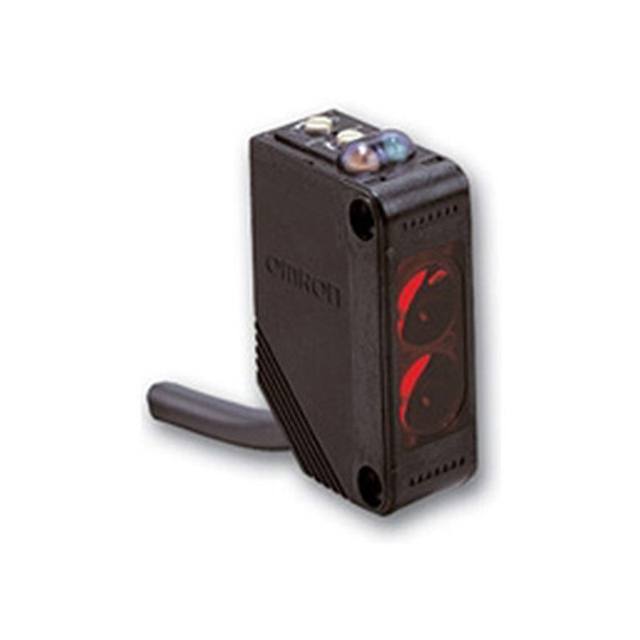
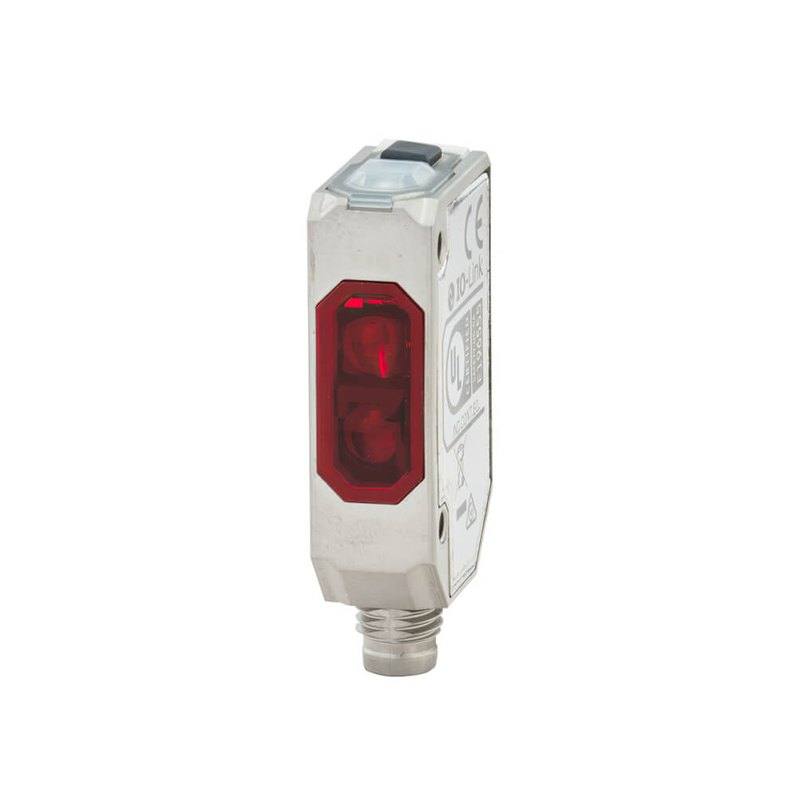
Omron / Sentech E3AS-L Series Distance-Settable Photoelectric Sensor (200 mm)
E3AS-L200
The E3AS-L200 is a distance-settable background suppression sensor based on triangulation with a 624 nm red LED light source, offering a 10–200 mm sensing range with a 25 × 25 mm spot size at 200 mm. The sensor is housed in a SUS316L stainless steel body (H39.4 × D22 × W11.4 mm) rated IP67 and IP69K, making it suitable for food, beverage, and washdown environments. Output variants include NPN open collector (E3AS-L200MN) and PNP with IO-Link COM2/COM3 (E3AS-L200MT/MD), with a 1 ms response time and teach-in or IO-Link configuration. Supply voltage is 10–30 VDC and operating temperature spans -25 to +55°C.
Brand
Omron / Sentech
Sensor type
Photoelectric
Sensing method
Background suppression
Light source
Red LED (624 nm)
Range / distance
10–200 mm (settable range 40–200 mm)
Response time
1 ms max (operate and reset)
Output type
npn_or_pnp
Communication
IO-Link COM3 (230.4 kbps) for MT models; COM2 (38.4 kbps) for MD models only
The Omron E3AS-L200 is a background suppression photoelectric sensor based on optical triangulation using a 624 nm red LED. Unlike diffuse reflectance sensors that react to any surface within a broad range, background suppression triangulation calculates the angular return of reflected light, allowing the sensor to ignore surfaces beyond a set threshold regardless of their reflectivity. The sensing range spans 10 to 200 mm, with the field-settable detection threshold adjustable from 40 to 200 mm. The spot size at maximum range is 25 x 25 mm — large enough to reliably catch low-contrast or matte targets while remaining discriminating enough to reject conveyor belts, guide rails, and other background structures. Response time is 1 ms for both the operate and reset transitions, making it fast enough for high-rate discrete-part counting and positioning tasks on modern packaging and sortation lines.
The sensor body is machined from SUS316L stainless steel and rated IP67 (IEC 60529) and IP69K (ISO 20653), the latter being the demanding high-pressure, high-temperature washdown standard required in food, beverage, dairy, and pharmaceutical production environments. The compact H39.4 x D22 x W11.4 mm footprint with a 25.4 mm mounting-hole pitch allows integration into tight machine frames and hygienic enclosures where larger housings would be impractical. The -25 to +55 deg C operating range (storage to -40/+70 deg C) covers ambient conditions from cold-store conveying through heated process zones.
Three output variants address different installation architectures. The E3AS-L200MN provides an NPN open-collector switched output for conventional PLC discrete input cards. The E3AS-L200MT and E3AS-L200MD are PNP output variants that add IO-Link: the MT runs COM3 at 230.4 kbps for high-speed cyclic data exchange with IO-Link masters, while the MD uses COM2 at 38.4 kbps for standard IO-Link environments. IO-Link variants allow remote parameterization of the detection threshold over the M8 4-pin connector (or optional M12 Smartclick), eliminating manual teach-in when sensor positions change and enabling centralized quality logging. Supply voltage is 10-30 VDC (ripple p-p 10% max), broad enough to work directly off either 12 V or 24 V DC bus rails without an intermediate converter.
Best for
Presence and positioning detection of bottles, cans, pouches, and cartons on washdown-duty food and beverage lines where IP69K protection and SUS316L stainless housing are mandatory for hygiene compliance
Part-present confirmation in packaging machinery — verifying label, cap, or stopper placement at high production rates where the 1 ms response time keeps pace with rapid indexing cycles
Object detection in pharmaceutical blister-pack and vial inspection conveyors where consistent sensing of clear or low-reflectance targets against variable backgrounds is required without reflective-tape targets
Sorting gate triggering in logistics and e-commerce fulfillment sortation lanes where background suppression eliminates false triggers from belt surfaces and conveyor frames
Position-confirmation feedback in automotive sub-assembly fixtures where the IO-Link COM3 interface enables recipe-driven setpoint switching and real-time diagnostic data back to the line controller
Selection notes
Range setting and target size: the full sensing range is 10 to 200 mm, with the background suppression threshold field-settable from 40 to 200 mm. For targets smaller than the 25 x 25 mm spot at maximum range, or for very close-range detection (10-40 mm), confirm the specific operating mode and minimum detectable object size against the application geometry before committing to this model.
IO-Link variant selection: the MT (COM3, 230.4 kbps, PNP output) is preferred for applications requiring fast cyclic process-data updates or tight synchronization with the IO-Link master scan cycle; the MD (COM2, 38.4 kbps, PNP output) suits standard IO-Link deployments where update rate is less critical. For non-IO-Link PLC inputs, the NPN open-collector MN variant avoids the need for an IO-Link master entirely.
Connection and cabling: three connection options are available — M8 4-pin connector, 2 m or 5 m pre-wired cable, and M12 Smartclick. In washdown environments the M8 or M12 connector versions reduce cable ingress risk; pre-wired versions should be avoided where frequent replacement or high-pressure spray is expected unless adequately sealed at the cable entry.
Supply voltage tolerance: the 10-30 VDC range with a ripple limit of 10% p-p requires that the supplying DC rail is adequately regulated. Long cable runs or shared rails with motor drives should be evaluated for voltage drop and conducted noise to stay within operating limits.
Temperature limits in heated process areas: while the +55 deg C upper operating limit covers most ambient environments, sensors mounted close to ovens, heat tunnels, or steam-cleaning zones should be verified against actual local temperatures, particularly for continuous duty cycles.
Specifications: General
Brand
Omron / Sentech
Sensor type
Photoelectric
Specifications: Performance
Range / distance
10–200 mm (settable range 40–200 mm)
Response time
1 ms max (operate and reset)
Specifications: Interface
Communication
IO-Link COM3 (230.4 kbps) for MT models; COM2 (38.4 kbps) for MD models only
These steps take an Omron Sentech (STC) camera from the box to a stable first image and on to your own application. They apply across the GigE Vision, USB3 Vision and CoaXPress STC families; the interface only changes how you cable and power the camera.
Download and install the Sentech SDK on the host PC. The package provides StViewer, the viewing and configuration software you use to bring the camera up, and StApi, the programming SDK you integrate later. Because the cameras are GenICam/GenTL-compliant, StApi also registers a GenTL producer, so any GenICam-compliant third-party vision software can discover and drive the camera as an alternative front end.
2. Cable, power and connect the camera
Connect according to the interface. GigE Vision: link to a Gigabit NIC (use PoE or the separate power input) and put the camera and host on the same subnet; for USB3 Vision use a USB 3.x port and a certified cable; for CoaXPress (STC) connect to a CoaXPress frame grabber, which also supplies Power-over-Coax. Then open StViewer and let it enumerate the camera. If a GigE camera does not appear, check the IP configuration and firewall, and on USB3 confirm the host bandwidth and driver.
3. Configure exposure, gain and white balance
Open the device in StViewer and start a live stream. Set exposure and gain for a well-exposed, low-noise image: raise exposure first and only add gain when more light or a faster shutter is not an option, keeping exposure short enough to freeze motion on global-shutter models. On colour cameras, run white balance under your actual production lighting. Adjust the lens aperture and focus on a representative target before tuning anything else.
4. Set the trigger and grab a first image
Start in free-run (continuous) acquisition to confirm a clean, stable image. For inline inspection switch to hardware or software triggering: select the trigger source, set the active edge and any delay, and wire the strobe or illumination to the camera's I/O so lighting fires with each exposure. Acquire and save a frame in StViewer; this saved image is your reference for the SDK stage and for downstream inspection.
5. Move to the StApi SDK (or any GenICam software)
Once the image is stable, reproduce the same settings in code. Use StApi to open the device, apply the GenICam features you validated in StViewer (exposure, gain, trigger, pixel format) and grab frames into your application via the bundled C++, C, C#/.NET or Python interfaces; the included samples are the fastest starting point. Prefer a different stack? The same GenICam/GenTL camera works with third-party vision libraries. With a reliable feed, you can route it into a deep-learning inspection such as Rosepetal for AI-based defect detection.
Frequently asked questions
All three variants share the same mechanical housing, IP67/IP69K rating, sensing principle, and 10-200 mm range. The MN provides an NPN open-collector switched output with no IO-Link capability, suited to standard PLC discrete inputs. The MT is a PNP output variant that adds IO-Link COM3 communication at 230.4 kbps for high-speed data exchange with an IO-Link master. The MD is also a PNP output variant with IO-Link COM2 at 38.4 kbps for standard-speed IO-Link environments. Both IO-Link variants allow remote parameter setting and diagnostics over the M8 4-pin connector or M12 Smartclick option.
Yes. The sensor body is SUS316L stainless steel and carries both IP67 (immersion) and IP69K (high-pressure, high-temperature spray per ISO 20653) ratings. These are the two certifications typically required for sensors installed in food processing, beverage filling, and dairy washdown zones. The operating temperature range extends to +55 deg C to accommodate warm washdown water.
No reflective tape or reference target is needed. The background suppression principle uses triangulation to compute target distance; the detection threshold is set either by a teach-in procedure (physically positioning the sensor at the desired cutoff distance and pressing the teach button) or remotely via IO-Link parameter commands on the MT and MD variants. Once set, the sensor will detect objects within the threshold distance and ignore surfaces beyond it regardless of their reflectivity.
The spot size is 25 x 25 mm at the 200 mm maximum range distance. For targets smaller than the spot, the sensor will still switch provided sufficient reflected energy returns from the target surface, but the switching behavior at the threshold boundary may be less sharp than for larger targets. Installers detecting small or narrow components should verify detection margin at the intended working distance during commissioning.
The 1 ms maximum response time (both operate and reset) means the sensor can theoretically resolve object transitions up to approximately 500 events per second. Whether this is adequate depends on the line speed, object length, and gap between objects. For a conveyor running at 1 m/s, a 1 ms response resolves features as small as 1 mm in the direction of travel, which is appropriate for most packaging presence-detection tasks. Very high-speed applications should account for cable propagation delay and PLC input filter settings in addition to the sensor response time.