Omron / Sentech E3Z-D Series Diffuse-Reflective Photoelectric Sensor (NPN/PNP)
E3Z-D61
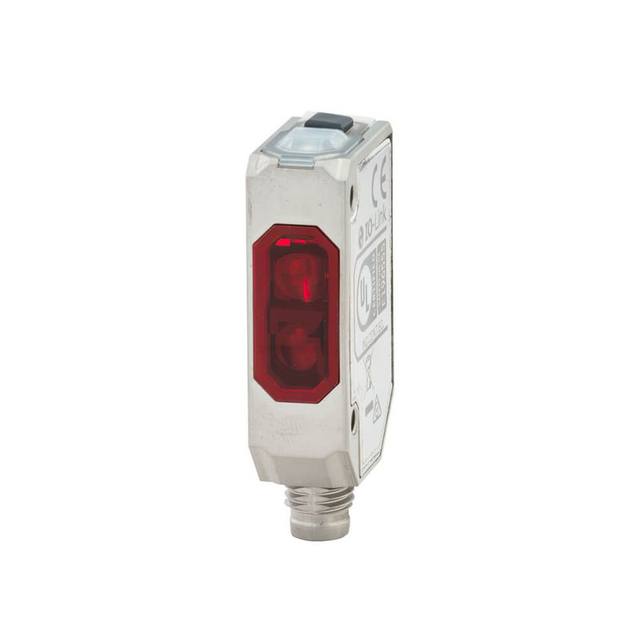
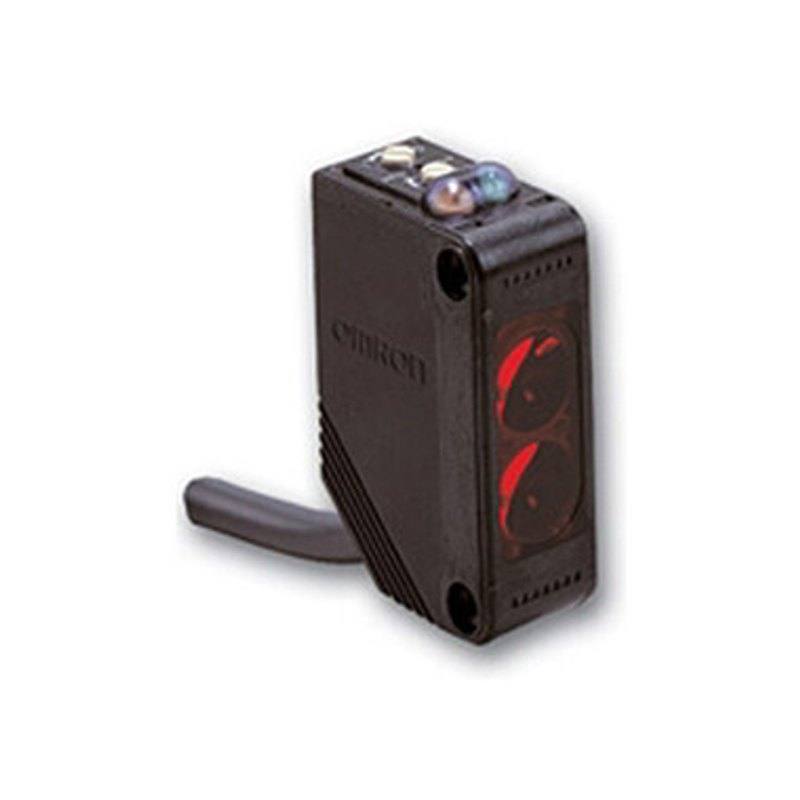
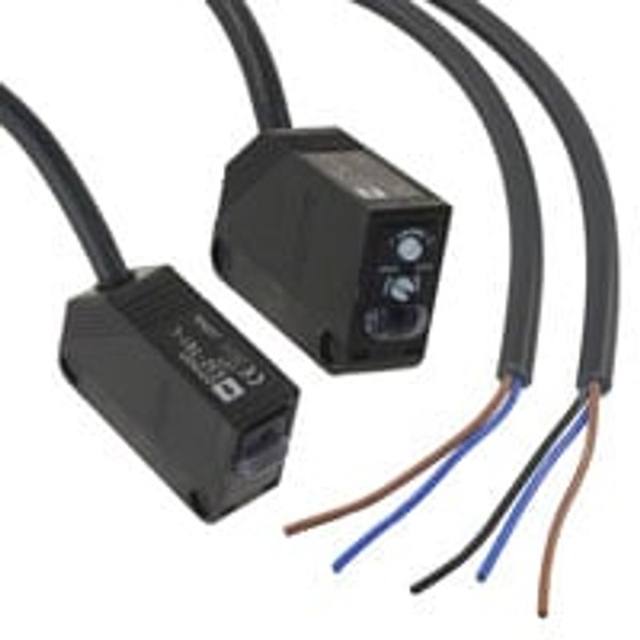
The Omron E3Z-D series are rectangular-housing diffuse-reflective photoelectric sensors with built-in amplifier rated IP67. They use an Infrared LED light source (860 nm) and are available with sensing distances of 5–100 mm (wide-view: D61/D66/D81/D86) or 1 m (D62/D67/D82/D87), powered from 12–24 VDC. Output is open-collector NPN (D6x) or PNP (D8x) rated 100 mA max, with Light-ON/Dark-ON selectable operation and a one-turn sensitivity potentiometer. The sensor housing is PBT plastic measuring 10.8 × 31 × 20 mm; response time is 1 ms max and operating temperature is −25°C to 55°C (−30°C for connector models D66/D86/D67/D87).
Brand
Omron / Sentech
Sensor type
Photoelectric
Sensing method
Diffuse reflective
Light source
Infrared LED (860 nm)
Range / distance
100 mm (D61/D66/D81/D86 wide-view, 5–100 mm); 1000 mm (D62/D67/D82/D87)
Response time
1 ms max (operate or reset)
Output type
NPN open collector (D61/D62/D66/D67); PNP open collector (D81/D82/D86/D87)
The E3Z-D series are compact diffuse-reflective photoelectric sensors built around a 860 nm infrared LED light source housed in a slim 10.8 × 31 × 20 mm PBT body. Two distinct sensing-distance classes cover different installation needs: the wide-view D61/D66/D81/D86 variants detect targets from 5 to 100 mm, making them well-suited to applications where the sensor must be mounted close to the product and consistent detection across a shallow depth band is required. The longer-range D62/D67/D82/D87 variants extend detection to 1,000 mm, which enables stand-off mounting on conveyor frames, chutes, or robotic end-of-arm tooling where physical access to the target is limited. All models share a 1 ms maximum response time (operate or reset), which is more than adequate for triggering a downstream camera, diverter, or reject gate on typical industrial lines.
Output wiring divides the family cleanly into two parallel branches. The D6x models (D61/D62/D66/D67) provide an NPN open-collector output rated at 100 mA max, pairing with sink-input PLCs and NPN-input vision controllers that dominate Japanese and Asian automation lines. The D8x models (D81/D82/D86/D87) provide the equivalent PNP sourcing output for source-input European and North American controllers. Both branches offer Light-ON / Dark-ON mode selection and a one-turn sensitivity potentiometer, so the same mechanical installation can be tuned in the field to accommodate varying target reflectivities — matte cardboard, glossy film wrap, or dark plastic parts — without changing the sensor or wiring. Power supply tolerance is 12–24 VDC ±10% with up to 10% ripple (p-p), which means the sensor operates correctly on most 24 V industrial rail supplies without additional regulation.
The housing is rated IP67 per IEC 60529, sealing against dust ingress and temporary water immersion, and the PBT thermoplastic construction resists the mild cleaning agents used in food, beverage, and pharmaceutical lines. Operating temperature spans −25 °C to 55 °C for pre-wired cable models and extends to −30 °C for the M8-connector D66/D86/D67/D87 variants — the lower limit is relevant for cold-store logistics sortation and freezer tunnel entry/exit detection. Connection is available as a factory-terminated 2 m pre-wired cable (simplest for permanent installations) or a 4-pin M8 quick-disconnect connector, the latter reducing maintenance downtime when sensors must be replaced without rewiring.
Best for
Presence/absence detection of boxes, cartons, or pouches on packaging and palletising lines, where the 5–100 mm wide-view range keeps the sensor clear of product height variations and the 1 ms response time feeds timely trigger signals to downstream labellers or checkweighers.
Parcel and tote detection on logistics sortation conveyors, where the 1,000 mm stand-off range on D62/D67/D82/D87 models allows mounting on gantry frames well above the belt without requiring proximity to the product stream.
End-of-arm tooling presence confirmation on robotic pick-and-place cells — the small 10.8 mm sensor width fits in tight gripper geometries and the 100 mA NPN/PNP output drives most robot I/O cards directly.
Food and beverage container counting or jam detection in wet production environments, where IP67 sealing and PBT construction tolerate continuous moisture and mild detergent wash-downs typical of such lines.
Cold-store entry/exit gate control and freezer conveyor object detection, where the −30 °C lower operating limit of the M8-connector models (D66/D86/D67/D87) ensures reliable operation that pre-wired variants rated only to −25 °C may not match.
Selection notes
Choose D61/D66/D81/D86 (wide-view, 5–100 mm) for close-proximity sensing where target standoff can be controlled; use D62/D67/D82/D87 (up to 1,000 mm) when the sensor must be mounted remotely or the mechanical envelope prevents close installation — the two ranges are not interchangeable in terms of detection margin on small targets.
Match output polarity to the controller: D6x (NPN — D61/D62/D66/D67) for sink-input PLCs common in Japanese/Asian systems; D8x (PNP — D81/D82/D86/D87) for source-input European-standard controllers. Using the wrong polarity will prevent switching even though the sensor is correctly powered and detecting.
Select the M8-connector variants (D66/D86/D67/D87) on lines with regular sensor replacement or where the −30 °C cold-store operating limit is needed; reserve the pre-wired 2 m cable models (D61/D62/D81/D82) for permanent installations where downtime from rewiring is acceptable.
The 860 nm IR emitter is invisible to the naked eye — use the built-in stability indicator LED for commissioning alignment; on highly reflective or transparent targets, adjust the one-turn potentiometer to set the switching threshold rather than relying on a fixed default, as diffuse-reflective performance is target-colour and surface-finish dependent.
At the 1,000 mm range, diffuse-reflective detection is sensitive to background objects within the beam cone; install the sensor so the immediate background behind the detection zone is darker or more distant than the target, or use a background-suppression variant if background rejection is a strict requirement.
Specifications: General
Brand
Omron / Sentech
Sensor type
Photoelectric
Specifications: Performance
Range / distance
100 mm (D61/D66/D81/D86 wide-view, 5–100 mm); 1000 mm (D62/D67/D82/D87)
Response time
1 ms max (operate or reset)
Specifications: Interface
Connection
Pre-wired 2 m cable or M8 4-pin connector
Specifications: Electrical
Supply voltage
12–24 VDC ±10%
Specifications: Environment
IP rating
IP67 (IEC 60529)
Operating temperature
−25°C to 55°C (pre-wired models); −30°C to 55°C (M8 connector D66/D86/D67/D87)
Specifications: Sensing
Sensing method
Diffuse reflective
Light source
Infrared LED (860 nm)
Specifications: Output
Output type
NPN open collector (D61/D62/D66/D67); PNP open collector (D81/D82/D86/D87)
Specifications: Mechanical
Housing material
PBT (polybutylene terephthalate)
Dimensions
W 10.8 mm × H 31 mm × D 20 mm
Weight
~65 g packed (pre-wired), ~20 g (connector)
Applications this camera is commonly selected for. Open one to see the full recommended hardware and approach.
These steps take an Omron Sentech (STC) camera from the box to a stable first image and on to your own application. They apply across the GigE Vision, USB3 Vision and CoaXPress STC families; the interface only changes how you cable and power the camera.
Download and install the Sentech SDK on the host PC. The package provides StViewer, the viewing and configuration software you use to bring the camera up, and StApi, the programming SDK you integrate later. Because the cameras are GenICam/GenTL-compliant, StApi also registers a GenTL producer, so any GenICam-compliant third-party vision software can discover and drive the camera as an alternative front end.
2. Cable, power and connect the camera
Connect according to the interface. GigE Vision: link to a Gigabit NIC (use PoE or the separate power input) and put the camera and host on the same subnet; for USB3 Vision use a USB 3.x port and a certified cable; for CoaXPress (STC) connect to a CoaXPress frame grabber, which also supplies Power-over-Coax. Then open StViewer and let it enumerate the camera. If a GigE camera does not appear, check the IP configuration and firewall, and on USB3 confirm the host bandwidth and driver.
3. Configure exposure, gain and white balance
Open the device in StViewer and start a live stream. Set exposure and gain for a well-exposed, low-noise image: raise exposure first and only add gain when more light or a faster shutter is not an option, keeping exposure short enough to freeze motion on global-shutter models. On colour cameras, run white balance under your actual production lighting. Adjust the lens aperture and focus on a representative target before tuning anything else.
4. Set the trigger and grab a first image
Start in free-run (continuous) acquisition to confirm a clean, stable image. For inline inspection switch to hardware or software triggering: select the trigger source, set the active edge and any delay, and wire the strobe or illumination to the camera's I/O so lighting fires with each exposure. Acquire and save a frame in StViewer; this saved image is your reference for the SDK stage and for downstream inspection.
5. Move to the StApi SDK (or any GenICam software)
Once the image is stable, reproduce the same settings in code. Use StApi to open the device, apply the GenICam features you validated in StViewer (exposure, gain, trigger, pixel format) and grab frames into your application via the bundled C++, C, C#/.NET or Python interfaces; the included samples are the fastest starting point. Prefer a different stack? The same GenICam/GenTL camera works with third-party vision libraries. With a reliable feed, you can route it into a deep-learning inspection such as Rosepetal for AI-based defect detection.
Frequently asked questions
Yes. The wide-view models (D61, D66, D81, D86) detect targets from 5 mm to 100 mm. The long-range models (D62, D67, D82, D87) detect up to 1,000 mm. All models share the same 860 nm infrared LED, but the optical geometry and sensitivity are factory-set differently for each class — you cannot reconfigure a wide-view unit to reach 1,000 mm by adjusting the potentiometer.
Models with a 'D6' designation (D61, D62, D66, D67) provide an NPN open-collector output and are wired to sink-input PLC terminals. Models with a 'D8' designation (D81, D82, D86, D87) provide a PNP open-collector output and are wired to source-input PLC terminals. The output is rated 100 mA maximum in both cases, which directly drives most PLC digital input modules without an interposing relay.
The housing carries an IP67 rating per IEC 60529, meaning it is sealed against dust ingress and withstands temporary immersion in water up to 1 m depth for 30 minutes. The PBT thermoplastic housing also tolerates the mild cleaning agents used in food and beverage lines. It is not rated for high-pressure steam cleaning (IP69K), so if high-pressure hot wash-down is standard on the line, an IP69K-rated alternative should be considered.
The pre-wired cable models (D61, D62, D81, D82) are rated down to −25 °C. The M8-connector models (D66, D67, D86, D87) extend the lower operating limit to −30 °C. For typical ambient-temperature cold stores and freezer tunnels this is sufficient; below −30 °C you would need a sensor rated for extreme-cold environments.
The response time is 1 ms maximum for both the operate (ON) and reset (OFF) transitions. This fast response time is well-suited to detecting individual objects on industrial conveyors and production lines. For applications with very fast-moving or closely-spaced targets, verify the required detection window against this 1 ms figure using your actual line speed and minimum object or gap size.