
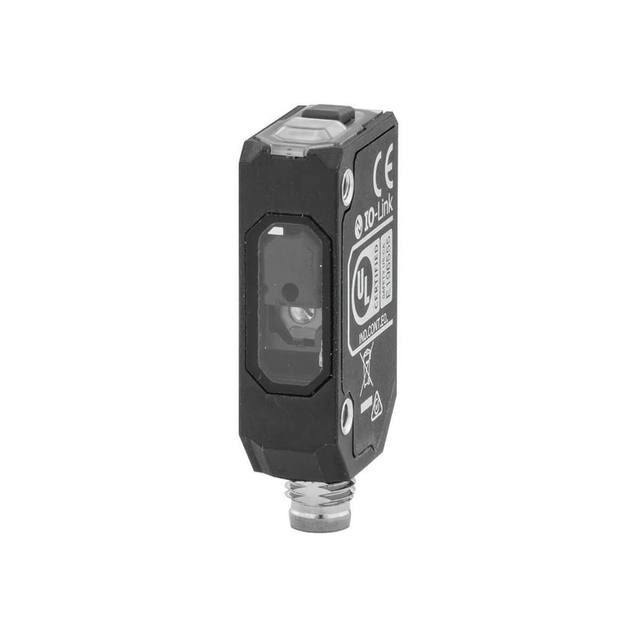
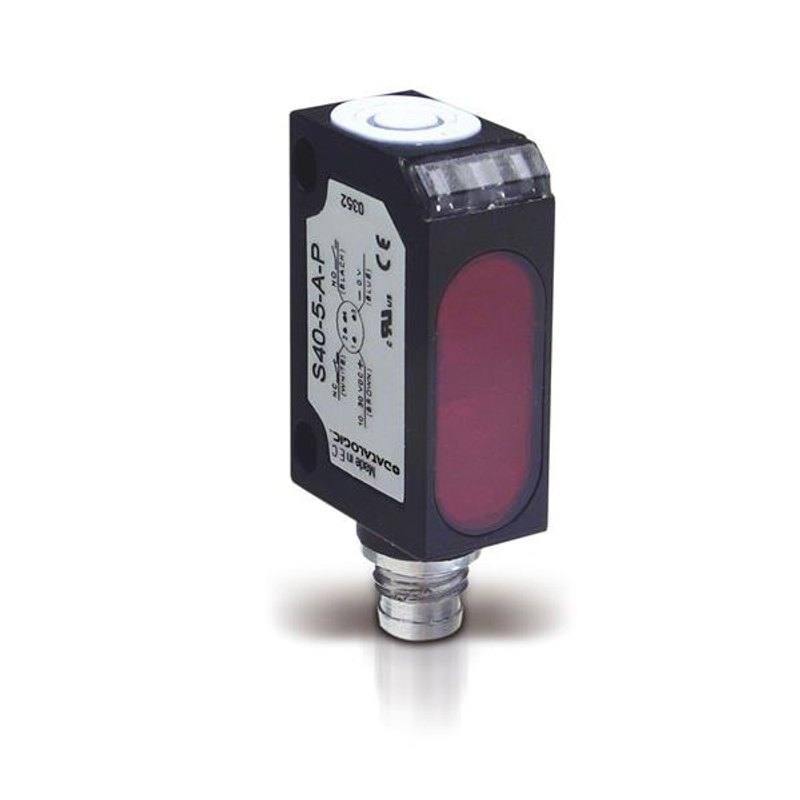
- Recommended by AIS Vision
Datalogic / Datasensing S40 Series Miniature Photoelectric Sensors
S40
The S40 series is a family of miniature ABS-housed photoelectric sensors (IP67) offered as an ordering family (S40-...) covering polarised retroreflex (to 2.5 m / laser to 6 m on R2), diffuse proximity (0.5...30 cm), background suppression (15...100 mm) and through-beam models, all with visible red 660 nm LED emission, plus 650 nm red-laser (Class II) variants for proximity, background suppression and retroreflex offering down to 0.2 mm resolution. Detection range and sensitivity are set by an EASYtouch push-button Teach-in or remotely by cable. Outputs are selectable NPN or PNP (100 mA, short-circuit protected) with dark/light programmable operating mode; response time is 0.5 ms (125 us for laser B03/C03) and switching frequency up to 1 kHz (4 kHz laser). Sensors run on 10...30 Vdc with M8 4-pole connector or 2 m cable and operate from -20 to +60 C.
- Brand
- Datalogic / Datasensing
- Sensor type
- Photoelectric
- Sensing method
- Retroreflective (polarised), diffuse proximity, background suppression, through-beam
- Light source
- Red LED 660 nm / red laser 650 nm (Class II)
- Range / distance
- Up to 6 m (laser polarised retroreflex on R2); 2.5 m LED retroreflex; 0.5...30 cm diffuse; 15...100 mm background suppression
- Response time
- 0.5 ms (125 us for laser B03/C03 versions)
- Switching frequency
- 1 kHz max (4 kHz for laser B03/C03 versions)
- Output type
- NPN or PNP, 100 mA max, short-circuit protected
- Resolution
- 0.2 mm on focus point (laser proximity / background suppression); 1 mm laser retroreflex
- Supply voltage
- 10...30 Vdc, reverse polarity protection
- Connection
- 4-pole M8 connector or 2 m Ø3.5 mm cable
- Housing material
- ABS housing, PMMA lens
Technical overview
The S40 is not a single sensor but a miniature cubic photoelectric family from Datalogic, packed into a 32 x 20 x 12 mm ABS housing with a PMMA lens and rated IP67. Because it is offered as an ordering family, the same body covers four distinct optical principles: polarised retroreflective, diffuse proximity, background suppression, and through-beam. That choice is the most important design decision you make. Polarised retroreflex (with a reflector) reaches 2.5 m on the red 660 nm LED versions and up to 6 m on the 650 nm Class II laser R2 variant, and is the workhorse for detecting any opaque object crossing a beam. Diffuse proximity (0.5 to 30 cm) sees the target directly without a reflector but is sensitive to surface colour and finish, while background suppression (15 to 100 mm) ignores whatever sits behind the target -- the right pick when a part must be detected against a busy or reflective backstop. Through-beam, with separate emitter and receiver, gives the longest and most reliable detection of opaque objects and is the most forgiving of dirt and surface variation.
| Brand | Datalogic / Datasensing |
|---|---|
| Sensor type | Photoelectric |
| Range / distance | Up to 6 m (laser polarised retroreflex on R2); 2.5 m LED retroreflex; 0.5...30 cm diffuse; 15...100 mm background suppression |
|---|---|
| Response time | 0.5 ms (125 us for laser B03/C03 versions) |
| Switching frequency | 1 kHz max (4 kHz for laser B03/C03 versions) |
| Resolution | 0.2 mm on focus point (laser proximity / background suppression); 1 mm laser retroreflex |
| Connection | 4-pole M8 connector or 2 m Ø3.5 mm cable |
|---|
| Supply voltage | 10...30 Vdc, reverse polarity protection |
|---|
| Operating temperature | -20 to +60 C (storage -20 to +80 C) |
|---|---|
| IP rating | IP67 |
| Sensing method | Retroreflective (polarised), diffuse proximity, background suppression, through-beam |
|---|---|
| Light source | Red LED 660 nm / red laser 650 nm (Class II) |
| Output type | NPN or PNP, 100 mA max, short-circuit protected |
|---|
| Housing material | ABS housing, PMMA lens |
|---|---|
| Dimensions | 32 x 20 x 12 mm (miniature cubic) |
| Weight | 10 g max (connector version); 40 g max (cable version) |
Frequently asked questions
Related technical guides
Guide
How to choose an industrial sensor for vision triggering and part detection
A practical guide to selecting discrete sensors that trigger cameras, index parts and gate inspection on a vision station. Covers sensing principle, range, target, PNP/NPN/IO-Link outputs, response time and IP rating, plus wiring the trigger to the camera.
Guide
Photoelectric sensor types explained: through-beam, retroreflective, diffuse and background suppression
A practical guide to the core photoelectric sensing principles, through-beam, retroreflective, diffuse and background suppression, covering range, reliability, target and surface dependence, light source choice, output options and how to pick the right one for your application.
Guide
Laser displacement and distance sensors: triangulation, confocal and time-of-flight
A practical guide to laser displacement and distance sensors: how triangulation, confocal and time-of-flight measure distance, height and profile, how resolution trades against range and target reflectivity, and when a dedicated measurement sensor beats a vision system.
Related products
- Recommended by AIS Vision
On request Omron / SentechOmron / Sentech E3Z-LL Series (Laser BGS Distance-Settable Photoelectric Sensor)E3Z-LL61
- Recommended by AIS Vision
On request
AIS Vision · Integration
We validate camera + lens + lighting
AIS Vision defines and tests the optimal combination of camera, optics and lighting for your application before you buy.