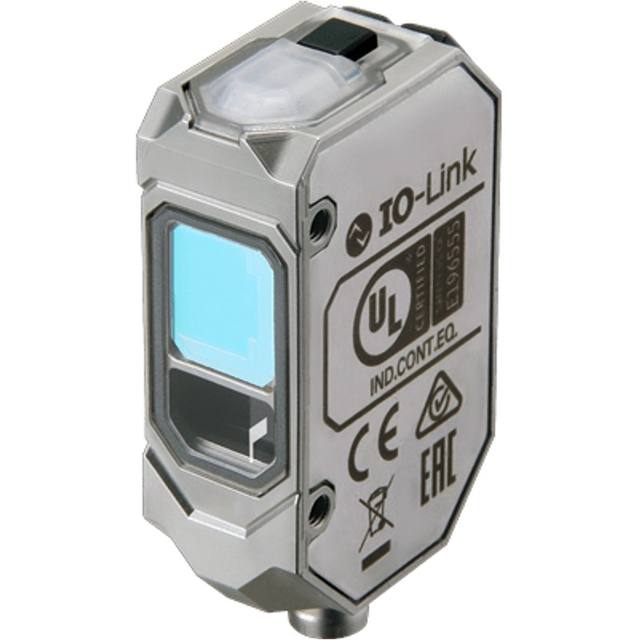
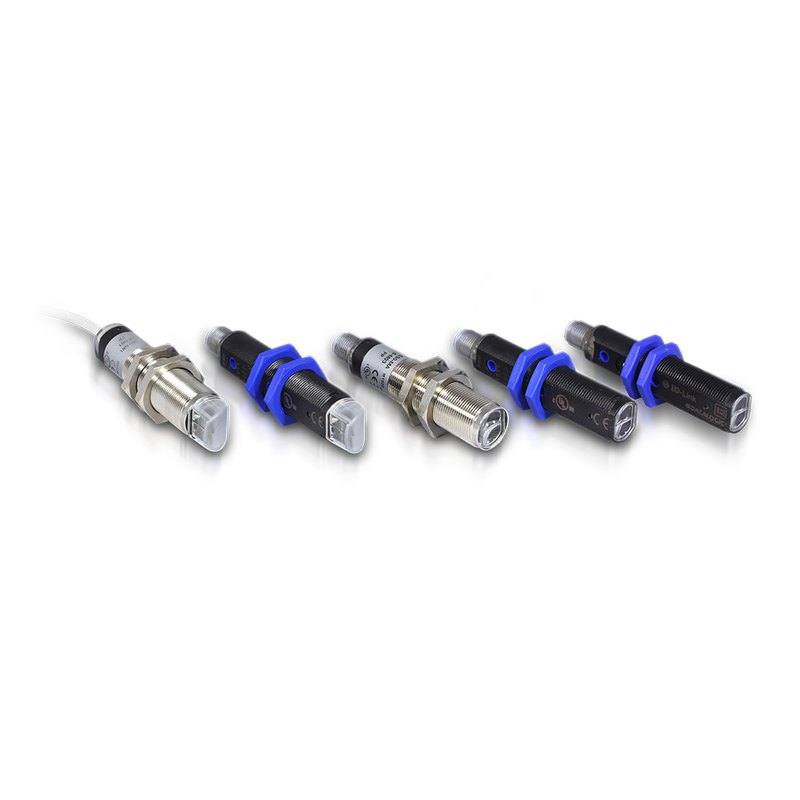
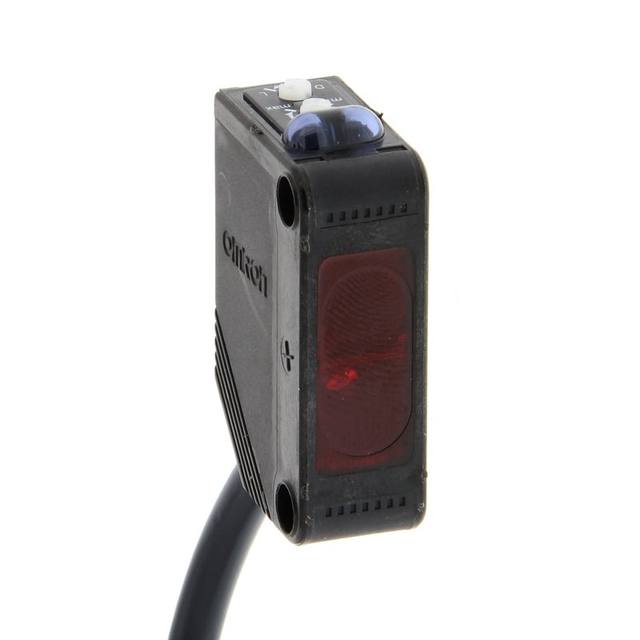
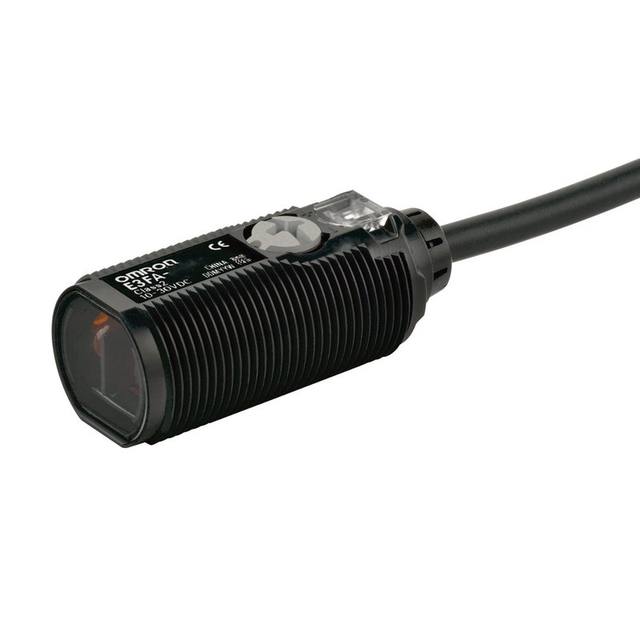
The S5N-PA-5-C01-PK is an M18 tubular (Ø18 x 67 mm) diffuse-proximity photoelectric sensor with axial optics and infrared LED emission. It provides a 400 mm nominal sensing distance on a white target (Kodak 90%, 100x100 mm) with a 500 us response time and trimmer sensitivity adjustment. Output is PNP light/dark selectable (4-wire) with IO-Link V1.1 connectivity, 10-30 VDC supply, IP67 protection and an M12 connection in a PBT/PMMA plastic body.
Brand
Datasensing (Datalogic)
Sensor type
Photoelectric (diffuse proximity)
Range / distance
400 mm nominal (white target Kodak 90%, 100x100 mm)
The S5N-PA-5-C01-PK is a diffuse-proximity photoelectric sensor, meaning emitter and receiver share a single M18 tubular housing (Ø18 x 67 mm) and the device detects an object by the infrared light it bounces back rather than by an interrupted beam to a separate reflector or receiver. Because detection depends on reflected energy, the rated range is target-dependent: the 400 mm nominal figure is referenced to a high-reflectance white card (Kodak 90%, 100 x 100 mm), so darker, smaller, glossy or angled surfaces will be seen at proportionally shorter distances. The trimmer sensitivity adjustment exists precisely for this reason, letting you tune the switching threshold to the actual product and background so the sensor triggers reliably on the part you care about while ignoring conveyor surfaces or trays behind it. The axial optics emit straight out the front face along the tube axis, which keeps the optical alignment simple in confined mounting positions where the sensor is aimed down at a conveyor or across a lane.
As a presence and edge-detection device the sensor outputs a PNP switched signal on a 4-wire connection with light/dark operate selectable, so you can configure it to switch ON when a target is present (light-operate) or ON when the path is clear (dark-operate) depending on whether you are gating product-present or gap-present. With a 500 us (0.5 ms) response time it resolves edges on a moving line fast enough to serve as a hardware trigger for a camera or PLC: the PNP transition marks the leading edge of each part, which a vision system latches to grab one image per object. The same output can drive a counter, a reject gate or a flow-control input. The IO-Link V1.1 interface means the sensor doubles as a smart device on a point-to-point digital link, allowing remote parameter setting, threshold readback and diagnostics from the controller instead of only a binary switch line, which is useful for recipe changeovers and for monitoring contamination drift on the optics.
Electrically and environmentally the device is built for the line floor: a wide 10-30 VDC supply covers standard 24 VDC machine power, the M12 connector gives a clean disconnect for service, and IP67 sealing lets it tolerate washdown splash and dust in packaging and food-adjacent areas. The PBT/PMMA plastic body is lighter and more chemically forgiving than metal in many wet environments, while the rated operating range of -25 to +55 degC (without freeze, so no ice formation) sets the cold and warm limits for cold-store anterooms and warm packaging halls. Note this is a sensing and triggering component, not an imaging device: it provides the timing or presence signal that a separate camera, lens and lighting use to actually inspect or read the part.
Best for
Detecting individual cartons, trays or pouches arriving on a packaging line and generating a one-image-per-part trigger to a vision inspection camera, using the 500 us response to catch each leading edge cleanly.
Item-present and gap detection on logistics sortation conveyors, where each parcel passing the M18 head fires the PNP output to index a divert gate or singulation control.
Counting and flow control of products up to roughly 400 mm away on white or light packaging, with the trimmer set so the sensor sees the product but ignores the belt or background.
Food and beverage packaging zones that see splash and frequent cleaning, where the IP67 plastic housing and M12 disconnect survive the washdown environment while signalling bottle or container presence.
IO-Link-enabled stations where the line controller needs to push sensitivity settings for fast format changeovers and read back diagnostics, rather than relying on a fixed binary switch.
Selection notes
Confirm your real target against the 400 mm rating: that distance assumes a 90% white card, so dark, shiny, transparent or small parts will be detected closer and may need the sensitivity trimmer turned up or the head mounted nearer the product.
As a diffuse sensor it has no separate receiver or reflector to align, but it can be confused by reflective backgrounds close behind the target; if background discrimination is critical, verify the trimmer can separate part from background or consider a different sensing type instead.
Plan the trigger wiring as PNP sourcing into a 24 VDC input: choose light-operate or dark-operate to match whether you trigger on product-present or on the gap, and route the M12 output to your camera or PLC trigger input.
Match the electrical interface to the rest of the cell: standard 10-30 VDC supply and M12 make it drop-in for most machines, and if you have an IO-Link master you gain remote configuration and diagnostics; without a master it still works as a plain PNP switch.
Check the environment limits before designing it in: IP67 and the PBT/PMMA body suit washdown packaging, but -25 to +55 degC (no freezing) rules out frozen or ice-forming surfaces and very high-temperature zones, where a metal-bodied or differently rated sensor would be the alternative.
Specifications: General
Brand
Datasensing (Datalogic)
Sensor type
Photoelectric (diffuse proximity)
Specifications: Performance
Range / distance
400 mm nominal (white target Kodak 90%, 100x100 mm)
Response time
500 us (0.5 ms) response time
Specifications: Interface
Communication
IO-Link V1.1
Connection
M12 connector
Specifications: Electrical
Supply voltage
10-30 VDC
Specifications: Environment
IP rating
IP67
Operating temperature
-25 to +55 (without freeze) degC
Specifications: Mechanical
Housing material
Plastic PBT / PMMA
Dimensions
Ø18 x 67 (M18 tubular) mm
Specifications: Sensing
Sensing method
Diffuse
Light source
Infrared LED
Specifications: Output
Output type
PNP
Applications this camera is commonly selected for. Open one to see the full recommended hardware and approach.
1. Install the IMPACT Software Suite and connect the camera
Install the IMPACT Software Suite on your PC, which provides both the configuration/viewer tools and the SDK. For a GigE Vision model (E100, M or U series), connect it to a dedicated NIC and, for USB3 models, use a certified USB3 cable and port. Power the camera and confirm it enumerates.
2. Bring the camera online and verify the link
For GigE Vision, put the camera and the host NIC on the same subnet (a static IP on the camera matching the NIC range is the most reliable starting point); for USB3, confirm the device is recognized. Open the IMPACT viewer/device tool, discover the camera, and verify a stable connection before streaming. Enabling jumbo frames on the NIC helps GigE throughput.
3. Set exposure, gain and trigger, then grab a first image
In the IMPACT tools, start a live stream and adjust exposure and gain until the image is well-lit without saturation; set white balance on color models. Begin in free-run (continuous) mode to confirm imaging, then switch to hardware or software trigger as your application requires. Capture and save a reference image once the scene looks correct.
4. Build a vision tool or move to the SDK/API
Use the IMPACT point-and-click vision tools to assemble an inspection, or use the IMPACT SDK to access the camera and results programmatically and feed them into your HMI/PLC application. As these are GenICam/GenTL-compliant devices, you can alternatively drive them from any GenICam-compliant third-party vision library if your pipeline standardizes on one.
5. Route the stable feed to deep-learning inspection (optional)
Once you have a stable, repeatable image, the feed can be sent to a deep-learning inspection platform such as Rosepetal for defect detection or classification tasks that go beyond rule-based tooling. Keep lighting, optics and trigger timing fixed so the images reaching the model stay consistent.
Frequently asked questions
It has a 400 mm nominal sensing distance, but that figure is measured against a white reference target (Kodak 90%, 100 x 100 mm). Because it is a diffuse sensor that works on reflected infrared light, darker, smaller or glossy targets will be detected at shorter distances, which is why it includes a sensitivity trimmer to tune the threshold to your actual product.
Yes. Its PNP output switches in 500 us (0.5 ms), so the leading edge of each passing part produces a fast, clean transition you can wire into a camera or PLC trigger input to capture one image per object. Light/dark operate selection lets you choose whether the output asserts on product-present or on a clear path.
It provides a PNP output on a 4-wire connection with light/dark operate selectable, terminated in an M12 connector and powered from 10-30 VDC. It also supports IO-Link V1.1, so on an IO-Link master you can set parameters such as sensitivity remotely and read diagnostics in addition to the standard switching signal.
It is rated IP67 with a PBT/PMMA plastic body, which handles splash and routine cleaning in packaging and food-beverage zones. Its operating range is -25 to +55 degC without freezing, so it is not intended for ice-forming or frozen-surface conditions.
This is a diffuse-proximity sensor: the emitter and receiver are in one M18 housing and it detects the infrared light reflected back from the object itself, so no separate reflector or opposing receiver is needed. That makes installation simpler, but detection depends on target reflectivity and a close reflective background can interfere, which is where the trimmer adjustment or a different sensing type would be considered.