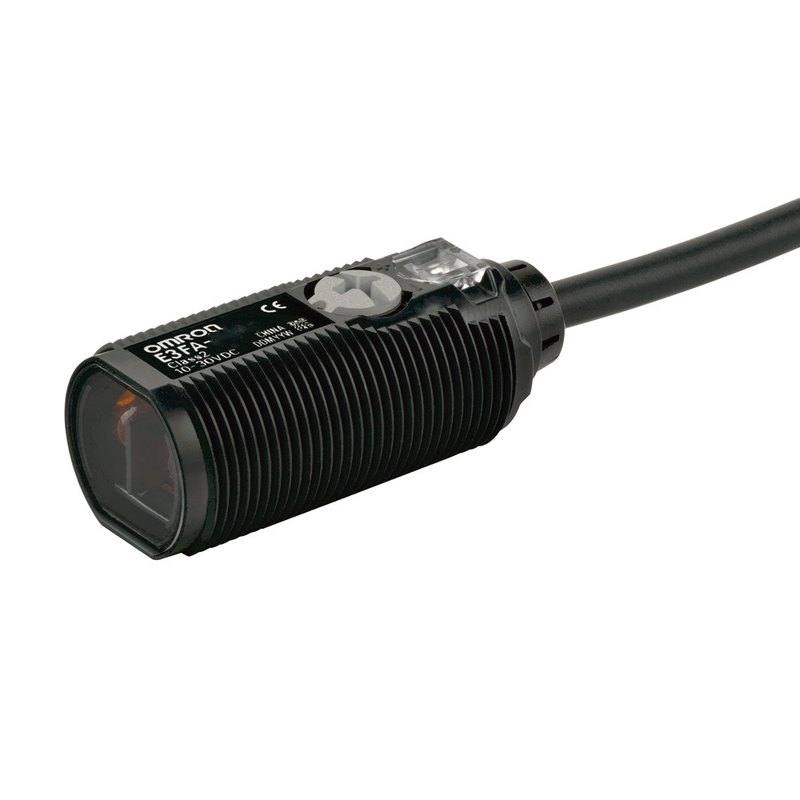
The E3FA-DP12 2M is a cylindrical M18 (ABS housing) diffuse-reflective photoelectric sensor with a 300 mm sensing distance and a polarity-free red-light LED source. It provides a PNP output with Light-ON/Dark-ON operation, a 0.5 ms response time, and runs on a 10-30 VDC supply with manual sensitivity adjustment. The housing is rated IP67/IP69K and is supplied pre-wired with a 2 m cable.
The Omron E3FA-DP12 is a diffuse-reflective photoelectric sensor, meaning the emitter and receiver share a single M18 cylindrical body and the sensor detects an object by the light it bounces straight back. There is no separate reflector or opposing receiver to mount, so installation is one-sided: you aim the face at the zone where the target will pass and the sensor triggers when enough of its own red LED light returns from the object's surface. The quoted 300 mm sensing distance is therefore a maximum that depends heavily on the target. A matte, light-coloured or large surface returns more light and reads near the top of the range, while dark, glossy, transparent or angled surfaces return less and shorten the usable distance. The red LED source is a visible light type, which helps during setup because you can position it on the part and use the manual sensitivity adjustment to tune the switching threshold so that the background is ignored and only the part is seen.
Electrically the sensor is a PNP switching device running on a 10-30 VDC supply, with selectable Light-ON / Dark-ON operation so the output can be configured to activate either when the target is present or when it is absent. In a vision cell this makes it a clean part-present trigger: the PNP output sources current to a camera's trigger input or to a PLC/controller input that in turn fires the camera and lighting, rather than the sensor being an imaging device itself. The 0.5 ms response time is the limiting factor for how fast parts can pass and still be caught, so it is well suited to gating image acquisition on a moving conveyor where precise, repeatable trigger timing matters. Because the output is a simple discrete PNP signal (not IO-Link or analog), it reports presence/absence only, not distance or measurement.
The housing is ABS rated IP67 and IP69K, so it tolerates dust, immersion-level washdown and the high-pressure, high-temperature cleaning typical of food and beverage lines, which matches its washdown application targets. It ships pre-wired with a fixed 2 m cable rather than a connector, so there is no field plug to specify, but the run length is fixed at install and the cable must be routed and protected accordingly. Mechanically the M18 threaded cylindrical barrel mounts through a bracket or panel and allows fine axial adjustment of working distance, while the diffuse single-body design keeps the footprint to one side of the conveyor.
Best for
Part-present detection and image-acquisition triggering on packaging and inspection lines, where the PNP output gates a camera as each package or product reaches the inspection window
Conveyor item counting and gap detection in logistics sortation, using the 0.5 ms response time to resolve closely spaced parcels moving at speed
Washdown food and beverage stations where the IP67/IP69K ABS housing survives high-pressure, high-temperature cleaning while detecting containers, caps or trays
Single-sided presence sensing in tight cells where a through-beam pair or reflector cannot be mounted, since the diffuse design needs access from one side only
Setup on changing product surfaces, where the visible red LED helps an installer position the sensor and dial the manual sensitivity to ignore the conveyor background
Selection notes
Confirm your target surface returns enough light at the required distance: the 300 mm range is a maximum for cooperative matte/light targets, and dark, glossy, transparent or steeply angled parts will detect at noticeably shorter distances, so test against the actual product.
As a diffuse sensor it has no fixed cut-off plane, so a close or reflective background can also return light; use the manual sensitivity adjustment (and Light-ON/Dark-ON selection) to set the threshold between part and background, or choose a retroreflective/through-beam type if background suppression is critical.
Wire it as a PNP (sourcing) trigger: verify your camera or controller accepts a PNP discrete input on a 10-30 VDC rail before designing it in; it does not provide IO-Link or analog output, so it signals presence only, not measurement or distance.
The 2 m fixed cable and lack of a connector mean cable length and routing are decided at install; plan the run, strain relief and any junction accordingly, as there is no field-replaceable plug.
Plan the mechanical install around the M18 threaded cylindrical barrel and one-sided mounting, and treat the 0.5 ms response time as the ceiling for line speed when timing the trigger relative to the camera and lighting.
Specifications: General
Brand
Omron / Sentech
Sensor type
Photoelectric (diffuse-reflective)
Specifications: Performance
Range / distance
Up to 300 mm
Response time
0.5 ms
Specifications: Interface
Connection
Cable
Specifications: Electrical
Supply voltage
10-30 VDC
Specifications: Environment
IP rating
IP67 / IP69K
Specifications: Mechanical
Housing material
ABS
Specifications: Sensing
Sensing method
Diffuse
Specifications: Output
Output type
PNP
Applications this camera is commonly selected for. Open one to see the full recommended hardware and approach.
These steps take an Omron Sentech (STC) camera from the box to a stable first image and on to your own application. They apply across the GigE Vision, USB3 Vision and CoaXPress STC families; the interface only changes how you cable and power the camera.
Download and install the Sentech SDK on the host PC. The package provides StViewer, the viewing and configuration software you use to bring the camera up, and StApi, the programming SDK you integrate later. Because the cameras are GenICam/GenTL-compliant, StApi also registers a GenTL producer, so any GenICam-compliant third-party vision software can discover and drive the camera as an alternative front end.
2. Cable, power and connect the camera
Connect according to the interface. GigE Vision: link to a Gigabit NIC (use PoE or the separate power input) and put the camera and host on the same subnet; for USB3 Vision use a USB 3.x port and a certified cable; for CoaXPress (STC) connect to a CoaXPress frame grabber, which also supplies Power-over-Coax. Then open StViewer and let it enumerate the camera. If a GigE camera does not appear, check the IP configuration and firewall, and on USB3 confirm the host bandwidth and driver.
3. Configure exposure, gain and white balance
Open the device in StViewer and start a live stream. Set exposure and gain for a well-exposed, low-noise image: raise exposure first and only add gain when more light or a faster shutter is not an option, keeping exposure short enough to freeze motion on global-shutter models. On colour cameras, run white balance under your actual production lighting. Adjust the lens aperture and focus on a representative target before tuning anything else.
4. Set the trigger and grab a first image
Start in free-run (continuous) acquisition to confirm a clean, stable image. For inline inspection switch to hardware or software triggering: select the trigger source, set the active edge and any delay, and wire the strobe or illumination to the camera's I/O so lighting fires with each exposure. Acquire and save a frame in StViewer; this saved image is your reference for the SDK stage and for downstream inspection.
5. Move to the StApi SDK (or any GenICam software)
Once the image is stable, reproduce the same settings in code. Use StApi to open the device, apply the GenICam features you validated in StViewer (exposure, gain, trigger, pixel format) and grab frames into your application via the bundled C++, C, C#/.NET or Python interfaces; the included samples are the fastest starting point. Prefer a different stack? The same GenICam/GenTL camera works with third-party vision libraries. With a reliable feed, you can route it into a deep-learning inspection such as Rosepetal for AI-based defect detection.
Frequently asked questions
It detects up to 300 mm. Because it is a diffuse-reflective sensor it relies on light bounced back from the object itself, so that figure is a maximum for cooperative targets; dark, glossy, transparent or angled surfaces return less light and detect at a shorter distance, so testing against your actual part is recommended.
It provides a PNP discrete output with selectable Light-ON/Dark-ON operation, powered from a 10-30 VDC supply. This wires directly as a part-present trigger into a camera's PNP-compatible trigger input or a PLC/controller input that fires the camera and lighting. It reports presence/absence only, not distance or analog measurement.
The response time is 0.5 ms, which sets the upper limit on how quickly parts can pass and still be detected reliably. For triggering image capture on a moving conveyor this gives precise, repeatable timing at high throughput.
Yes. The ABS housing is rated IP67 and IP69K, so it withstands dust, immersion and the high-pressure, high-temperature cleaning used on food and beverage lines.
No. It is a single-body diffuse-reflective sensor, so the emitter and receiver are in one M18 housing and it detects light bounced back from the object directly. You mount it from one side only, with no separate reflector or opposing receiver to align.