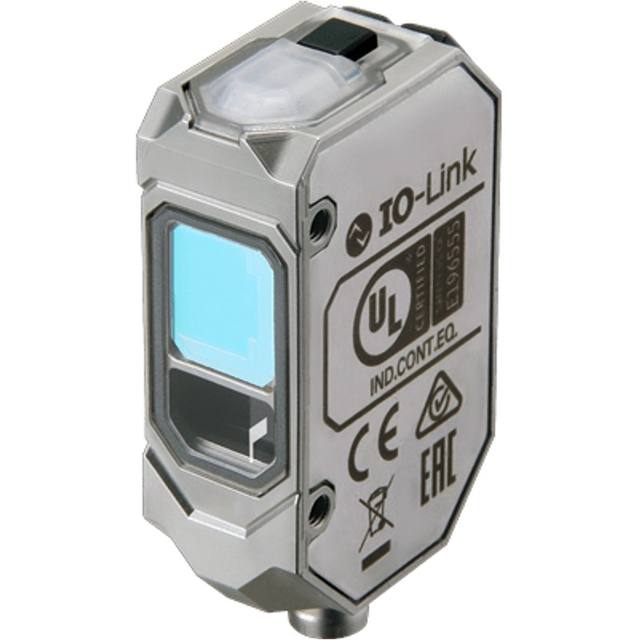
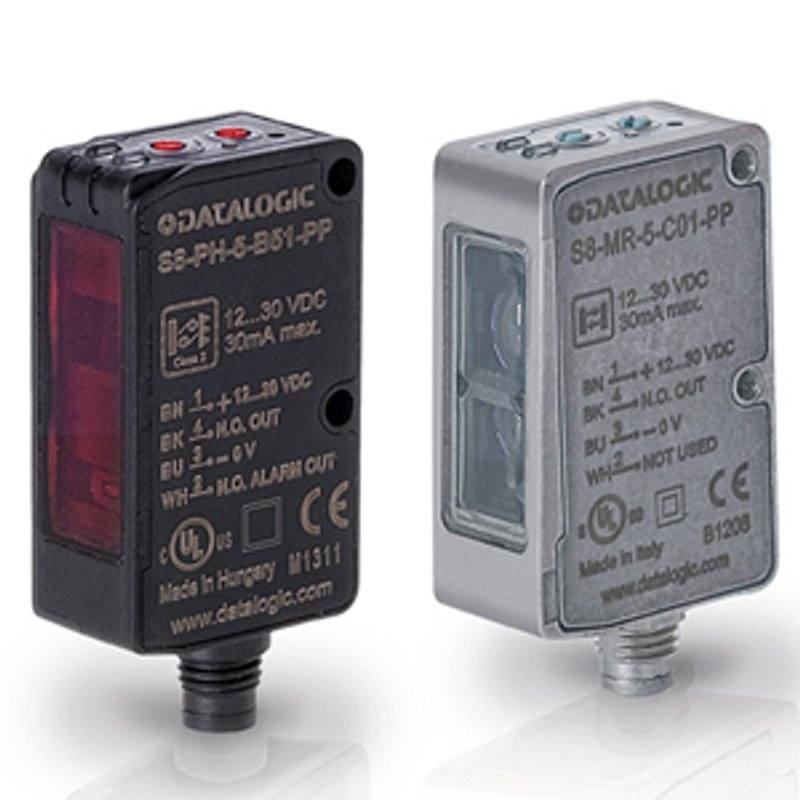
The S8-PH-5-B51-PP is a polarized retroreflective photoelectric sensor in a compact 14x43x25 mm ABS cubic housing with PMMA optics. It uses a red laser source with an extremely focused spot (under 1 mm) and a nominal sensing range of 12 m. Output is PNP light/dark selectable with IO-Link COM2 capability, 0.5 ms response time, 12-30 VDC supply, IP67 protection and an M8 4-pin connector.
The S8-PH-5-B51-PP is a polarized retroreflective photoelectric sensor, which means the emitter and receiver share a single housing and the beam is bounced back from a dedicated reflector mounted opposite the sensor. The 'polarized' qualifier matters in practice: the device uses crossed polarizing filters so that the rotated, depolarized light returning from a proper corner-cube reflector is accepted, while specular glare bounced straight off shiny targets (shrink-wrap, foil lidding, glossy cartons, mirrored cans) is rejected. That makes detection a clean make/break event the moment an object interrupts the beam path between sensor and reflector, rather than a reflectivity-dependent reading off the target itself, so the same threshold works across light and dark surfaces. The light source here is a red laser diode producing an extremely focused spot specified at under 1 mm, with a nominal sensing range of 12 m to the reflector. The tight laser spot is the headline feature: it lets you detect small parts, thin edges, gaps and narrow features at long range that a wider LED-spot retroreflective sensor would average out or miss.
Electrically the sensor switches a PNP output that is light/dark selectable, so you can configure it to turn on either when the beam is present (light-operate) or when it is interrupted (dark-operate) to suit your logic. The 0.5 ms response time corresponds to a switching frequency high enough to resolve fast-moving products on a conveyor or to act as a precise position/presence trigger, and combined with the small spot it gives sharp, repeatable edge timing. It also supports IO-Link COM2, which means beyond the simple discrete switch it can be operated as a smart device on an IO-Link master for remote parameter setting (threshold, output mode), diagnostics and process data, while still falling back to the standard PNP switching output (SIO mode) when no master is present. Supply is a wide 12-30 VDC and the electrical interface is an M8 connector, giving power, ground and signal lines on a compact pluggable cable.
Physically it is a small cubic device in a 14 x 43 x 25 mm ABS housing with PMMA optical windows, rated IP67 and specified for -25 to +55 degC operation, so it tolerates washdown-adjacent and dusty packaging or logistics environments without special enclosures. In a machine-vision context this part is not an imager; it is a presence/position sensing element. Its most common role alongside a camera is as the hardware trigger: the focused laser beam defines an exact line on the conveyor, and the instant a product breaks (or re-establishes) the beam the PNP edge fires the camera and lighting strobe so every part is captured at the same position. It can equally serve as upstream presence detection, gating, counting or jam detection feeding a PLC, with the camera inspection downstream.
Best for
Triggering a vision inspection or print-verification station on a packaging line: the sub-1 mm laser spot defines a precise capture line so each carton, pouch or bottle is photographed at the identical position as it breaks the beam to the reflector.
Presence and gap detection on logistics sortation conveyors, where the 12 m range lets a single sensor span a wide conveyor or chute to a reflector and the polarized optics ignore glare from glossy parcels and poly-bagged items.
Detecting clear, shiny or wrapped products such as shrink-film bundles, foil-lidded trays and reflective cans in food and beverage packaging, where the crossed-polarizer design rejects specular reflections that would fool a standard retroreflective sensor.
Small-part and edge detection at long working distances, for example counting tightly spaced items, sensing label leading edges or confirming flap position, using the focused laser spot to resolve features a wide beam would miss.
Smart, remotely configurable line sensing via IO-Link COM2, where threshold and light/dark output mode are set and monitored from the controller for fast changeover and predictive diagnostics across packaging and logistics cells.
Selection notes
A matching retroreflector is required: this is a retroreflective sensor, so plan for a corner-cube polarizing reflector mounted opposite the sensor within the 12 m range and aligned to the laser spot. Without a proper polarization-preserving reflector the crossed-filter detection will not work correctly.
Use the sub-1 mm laser spot to your advantage for small parts and precise edges, but mount rigidly and align carefully: a focused long-range beam is less forgiving of vibration and reflector misalignment than a wide LED spot, so allow for stable brackets over the full standoff distance.
When pairing with a camera, wire the PNP output as the trigger and confirm your camera or controller accepts a PNP (sourcing) input at 12-30 VDC; set light/dark operate so the edge fires at the moment you want capture (object enters vs. clears the beam). The 0.5 ms response keeps trigger jitter low even at conveyor speed.
Decide between discrete and IO-Link operation up front. As a plain trigger the M8 PNP output is plug-and-play; if you want remote setup, threshold storage and diagnostics, budget an IO-Link COM2 master port. Both can coexist since the device falls back to SIO switching when no master is connected.
Confirm the environment fits the ratings: IP67 and -25 to +55 degC with an ABS/PMMA housing suit typical packaging and logistics areas, but for aggressive chemical washdown, high heat or where a through-target distance rather than a beam-break is needed, consider a sealed metal-housing or a laser displacement/distance sensor instead.
Specifications: General
Brand
Datasensing (Datalogic)
Sensor type
Photoelectric (polarized retroreflective)
Specifications: Performance
Range / distance
Up to 12 m (12000 mm) nominal sensing range
Response time
0.5 ms response time
Specifications: Interface
Communication
IO-Link COM2
Connection
M8 connector
Specifications: Electrical
Supply voltage
12-30 VDC
Specifications: Environment
IP rating
IP67
Operating temperature
-25 to +55 degC
Specifications: Mechanical
Housing material
ABS housing, PMMA optics
Dimensions
14 x 43 x 25 mm
Specifications: Sensing
Sensing method
Retroreflective
Light source
Red laser diode
Specifications: Output
Output type
PNP
Applications this camera is commonly selected for. Open one to see the full recommended hardware and approach.
1. Install the IMPACT Software Suite and connect the camera
Install the IMPACT Software Suite on your PC, which provides both the configuration/viewer tools and the SDK. For a GigE Vision model (E100, M or U series), connect it to a dedicated NIC and, for USB3 models, use a certified USB3 cable and port. Power the camera and confirm it enumerates.
2. Bring the camera online and verify the link
For GigE Vision, put the camera and the host NIC on the same subnet (a static IP on the camera matching the NIC range is the most reliable starting point); for USB3, confirm the device is recognized. Open the IMPACT viewer/device tool, discover the camera, and verify a stable connection before streaming. Enabling jumbo frames on the NIC helps GigE throughput.
3. Set exposure, gain and trigger, then grab a first image
In the IMPACT tools, start a live stream and adjust exposure and gain until the image is well-lit without saturation; set white balance on color models. Begin in free-run (continuous) mode to confirm imaging, then switch to hardware or software trigger as your application requires. Capture and save a reference image once the scene looks correct.
4. Build a vision tool or move to the SDK/API
Use the IMPACT point-and-click vision tools to assemble an inspection, or use the IMPACT SDK to access the camera and results programmatically and feed them into your HMI/PLC application. As these are GenICam/GenTL-compliant devices, you can alternatively drive them from any GenICam-compliant third-party vision library if your pipeline standardizes on one.
5. Route the stable feed to deep-learning inspection (optional)
Once you have a stable, repeatable image, the feed can be sent to a deep-learning inspection platform such as Rosepetal for defect detection or classification tasks that go beyond rule-based tooling. Keep lighting, optics and trigger timing fixed so the images reaching the model stay consistent.
Frequently asked questions
Yes. It is a polarized retroreflective sensor, so it works against a dedicated retroreflector mounted opposite it and detects when an object breaks the beam between the two. The nominal sensing range to the reflector is up to 12 m (12000 mm).
That is exactly what the polarized design targets. Crossed polarizing filters accept the depolarized light returning from the corner-cube reflector while rejecting direct specular glare off glossy targets such as shrink-wrap, foil and reflective cans, so detection stays a clean beam-break event regardless of target shininess.
It provides a PNP switching output that is light/dark selectable, available on the M8 connector, plus IO-Link COM2. With a 0.5 ms response time the PNP edge makes a precise, low-jitter hardware trigger for a camera and strobe as each part breaks (or clears) the focused laser beam.
The red laser source produces an extremely focused spot specified at under 1 mm, which lets it detect small parts, thin edges and narrow gaps at long working distance more precisely than a wider LED-spot retroreflective sensor.
It runs on a wide 12-30 VDC supply, is rated IP67, and operates from -25 to +55 degC in a compact 14 x 43 x 25 mm ABS housing with PMMA optics, suiting dusty and washdown-adjacent packaging and logistics environments.