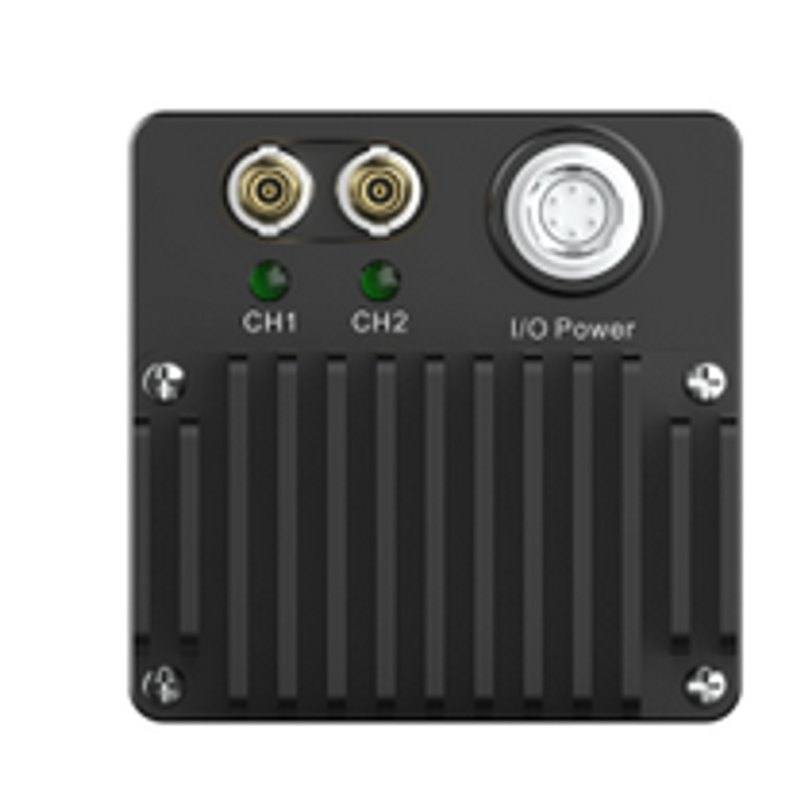
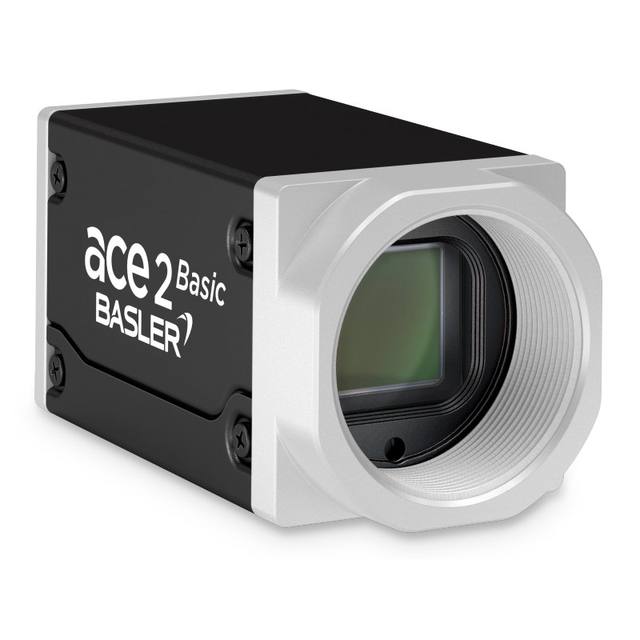
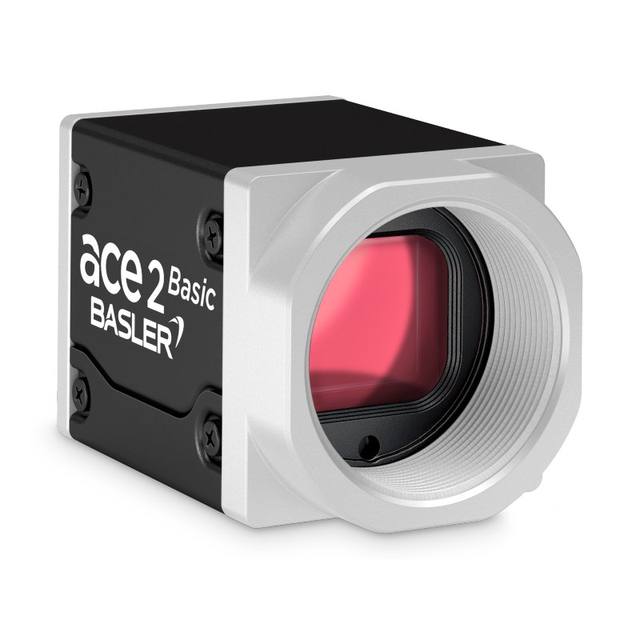
The iRAYPLE AX5E07MX250E/CX250E are 50 MP large area scan cameras built on a custom 29.9×16.0 mm CMOS sensor with 3.2 µm square pixels and a global shutter. They deliver 44 fps over a CXP-6 interface (4×6.25 Gbps) and support PoCXP as well as DC 24 V power supply via a 12-pin Hirose connector. Both variants offer 12-bit output, pixel-by-pixel flat-field correction, ROI, opto-isolated GPIO, and conform to CoaXPress/GenICam standards. The mono variant outputs Mono8/10/12 formats; the color variant outputs BayerRG8/10/12.
The iRAYPLE AX5E07MX250E is built around a custom 29.9 x 16.0 mm CMOS sensor that resolves 9344 x 5000 pixels at a 3.2 µm pitch, yielding a marketed 47 MP (46.72 MP effective) image in a single exposure. The global shutter eliminates rolling-shutter motion artifacts, making the camera suitable for moving webs, belt conveyors, and any scene where object or camera motion would otherwise smear fine detail. At 44 fps at full resolution the camera delivers over two billion pixels per second, a throughput figure that demands the four-lane CXP-6 interface (4 x 6.25 Gbps) to remain non-bottlenecked. That bandwidth also means the host PC needs a qualified CoaXPress frame-grabber card rated for the aggregate 25 Gbps stream; a single coaxial cable per lane carries signal, trigger, and — when PoCXP is used — power, eliminating a separate power run. For installations where PoCXP is not available, the 12-pin Hirose connector accepts DC 24 V directly, consuming 21.6 W at full operation. The 12-bit pixel depth (Mono8/10/12 output on the mono variant, BayerRG8/10/12 on the color variant) preserves the tonal gradations needed for gray-level defect scoring and color deviation measurement, and pixel-by-pixel flat-field correction compensates for optical and sensor non-uniformity before images leave the camera.
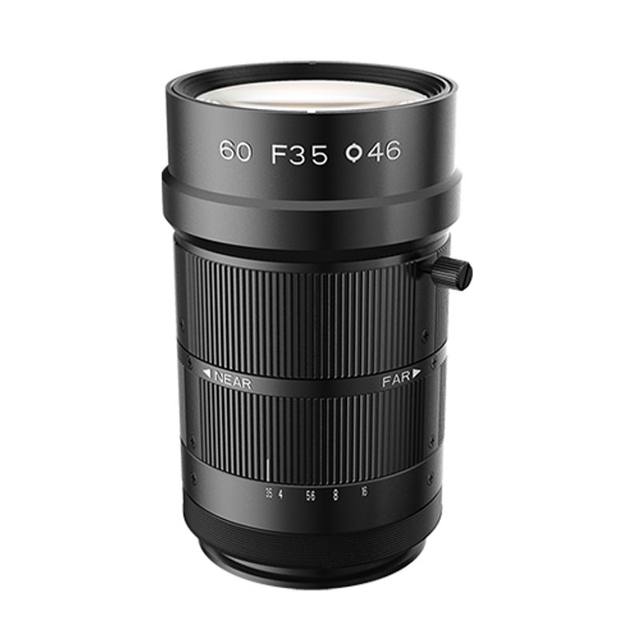
The 29.9 x 16.0 mm sensor calls for a large-format lens with an image circle that covers the sensor's approximately 33.9 mm corner-to-corner diagonal, and iRAYPLE specifies the M58x0.75 thread mount to match that requirement. M58 is the accepted standard for large-sensor machine-vision lenses above the 1.1-inch class, so the ecosystem of compatible optics — including telecentric lenses for gauging and high-resolution macro lenses for fine-pitch inspection — is well-established. Because the pixel pitch is 3.2 µm, the sensor's Nyquist frequency is approximately 156 lp/mm; lens MTF should exceed this figure at the intended working aperture to avoid resolution being limited by the optic rather than the sensor. The opto-isolated GPIO supports external triggering for precise strobe synchronization, keeping motion blur within acceptable bounds when paired with a short-duration high-intensity strobe — a critical pairing for this class of high-resolution camera where any blur directly degrades measurement accuracy.
The camera body measures 72 x 72 x 69.8 mm and weighs 690 g, a compact-relative-to-sensor-size form factor that suits gantry and robot-end-of-arm mounting without excessive counterweighting. The -30 °C to 50 °C operating range covers both cold-chain and warm press-room environments without supplemental thermal management in most industrial sites. GenICam compliance means standard vision libraries (Halcon, VisionPro, OpenCV via Aravis, and any GenTL-compatible SDK) can address the camera without vendor-specific shims, and ROI windowing lets integrators trade vertical pixels for higher effective frame rates when only a horizontal strip of the scene is relevant — useful in web inspection where the material width is fixed and the full 5000-row height is not always required. The mono variant suits applications where contrast, throughput, and 12-bit dynamic range matter more than hue discrimination; the color (BayerRG) variant adds color-defect and print-color-matching capability at the cost of one demosaicing step in the processing pipeline.
Best for
Large-panel surface inspection — PCB bare-board, display glass, or solar cell — where a single 47 MP frame covers the full panel width at fine spatial resolution, eliminating stitching and the alignment errors it introduces.
High-speed semiconductor or electronics final inspection on a moving conveyor at up to 44 fps, where the global shutter freezes part motion and the 12-bit depth enables gray-level scoring of micro-scratches, contamination, or solder-mask voids.
Dimensional measurement and geometric gauging of large mechanical assemblies or precision sheet-metal parts, where the combination of high pixel count, flat-field correction, and a telecentric M58 lens delivers sub-pixel edge repeatability across a wide field.
Web and roll-to-roll printing quality control (packaging film, pharmaceutical blister foil, label stock) using ROI windowing to maximize frame rate on the active print width while the global shutter eliminates skew on fast-moving material.
Automotive body or stamped-part inspection where the wide operating temperature range (-30 °C to 50 °C) and compact 72 x 72 mm body allow the camera to be mounted close to presses or in temperature-variable paint-shop environments.
Selection notes
Frame-grabber compatibility is mandatory: the CXP-6 4-lane interface requires a certified CoaXPress host card capable of sustaining the aggregate ~25 Gbps data stream. Verify the card's GenTL producer version matches the camera's GenICam descriptor before procurement.
Lens image circle must cover the 29.9 x 16.0 mm sensor, which has a corner-to-corner diagonal of approximately 33.9 mm. Standard C-mount or F-mount lenses are incompatible; only M58x0.75-mount lenses with sufficient image circle should be specified, and MTF at the sensor's Nyquist frequency (approximately 156 lp/mm at 3.2 µm pixel pitch) should be confirmed at the intended aperture.
Power source: if PoCXP is used, confirm the frame-grabber can supply sufficient power for the camera's 21.6 W draw across the installed cable run. If DC 24 V via the 12-pin Hirose connector is used instead, ensure the supply is regulated at 24 V and rated for the camera's 21.6 W consumption.
Strobe and trigger design: at 44 fps the inter-frame interval is approximately 22.7 ms. The opto-isolated GPIO trigger must be timed so that strobe pulse width is short enough to freeze motion to within acceptable limits at the target conveyor speed, given the system magnification and the 3.2 µm pixel pitch at the sensor plane.
Thermal dissipation: 21.6 W in a 72 x 72 x 69.8 mm enclosure means the body will run warm. In enclosed machine cabinets or at ambient temperatures approaching the 50 °C operating ceiling, ensuring airflow across the camera body or using a thermally conductive mounting bracket as a heat path is recommended to maintain stable operation.
Matched automatically by: lens mount fits the camera mount · lens image circle covers the camera sensor — this camera: M58×0.75 · 29.9 mm × 16.0 mm sensor.
Follow these steps to bring up your iRAYPLE camera, capture a first image, and move from the viewer to your own application. The flow is the same across the A, AE, AX and L series; only the physical interface differs.
Download and install the iRAYPLE machine-vision SDK together with its viewer client for your operating system. The installer provides the camera drivers, the GenTL producer, and the viewer you will use for first light. For GigE Vision models, also install or enable the bundled filter/performance driver on the network adapter to maximize throughput.
2. Connect the camera to the correct interface
Wire the camera to its matching host interface: a dedicated Gigabit (or 10 GigE) NIC for GigE Vision models, a USB3 Vision port with a quality cable for USB3 models, or a frame grabber for CoaXPress models. Power the camera (PoE, USB bus power, or PoCXP / external supply as applicable). For GigE Vision, put the NIC and camera on the same subnet and, where supported, enable jumbo frames.
3. Detect and open the camera in the viewer
Launch the iRAYPLE viewer, run device enumeration, and select your camera from the discovered list. Open it to load the device feature tree (GenICam node map). If a GigE camera is found but cannot be opened, correct the IP configuration so the camera and NIC are in the same address range.
4. Set exposure, gain and trigger, then grab a first image
Start with continuous (free-run) acquisition under stable lighting. Adjust exposure time and gain for a well-exposed, low-noise image, set the pixel format (e.g. Mono8 or a Bayer/RGB format), and tune white balance on color models. Once the live image looks correct, switch trigger mode to hardware or software trigger to synchronize capture with your process, and verify a single triggered frame.
5. Move from the viewer to the SDK or a GenICam library
With imaging confirmed, reproduce the same settings in code using the SDK's C/C++ or Python API: enumerate, open, configure the relevant GenICam features, register a frame callback or grab loop, and convert frames to your pipeline's buffer format. Since the cameras are GenICam/GenTL-compliant, you can alternatively drive them from a third-party GenICam vision library. From here a stable image stream can feed a deep-learning inspection step such as Rosepetal for automated quality control.
Frequently asked questions
The camera supports ROI windowing, which reduces the number of rows read out per frame and allows the frame rate to increase above the 44 fps full-resolution figure. The exact ROI-to-fps relationship depends on the row reduction factor and the CXP-6 bandwidth ceiling; consult the camera's GenICam register map or iRAYPLE's datasheet for specific ROI presets. The four CXP-6 lanes (4 x 6.25 Gbps) set the hard ceiling on pixel throughput.
Yes. The camera explicitly supports PoCXP (Power over CoaXPress), so when paired with a frame-grabber that provides PoCXP, the coaxial cables carry both data and power, eliminating the need for the 12-pin Hirose DC 24 V connection. Verify the frame-grabber can supply sufficient power for the camera's 21.6 W draw at the installed cable run length.
The color variant uses a Bayer RG pattern on the same 9344 x 5000 sensor and outputs BayerRG8, BayerRG10, or BayerRG12 raw data. Demosaicing to RGB is performed in software or the frame-grabber. For print color inspection this is viable, but spatial resolution per color channel is reduced relative to the mono variant due to Bayer subsampling, and demosaicing introduces a small processing latency. If color measurement accuracy is critical, the selected demosaicing algorithm and white-balance calibration matter significantly.
The camera uses an M58x0.75 mount. Standard C-mount (1-inch) and F-mount lenses cannot cover the 29.9 x 16.0 mm sensor and will produce severe vignetting or mechanical interference. Only M58-mount lenses with an image circle sufficient to cover the sensor's approximately 33.9 mm corner-to-corner diagonal are appropriate.
The rated operating range is -30 °C to 50 °C. At ambient temperatures approaching the upper limit, the camera's 21.6 W self-heating may push the sensor toward the ceiling in a sealed enclosure. In those conditions, ensuring airflow across the camera body or using a thermally conductive mounting bracket as a heat path is recommended to maintain stable operation and sensor performance.