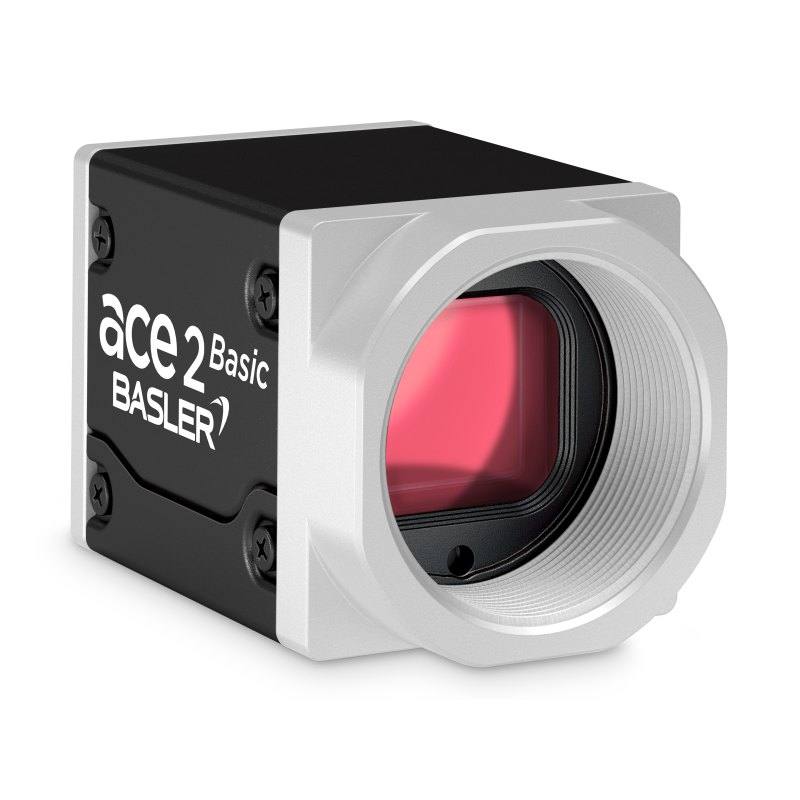
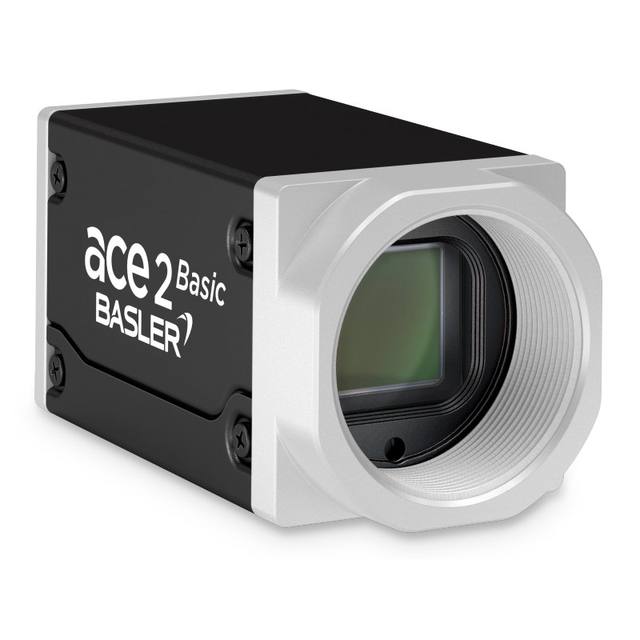
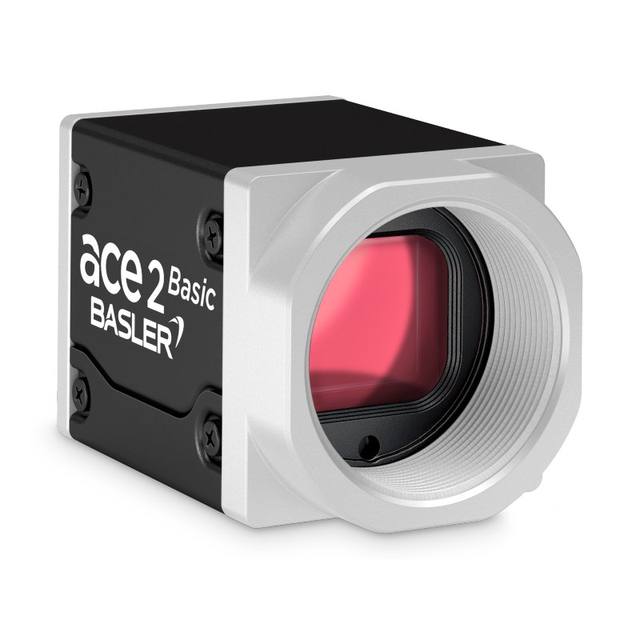
The Basler a2A4504-18ucBAS is a high-resolution area scan camera from the ace 2 R family, featuring a 20.2 MP Sony IMX541 (1.1" format) progressive scan CMOS sensor with global shutter at 2.74 µm pixel pitch. It connects via USB 3.0 (5 Gbit/s) and delivers up to 18 fps at 4504 × 4504 px resolution in 8/10/12-bit depth. The camera provides C-mount optics, one opto-isolated input, two GPIO lines, and an M8 6-pin I/O connector, with full USB bus power at ~3.7 W. Compliant with USB3 Vision and GenICam standards, it is rated IP30 and operates from −10 °C to +60 °C.
The Basler a2A4504-18ucBAS is built around the Sony IMX541 Pregius S sensor — a 1.1" format, 20.2 MP progressive scan CMOS device with a 2.74 µm pixel pitch arranged in a perfectly square 4504 × 4504 px array. The global shutter architecture is the decisive design choice here: every pixel integrates light simultaneously, so fast-moving parts, conveyor lines, or rotating assemblies are captured without any rolling-shutter skew or partial-frame distortion. At full 20.2 MP, the camera delivers up to 18 fps (approximately 19 fps peak) over its USB 3.0 SuperSpeed (5 Gbit/s) link, and the 8/10/12-bit depth selection lets integrators balance dynamic range against bandwidth as the application demands. The on-board IR cut filter makes this the color variant, suited wherever true RGB reproduction is needed — label color verification, pharmaceutical tablet differentiation, or PCB solder-mask color checks — while maintaining the IMX541's well-regarded low-noise characteristics.
Connectivity and integration are handled through the USB3 Vision and GenICam standards, which means the camera enumerates immediately in any compliant SDK or vision runtime without vendor-specific drivers. Power is drawn entirely from the USB 3.0 bus at approximately 3.7 W, eliminating any separate DC supply cable and simplifying cable routing in compact gantry or robot-mounted fixtures. The M8 6-pin I/O connector provides one opto-isolated input and two GPIO lines, giving the installer a hardware trigger line for synchronizing the exposure to a PLC or encoder, plus output lines for strobe control or pass/fail signaling. The C-mount lens interface covers the full 1.1" (12.34 × 12.34 mm, 17.45 mm diagonal) image circle, so lenses rated for 1.1" or larger formats are required to avoid corner vignetting at this resolution — a critical selection constraint at 20 MP.
With a 12.34 mm square sensor and 2.74 µm pixels, the field-of-view and pixel-budget math is straightforward for dimensional measurement: a 35 mm C-mount lens focused at 500 mm working distance covers roughly 175 × 175 mm, yielding approximately 39 µm/px — comfortably fine enough for sub-millimetre defect detection or character reading on pharmaceutical blister packs. The IP30 rating and −10 °C to +60 °C operating range suit controlled factory environments; the 85 g body mass keeps cantilever torque manageable on robot wrists and linear axes. At 18 fps and 20.2 MP, throughput is approximately 365 megapixels per second, which is demanding on the host PC's USB controller and memory bandwidth — single-camera installations are straightforward, but multi-camera setups should budget one USB 3.0 host controller per camera to avoid bus contention.
Best for
High-resolution surface inspection of flat panels, PCBs, or semiconductor wafers where a square field of view (4504 × 4504 px) maps naturally to square or near-square parts and the global shutter eliminates motion blur from step-and-settle or continuous-motion stages.
Pharmaceutical and medical-device inspection — blister-pack print verification, tablet color and embossing checks, and label OCR/OCV — where color fidelity from the IR cut filter and fine 2.74 µm pixel pitch resolve small text and markings at practical working distances.
Packaging line code reading and traceability (2D/DM/QR) at moderate throughput, where 18 fps is sufficient and the 20.2 MP pixel budget allows a single camera to cover a wide label area while maintaining the resolution needed to decode dense codes.
Dimensional gauging of precision components in electronics, automotive, or battery manufacturing, where the square sensor format and global shutter allow accurate edge detection on parts moving on a conveyor without shape distortion.
Robot-mounted or gantry inspection cells requiring bus-powered, cable-light integration: the single USB 3.0 cable carries both data and 3.7 W power, and the 85 g body keeps the end-of-arm payload low.
Selection notes
Lens must cover the full 1.1" image circle (17.45 mm diagonal): standard 2/3" lenses will vignette heavily at the corners of this sensor. Confirm the lens datasheet specifies 1.1" or larger format coverage before purchasing.
A single USB 3.0 host controller should be dedicated to this camera in multi-camera installations. Sharing a USB 3.0 root hub with other high-bandwidth peripherals risks dropped frames or reduced fps at 20.2 MP / 18 fps sustained throughput.
The one opto-isolated input is the reliable hardware trigger line; GPIO lines are not opto-isolated. Route the trigger from a PLC or encoder through the opto-isolated input to protect against ground loops and electrical noise on the factory floor.
Color variant with IR cut filter: if the inspection requires sensitivity to near-infrared illumination (e.g., 850 nm LED backlighting for silicon wafer inspection), the monochrome IMX541 variant without an IR cut filter is the appropriate choice instead.
IP30 rating provides basic protection against solid objects larger than 2.5 mm but no protection against liquids. Installations in wash-down or high-humidity environments require an external enclosure; factor enclosure dimensions into the optical working-distance budget.
Specifications: General
Brand
Basler
Camera type
Area Scan
Specifications: Sensor
Resolution
20.2 MP
Horizontal resolution
4504 × 4504 px
Mono / color
Color (with IR cut filter)
Sensor manufacturer
Sony Pregius S
Sensor model
Sony IMX541-AAQJ-C
Shutter
Global Shutter
Sensor size
1.1" (12.34 × 12.34 mm, diagonal 17.45 mm)
Pixel size
2.74 × 2.74 µm
Specifications: Performance
FPS
18 fps (max ~19 fps)
Specifications: Interface
Interface
USB 3.0 (5 Gbit/s SuperSpeed)
Protocols
USB3 Vision, GenICam
Specifications: Optics
Mount
C-mount
Specifications: Electrical
Power
Power via USB 3.0 (~3.7 W typical)
Power consumption
3.7 W
Specifications: Environment
IP rating
IP30
Operating temperature
-10 to +60 °C
Specifications: Mechanical
Dimensions
12.34 × 12.34 mm
Weight
85 g
Applications this camera is commonly selected for. Open one to see the full recommended hardware and approach.
Matched automatically by: lens mount fits the camera mount · lens image circle covers the camera sensor — this camera: C-mount · 1.1" (12.34 × 12.34 mm, diagonal 17.45 mm) sensor.
By category
All 67C-mount lenses 43Telecentric lenses 24
By brand
All 67Basler 34iRAYPLE 23Omron / Sentech 8Datalogic / Datasensing 2
Get a first image quickly with the pylon Viewer, then move into the pylon SDK for your application. These cameras are GenICam/GenTL-compliant, so any compliant vision software can drive them as well.
Download and install the pylon Camera Software Suite for your OS from Basler. This provides the pylon Viewer, the GenTL transport-layer producers and the pylon SDK (C/C++/.NET/Python). On Windows the installer adds the needed drivers; on Linux follow the included setup notes for USB and network permissions.
2. Connect the camera and check the link
Cable the camera to its matching interface: GigE Vision to a GigE port (use a quality cable and, ideally, a dedicated NIC with jumbo frames enabled), USB3 Vision to a USB 3.x port with the supplied cable, or CoaXPress to the frame grabber. Provide power where required (PoE, USB bus power, or PoCXP). Open the pylon Viewer and confirm the camera appears in the device list; for GigE, make sure the camera and NIC are on the same subnet.
3. Grab a first image and set exposure, gain and pixel format
Select the camera in the pylon Viewer and start a continuous grab. Adjust exposure time and gain until the image is well exposed (avoid clipped highlights), set the pixel format (e.g. Mono8 or a Bayer/RGB format), and focus the lens. Use a test pattern if the lens or scene is not ready yet.
4. Configure triggering and acquisition
Decide between free-run and triggered acquisition. For synchronized capture, set the trigger source (software or a hardware line on the I/O connector), trigger mode and any debounce or exposure mode, then verify timing. Note the parameter names you change in the Viewer feature tree, as you will reuse them in code.
5. Move to the SDK or a GenICam-compliant library
Recreate your settings in code with the pylon SDK (C, C++, .NET or Python) to open the device, apply the same features and pull frames into your pipeline; pylon vTools and pylon AI can add processing blocks. Because the cameras are GenICam/GenTL standard, third-party vision libraries work too. Once the image stream is stable, you can route frames to a deep-learning inspection such as Rosepetal for automated defect detection.
Frequently asked questions
The camera delivers up to 18 fps (approximately 19 fps peak) at the full 4504 × 4504 px resolution over USB 3.0. Reducing the region of interest increases frame rate proportionally, as fewer pixels are read out and transferred per frame.
No. The a2A4504-18ucBAS is fully bus-powered via its USB 3.0 connection at approximately 3.7 W typical. A single USB 3.0 cable provides both data transfer and power, with no separate DC input required.
The camera uses a C-mount lens interface. The Sony IMX541 sensor measures 12.34 × 12.34 mm with a 17.45 mm diagonal (1.1" format). Lenses must be rated for the 1.1" image circle to illuminate the full sensor without corner vignetting.
Yes. The M8 6-pin I/O connector provides one opto-isolated input for hardware triggering, plus two GPIO lines. The opto-isolated input should be used for PLC or encoder trigger signals to prevent ground loops; the GPIO lines can be configured for strobe output or other I/O functions via GenICam parameters.
The camera outputs 8-bit, 10-bit, or 12-bit pixel data. At 8-bit and 18 fps, raw throughput is approximately 365 MB/s; at 12-bit it rises to roughly 548 MB/s. USB 3.0 at 5 Gbit/s (approximately 500 MB/s effective) can sustain 8-bit comfortably; for 12-bit at full resolution and fps, reducing the region of interest or lowering the frame rate is recommended to stay within available bus bandwidth.