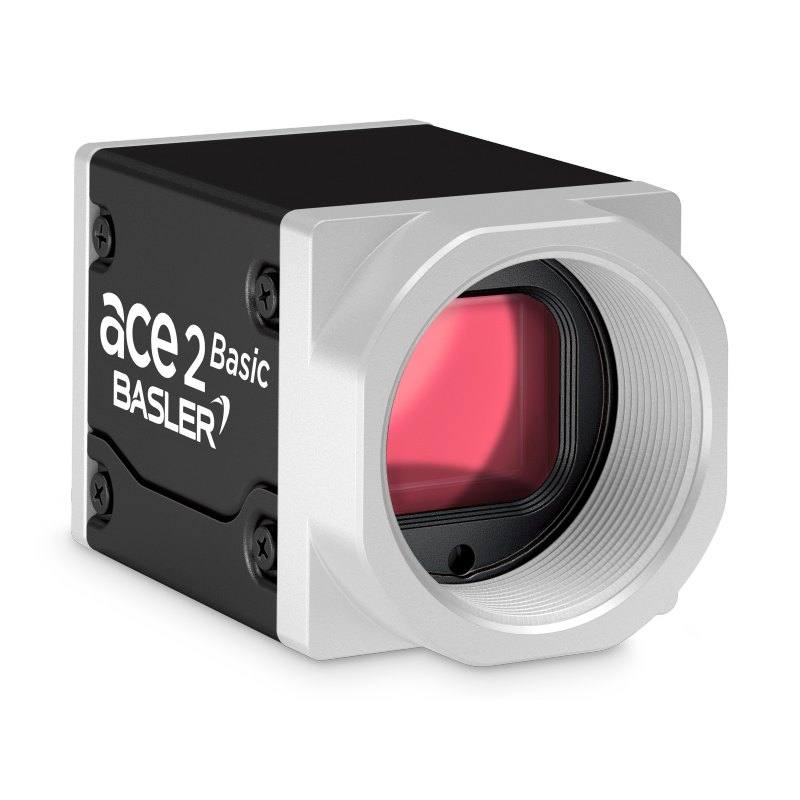
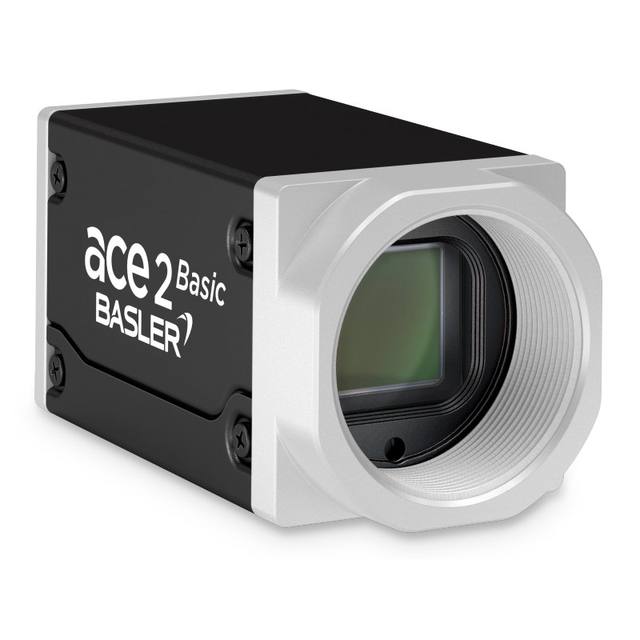
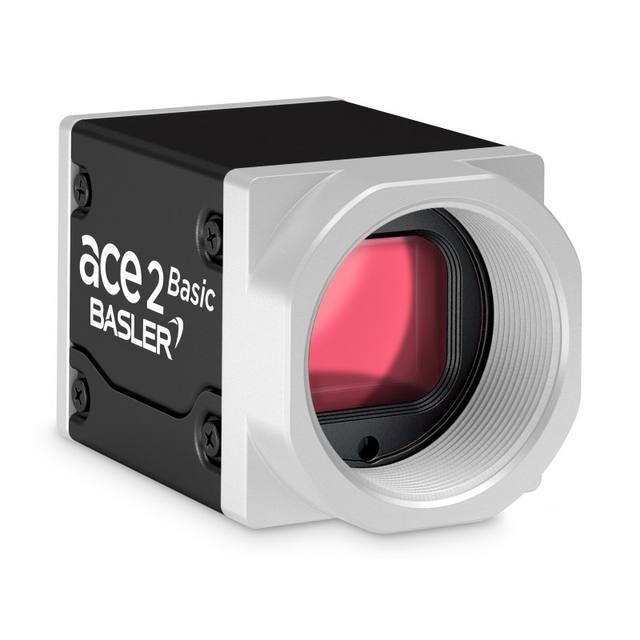
The a2A5320-23uc belongs to Basler's ace 2 R family and uses the Sony IMX542-AAQJ-C back-side illuminated CMOS sensor with a 1.1" optical format and 2.74 µm pixel pitch. It delivers up to 23.6 fps at full 5320 x 3032 resolution via a USB 3.0 SuperSpeed (5 Gbit/s) interface with USB3 Vision compliance. The camera features a global shutter for distortion-free capture of moving objects, C-mount lens compatibility, and draws power directly from the USB bus at approximately 3.7 W. The PRO variant additionally supports 12–24 VDC auxiliary power and adds enhanced I/O capabilities.
The Basler ace 2 a2A5320-23uc pairs a 16.1 MP Sony IMX542-AAQJ-C back-side illuminated (BSI) Pregius S CMOS sensor with a global shutter — a combination that directly addresses two of the hardest trade-offs in high-resolution area-scan work. At 5320 × 3032 pixels across a 1.1" optical format, the camera delivers a wide field of view without sacrificing the pixel density needed for fine-detail inspection; the 2.74 µm pixel pitch is small enough to resolve sub-millimetre features at typical working distances when paired with an appropriate C-mount optic, yet the BSI architecture recovers the quantum efficiency that small pixels would otherwise lose. The global shutter exposes every pixel simultaneously, so conveyor-fed parts, rotating components, and any target that moves during exposure are captured without the row-by-row distortion inherent to rolling-shutter designs. For an installer this means strobe timing can be kept extremely short — a single flash freezes motion completely — rather than requiring a mechanical stop or a precisely synchronised rolling-shutter strobe pulse.
The camera delivers up to 23.6 fps at full resolution over USB 3.0 SuperSpeed (5 Gbit/s), conforming to the USB3 Vision v1.0 and GenICam standards. USB3 Vision compliance means plug-and-play integration with any compliant vision software or runtime without vendor-specific drivers, and GenICam-based parameter access keeps the integration path consistent across camera families. Bus power at approximately 3.7 W drawn directly from the USB 3.0 port eliminates the need for a separate DC supply in the base (BAS) variant, reducing cabling complexity at the fixture. The PRO variant adds 12–24 VDC auxiliary power and enhanced I/O for applications that require hardware trigger lines, encoder inputs, or strobe outputs tied to a PLC or motion controller. The compact 48.1 × 29 × 29 mm housing at 85 g fits inside tight gantry brackets and multi-camera arrays where larger camera bodies would force optical compromises.
Lens selection for this sensor demands attention to image circle and resolving power. The 1.1" format (16.78 mm diagonal) requires a lens with a correspondingly large image circle; using a lens rated for a smaller format will introduce vignetting at the corners of the 5320 × 3032 frame. At 2.74 µm pixel pitch, the lens must resolve at least 182 lp/mm at the sensor plane to avoid becoming the resolution bottleneck — this typically points to high-grade industrial macro or telecentric optics rather than general-purpose C-mount glass. Lighting choice interacts closely with the global shutter: because all pixels are reset and read together, strobe lighting is the natural pairing, with pulse widths as short as the light source allows. The IP30 housing rating is adequate for controlled factory environments but not for wash-down or heavy particulate conditions; supplementary enclosures or directed air purging should be considered in dusty or humid lines. Operating temperature is specified to 60 °C for the BAS variant and 50 °C for the PRO variant, which covers most in-cabinet or fixture-mounted deployments but may require thermal management when the camera is mounted inside a heated enclosure or near an oven.
Best for
High-resolution surface and cosmetic defect inspection — the 16.1 MP global shutter frame captures fine scratches, colour deviations, and texture anomalies across a wide field in a single shot without motion blur, making it well-suited for electronics PCB panels, display glass, and automotive body panels moving on a conveyor.
Dimensional measurement and gauging of medium-to-large parts — the 5320 × 3032 pixel array provides the spatial sampling needed to resolve tight tolerances across a wide field of view, supporting inline measurement of connector positions, die locations, or stamped features without stitching multiple images.
Packaging and label inspection — colour output from the IMX542 enables simultaneous verification of print quality, barcode readability, colour-match to reference, and fill-level estimation on a single camera pass at line speeds consistent with the 23.6 fps frame rate.
Pharmaceutical and medical-device traceability — the combination of high resolution, global shutter, and colour allows the camera to read 2D Data Matrix codes, inspect blister packs for missing tablets, and verify label text under consistent strobe illumination with no motion artefacts.
Semiconductor and battery cell incoming or outgoing quality control — the 2.74 µm pixel pitch provides the spatial resolution to inspect electrode edges, weld seams, or die bond locations at magnifications achievable with standard industrial C-mount optics.
Selection notes
Lens image circle must cover the full 1.1" (16.78 mm diagonal) sensor format — lenses designed for 2/3" or 1" formats will vignette the corners of the 16.1 MP frame and reduce effective resolution at the edges. Confirm the manufacturer's rated image circle before committing to a lens.
At 2.74 µm pixel pitch the camera will expose any lens-resolution shortfall; specify optics with a published MTF or resolution figure of at least 180 lp/mm at the sensor plane. For dimensional accuracy applications consider telecentric lenses to eliminate perspective error across depth-of-field variations.
USB 3.0 cable length is typically limited to 3–5 m with passive cables; active optical or active copper USB 3.0 cables extend this to 10–15 m or beyond. Plan cable routing early, as the bandwidth of the 5 Gbit/s link must be sustained continuously at 23.6 fps for full-frame capture.
Choose the PRO variant if hardware trigger or strobe output lines are required — the BAS variant is bus-powered and suitable for software-triggered or free-run applications, but adding deterministic external trigger synchronisation to a PLC or encoder requires the PRO's auxiliary I/O.
The IP30 rating provides no protection against liquids or significant dust ingress. Installations on lines with wash-down cycles, coolant mist, or heavy swarf require an additional sealed housing or camera enclosure; factor enclosure dimensions into the optical working-distance calculation.
Specifications: General
Brand
Basler
Camera type
Area Scan
Specifications: Sensor
Resolution
16.1 MP
Horizontal resolution
5320 px
Mono / color
Color (visible spectrum)
Sensor manufacturer
Sony Pregius S
Sensor model
Sony IMX542-AAQJ-C
Shutter
Global Shutter
Sensor size
1.1" (16.78 mm diagonal)
Pixel size
2.74 µm × 2.74 µm
Specifications: Performance
FPS
22.3 fps (default) / 23.6 fps (max)
Specifications: Interface
Interface
USB 3.0 (SuperSpeed, 5 Gbit/s)
Protocols
USB3 Vision v1.0, GenICam
Specifications: Optics
Mount
C-mount
Specifications: Electrical
Power
USB bus power (5 VDC via USB 3.0)
Power consumption
3.7 W
Specifications: Environment
IP rating
IP30
Operating temperature
-10 to 60 °C (BAS) / -10 to 50 °C (PRO)
Specifications: Mechanical
Dimensions
48.1 × 29 × 29 mm (with connectors)
Weight
85 g
Housing material
Box
Applications this camera is commonly selected for. Open one to see the full recommended hardware and approach.
Matched automatically by: lens mount fits the camera mount · lens image circle covers the camera sensor — this camera: C-mount · 1.1" (16.78 mm diagonal) sensor.
By category
All 67C-mount lenses 43Telecentric lenses 24
By brand
All 67Basler 34iRAYPLE 23Omron / Sentech 8Datalogic / Datasensing 2
Get a first image quickly with the pylon Viewer, then move into the pylon SDK for your application. These cameras are GenICam/GenTL-compliant, so any compliant vision software can drive them as well.
Download and install the pylon Camera Software Suite for your OS from Basler. This provides the pylon Viewer, the GenTL transport-layer producers and the pylon SDK (C/C++/.NET/Python). On Windows the installer adds the needed drivers; on Linux follow the included setup notes for USB and network permissions.
2. Connect the camera and check the link
Cable the camera to its matching interface: GigE Vision to a GigE port (use a quality cable and, ideally, a dedicated NIC with jumbo frames enabled), USB3 Vision to a USB 3.x port with the supplied cable, or CoaXPress to the frame grabber. Provide power where required (PoE, USB bus power, or PoCXP). Open the pylon Viewer and confirm the camera appears in the device list; for GigE, make sure the camera and NIC are on the same subnet.
3. Grab a first image and set exposure, gain and pixel format
Select the camera in the pylon Viewer and start a continuous grab. Adjust exposure time and gain until the image is well exposed (avoid clipped highlights), set the pixel format (e.g. Mono8 or a Bayer/RGB format), and focus the lens. Use a test pattern if the lens or scene is not ready yet.
4. Configure triggering and acquisition
Decide between free-run and triggered acquisition. For synchronized capture, set the trigger source (software or a hardware line on the I/O connector), trigger mode and any debounce or exposure mode, then verify timing. Note the parameter names you change in the Viewer feature tree, as you will reuse them in code.
5. Move to the SDK or a GenICam-compliant library
Recreate your settings in code with the pylon SDK (C, C++, .NET or Python) to open the device, apply the same features and pull frames into your pipeline; pylon vTools and pylon AI can add processing blocks. Because the cameras are GenICam/GenTL standard, third-party vision libraries work too. Once the image stream is stable, you can route frames to a deep-learning inspection such as Rosepetal for automated defect detection.
Frequently asked questions
The a2A5320-23uc delivers up to 23.6 fps at its full 5320 × 3032 resolution over USB 3.0 SuperSpeed. A default operating rate of 22.3 fps is also specified. Reducing the region of interest (ROI) will increase the frame rate beyond this figure.
Yes — global shutter exposes all pixels simultaneously, so continuous lighting is viable and will produce sharp images of moving parts as long as the exposure time is short enough to freeze motion. Strobe lighting remains the preferred choice for maximising light intensity and minimising heat, but it is not a requirement imposed by the shutter type the way it is with rolling-shutter cameras.
The BAS variant draws approximately 3.7 W directly from the USB 3.0 bus and requires no external power supply. The PRO variant additionally supports 12–24 VDC auxiliary power and should use it when the host USB port cannot guarantee sufficient current or when longer cable runs introduce voltage drop.
The camera uses a standard C-mount. The Sony IMX542 sensor has a 1.1" optical format with a 16.78 mm diagonal image circle. Any lens used must be rated for at least 1.1" format coverage; lenses specified for smaller formats such as 2/3" or 1" will not fully illuminate the sensor at this resolution.
No. The housing carries an IP30 rating, which means it is protected against solid objects larger than 2.5 mm but offers no protection against liquids. For wet or high-humidity environments a supplementary sealed camera enclosure is required, and the working distance must be recalculated to account for the enclosure's front window.