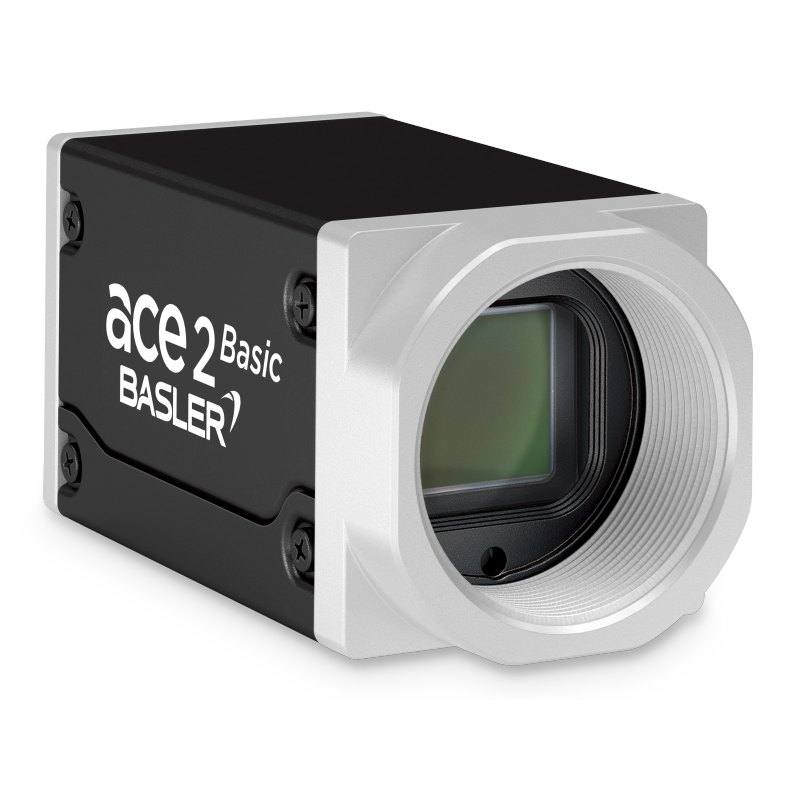
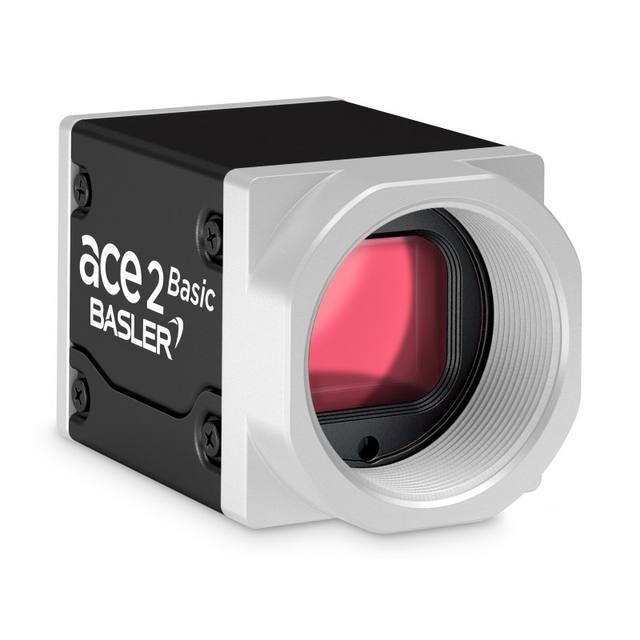
The Basler ace 2 a2A4096-44g5mBAS is a high-resolution monochrome industrial area scan camera featuring a 4096 × 3000 pixel (12.3 MP) Sony IMX545 global shutter CMOS sensor in a 1/1.1" format with 2.74 µm pixel pitch. It interfaces via 5GigE (NBASE-T, backward compatible with GbE/2.5GbE) and achieves up to 43.6 fps at full resolution (47 fps in Performance mode). The camera conforms to GigE Vision 2.0 and GenICam standards, outputs 8/10/12-bit pixel data, and provides a dynamic range of 69.9 dB with a typical SNR of 40 dB. It draws approximately 5.5 W from a 12–24 VDC supply, measures 55.5 × 29 × 29 mm (body), and carries an IP30 housing rating.
The a2A4096-44g5mBAS is built around Sony's IMX545-AAMJ-C, a Pregius S global shutter CMOS sensor delivering 12.3 megapixels across a 4096 × 3000 pixel array on a 1/1.1" (11.22 × 8.22 mm) die. The 2.74 µm pixel pitch allows Sony to pack this resolution into a sensor format that still accepts standard C-mount optics. The global shutter architecture means all pixels integrate simultaneously, eliminating the geometric distortion that rolling shutter sensors impose on moving parts or strobe-lit scenes. With a dynamic range of 69.9 dB and a typical SNR of 40 dB, the sensor holds enough tonal latitude to separate fine surface texture from background under LED strobe lighting without clipping highlights on specular metal or losing shadow detail on matte plastics.
At full 4096 × 3000 resolution the camera sustains 43.6 fps under standard GigE Vision operation and can be pushed to 47 fps in Basler's Performance mode — a firmware setting that relaxes some inter-frame overhead at the cost of strict standard compliance. The interface is 5GigE over NBASE-T, meaning a single Cat-6A or Cat-7 cable carries the full-resolution stream without compression. NBASE-T's backward compatibility with 100 Mbps, 1 GbE, and 2.5 GbE infrastructure is a practical installation advantage: the camera negotiates the highest mutually supported speed automatically, so an integrator can drop it into an existing GbE switch during commissioning and later cut over to a 5 GbE NIC without rewiring. GigE Vision 2.0 and GenICam compliance ensure it is natively supported by virtually every major vision SDK and runtime. At 5.5 W and 105 g, the thermal and mechanical load on a robot arm or gantry bracket is minimal. Note that Power over Ethernet is not supported — the camera requires 12–24 VDC delivered through its M8 6-pin I/O connector, which also carries hardware trigger and strobe-out lines.
The C-mount and 1/1.1" sensor format dictate lens selection. A 1/1.1" image circle has a 14 mm diagonal, which is larger than the 1/1.8" and 2/3" formats common in many machine-vision lens catalogs, so integrators must confirm that the selected lens specifies coverage to at least 14 mm diagonal — using an undersized lens will produce significant corner shading. At 2.74 µm pixels the lens must resolve better than roughly 180 lp/mm at the sensor plane to avoid being the limiting element; selecting a lens rated for the sensor format at the intended f-stop and working distance is essential. Trigger and lighting are straightforward to synchronize via the hardware I/O lines: the camera's strobe output can drive an LED controller directly, keeping flash duration and exposure tightly coupled for motion freezing at the 43.6 fps cadence. The IP30 housing rating is adequate for benchtop and enclosed machine installations but is not splash-proof; applications in wet or dusty environments will require a protective enclosure.
Best for
High-resolution surface inspection of flat or near-flat parts — semiconductors, PCBs, battery electrodes, and pharmaceutical blister packs — where 12.3 MP allows a large field of view without sacrificing the pixel density needed to detect fine scratches, pinholes, or print defects at production speed.
Dimensional measurement and gauging tasks on the production line, particularly for precision mechanical components and electronic assemblies, where the global shutter avoids part-motion artifacts and the 4096-pixel horizontal span provides fine measurement pitch over a wide field.
OCR and OCV of small text or 2D codes on labels, packaging, and direct-part marks, where the combination of 12.3 MP and monochrome sensitivity delivers the contrast and acuity to decode fine print at conveyor speeds up to the camera's 43.6 fps throughput.
Robot guidance and pick-and-place applications where global shutter is required to freeze fast-moving tooling and the compact 55.5 × 29 × 29 mm body keeps the camera within tight arm-mounted envelope constraints.
Multi-camera line builds and AVI systems in automotive, electronics, or pharma that standardize on GigE Vision and need a high-pixel-count head that works within existing Cat-6A networking infrastructure without upgrading to 10 GigE switches.
Selection notes
Lens image-circle coverage: the 1/1.1" sensor has a 14 mm diagonal. Confirm that any candidate C-mount lens is rated for this format at the intended working distance and aperture. Standard 2/3" or 1" lenses will vignette in the corners and should not be used.
PoE is not available — power must come from a 12–24 VDC source (absolute range 10.8–30 V) via the M8 6-pin I/O connector. Plan the cabinet wiring accordingly and verify that the I/O connector is also used for hardware trigger and strobe-out signals, so connector pinout conflicts must be resolved before prototyping.
Network infrastructure: 5GigE requires a 5GBASE-T-capable NIC (or switch port) and Cat-6A cabling to reach full throughput. The camera will auto-negotiate down to 1 GbE, which is useful during lab setup but limits frame rate headroom for the full 12.3 MP stream — plan the final NIC and cable run before performance sign-off.
The 2.74 µm pixel pitch demands a high-resolution lens. At f/4–f/8 the diffraction limit begins to approach the Nyquist frequency of the sensor; select a lens whose MTF datasheet shows adequate contrast at 180 lp/mm or better at the intended aperture.
IP30 housing is suitable for clean, enclosed machine-vision stations. If the installation is near cutting fluid, wash-down, or airborne particulates, a sealed housing or purge enclosure is required — the camera body itself offers no ingress protection beyond basic finger/tool exclusion.
Specifications: General
Brand
Basler
Camera type
Area Scan
Specifications: Sensor
Resolution
12.3 MP
Horizontal resolution
4096 × 3000 px
Mono / color
Monochrome
Sensor manufacturer
Sony Pregius S
Sensor model
Sony IMX545-AAMJ-C
Shutter
Global Shutter
Sensor size
1/1.1" (11.22 × 8.22 mm, 14 mm diagonal)
Pixel size
2.74 × 2.74 µm
Specifications: Performance
FPS
43.6 fps (up to 47 fps in Performance mode)
Specifications: Interface
Interface
5GigE (NBASE-T; also supports 100M/1G/2.5GbE)
Protocols
GigE Vision 2.0, GenICam
Specifications: Optics
Mount
C-mount
Specifications: Electrical
Power
12–24 VDC via M8 6-pin I/O connector (PoE not supported)
Power consumption
5.5 W
Supply voltage
12–24 VDC (min 10.8 V, max 30 V)
Specifications: Environment
IP rating
IP30
Operating temperature
−10 to +50 °C
Specifications: Mechanical
Dimensions
55.5 × 29 × 29 mm
Weight
105 g
Applications this camera is commonly selected for. Open one to see the full recommended hardware and approach.
Matched automatically by: lens mount fits the camera mount · lens image circle covers the camera sensor — this camera: C-mount · 1/1.1" (11.22 × 8.22 mm, 14 mm diagonal) sensor.
By category
All 90C-mount lenses 66Telecentric lenses 24
By brand
All 90Basler 34iRAYPLE 26Omron / Sentech 24Datalogic / Datasensing 6
Get a first image quickly with the pylon Viewer, then move into the pylon SDK for your application. These cameras are GenICam/GenTL-compliant, so any compliant vision software can drive them as well.
Download and install the pylon Camera Software Suite for your OS from Basler. This provides the pylon Viewer, the GenTL transport-layer producers and the pylon SDK (C/C++/.NET/Python). On Windows the installer adds the needed drivers; on Linux follow the included setup notes for USB and network permissions.
2. Connect the camera and check the link
Cable the camera to its matching interface: GigE Vision to a GigE port (use a quality cable and, ideally, a dedicated NIC with jumbo frames enabled), USB3 Vision to a USB 3.x port with the supplied cable, or CoaXPress to the frame grabber. Provide power where required (PoE, USB bus power, or PoCXP). Open the pylon Viewer and confirm the camera appears in the device list; for GigE, make sure the camera and NIC are on the same subnet.
3. Grab a first image and set exposure, gain and pixel format
Select the camera in the pylon Viewer and start a continuous grab. Adjust exposure time and gain until the image is well exposed (avoid clipped highlights), set the pixel format (e.g. Mono8 or a Bayer/RGB format), and focus the lens. Use a test pattern if the lens or scene is not ready yet.
4. Configure triggering and acquisition
Decide between free-run and triggered acquisition. For synchronized capture, set the trigger source (software or a hardware line on the I/O connector), trigger mode and any debounce or exposure mode, then verify timing. Note the parameter names you change in the Viewer feature tree, as you will reuse them in code.
5. Move to the SDK or a GenICam-compliant library
Recreate your settings in code with the pylon SDK (C, C++, .NET or Python) to open the device, apply the same features and pull frames into your pipeline; pylon vTools and pylon AI can add processing blocks. Because the cameras are GenICam/GenTL standard, third-party vision libraries work too. Once the image stream is stable, you can route frames to a deep-learning inspection such as Rosepetal for automated defect detection.
Frequently asked questions
No. The a2A4096-44g5mBAS does not support PoE. Power must be supplied externally at 12–24 VDC (absolute range 10.8–30 V, typical draw 5.5 W) through the M8 6-pin I/O connector.
The camera delivers 43.6 fps at full resolution under standard GigE Vision 2.0 operation, and up to 47 fps when Basler's Performance mode is enabled in the firmware.
Yes. The 5GigE NBASE-T interface is backward compatible with 100 Mbps, 1 GbE, and 2.5 GbE infrastructure; the camera auto-negotiates the highest mutually supported speed. Bear in mind that at 1 GbE the available bandwidth limits the sustained full-resolution frame rate, so final throughput qualification should be done with the target 5 GbE NIC in place.
For the surface-inspection, OCR, and dimensional tasks this camera targets, monochrome sensors deliver higher spatial resolution per megapixel (no Bayer interpolation), better low-light sensitivity, and cleaner contrast under monochromatic LED or UV illumination. Color information is typically introduced instead via bandpass filters or multiple lighting wavelengths captured in sequence.
The camera uses a C-mount and the sensor is 1/1.1" with an 11.22 × 8.22 mm active area (14 mm diagonal). Any lens used must be specified to cover the 1/1.1" or larger format to avoid corner vignetting. Lenses designed for 2/3" or smaller formats are not suitable.