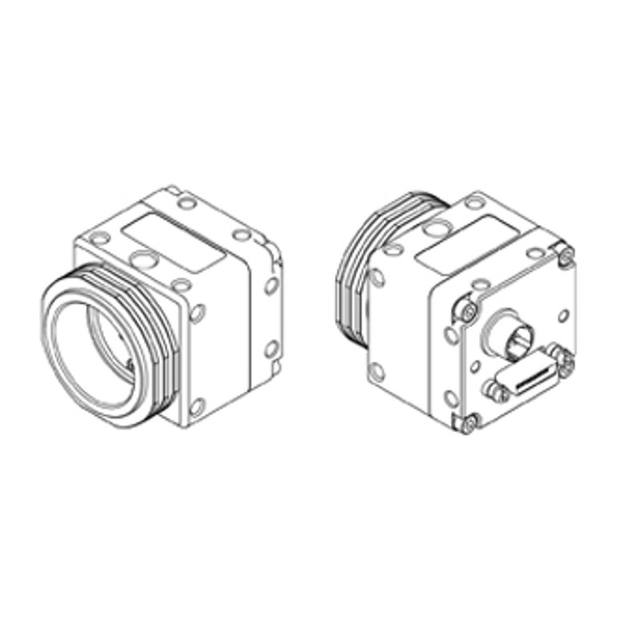
iRAYPLE AX5F57MP050E / AX5F57CP050E 65MP CXP-12 Large Area Scan Camera
AX5F57MP050E
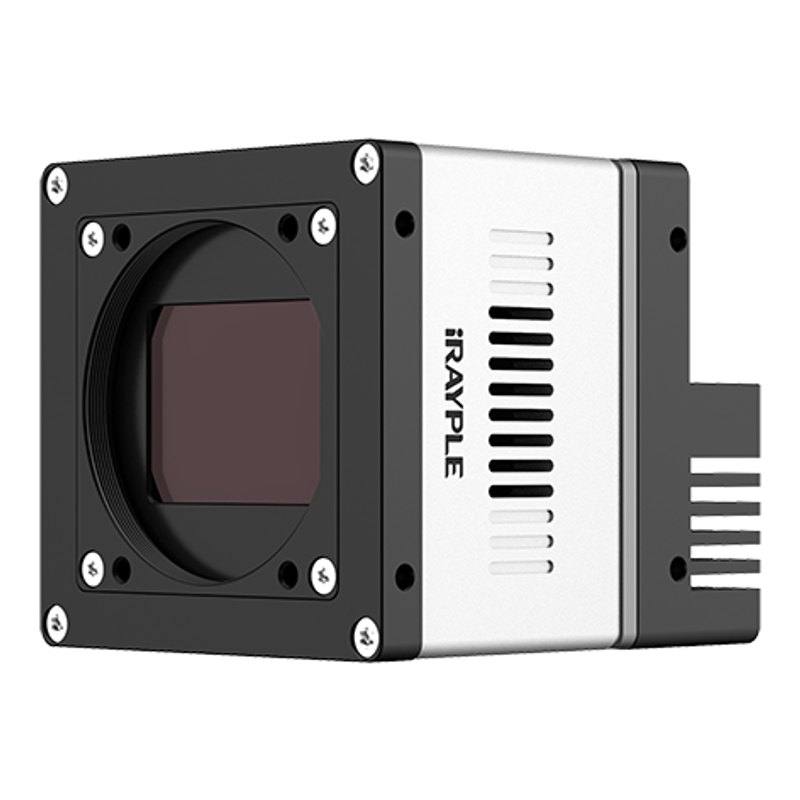
The iRAYPLE AX5F57MP050E/AX5F57CP050E are 65-megapixel large area scan cameras built around the Gpixel GMAX3265 sensor with 3.2 µm pixels across a 29.9 × 22.4 mm imaging area. They output at 71 fps over a 4-lane CoaXPress-12 interface (4 × 12.5 Gbps) via HD-BNC connectors, with an M58×0.75 lens mount. The cameras feature global shutter, 66 dB dynamic range, 40 dB SNR, and support pixel-by-pixel flat-field correction, ROI, hardware/software trigger, and RS232 plus 3-channel optocoupled I/O via a Hirose 12-pin connector. Power is supplied at DC 24V (PoCXP also supported) with 24 W consumption, and the 80×80×73.4 mm body weighs 790 g.
The iRAYPLE AX5F57MP050E is built around Gpixel's GMAX3265 sensor, delivering a 9344 × 7000 pixel (65 MP) imaging area measuring 29.9 × 22.4 mm with 3.2 µm square pixels. The global shutter architecture means every pixel integrates light simultaneously, eliminating the spatial distortion that rolling-shutter sensors introduce when imaging moving parts on a conveyor or a rotating component — a critical requirement for any dimensional measurement or surface inspection application where objects cannot be stopped. With 66 dB dynamic range and 40 dB SNR, the sensor handles scenes that mix bright specular highlights with fine low-contrast surface detail, reducing the need for elaborate lighting setups to compress scene contrast.
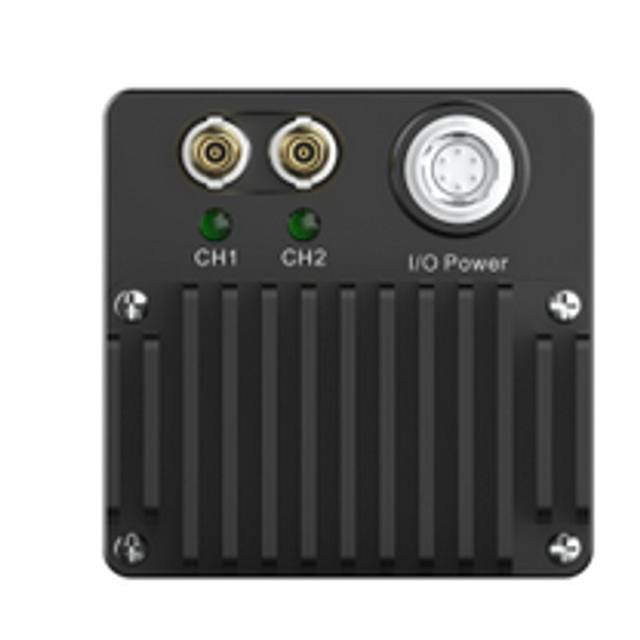
At 71 fps full-frame over a 4-lane CoaXPress-12 link (4 × 12.5 Gbps), this camera is one of very few 65 MP sensors that can sustain near-real-time throughput — a combination that matters when the goal is both high spatial resolution and meaningful line-rate inspection. CoaXPress-12 carries power, control, and image data on a single 75-Ω coaxial cable per lane via HD-BNC connectors, and the camera supports PoCXP, so cabling is clean and installation straightforward. The GenICam/CoaXPress protocol stack means any compliant frame grabber on the market will enumerate the camera correctly, and built-in features such as pixel-by-pixel flat-field correction, configurable ROI, and hardware/software trigger via the Hirose 12-pin connector (3-channel optocoupled I/O plus RS-232) give integrators precise control over acquisition timing without custom firmware.
The M58 × 0.75 lens mount is the standard interface for large-format industrial optics designed to cover sensors in the 35 mm and medium-format class. The 29.9 × 22.4 mm imaging area requires lenses with an image circle of at least 37 mm diagonal — installers should verify that the selected optic covers this format fully at the working f-stop to avoid corner shading. The 80 × 80 × 73.4 mm body and 790 g mass are compact relative to sensor size, and the −30 °C to +50 °C operating range suits most factory environments without supplemental cooling. Power draw is 24 W, supplied at DC 24 V via the Hirose 12-pin connector or through PoCXP from a compatible frame grabber, simplifying cabinet wiring.
Best for
Flat-panel display and semiconductor wafer inspection where a single camera frame must capture an entire large panel at sub-pixel defect resolution without stitching multiple images.
High-throughput surface defect inspection on wide-format materials — sheet metal, solar cells, printed circuit boards — where both spatial coverage and line speed must be maintained simultaneously.
Precision dimensional gauging of automotive stampings or large machined assemblies where global shutter eliminates motion-induced measurement error and 65 MP resolution provides the spatial sampling needed to resolve tight tolerances across wide fields of view.
Pharmaceutical and packaging print inspection where the full label or carton face must be imaged in one shot at sufficient resolution to read fine-pitch serialisation codes, expiry dates, and halftone print quality simultaneously.
High-resolution electronics assembly verification — inspecting populated PCBs for component placement, polarity, solder joint presence — where coverage of a full board without panel-stitching reduces cycle time and eliminates seam artefacts.
Selection notes
CoaXPress-12 at 4 lanes requires a frame grabber with four CXP-12 receivers and sufficient PCIe bandwidth to sustain 65 MP at 71 fps — verify your host PC's PCIe slot (typically PCIe x8 Gen 3 or x16 Gen 3 minimum) and that the grabber vendor supports the GMAX3265 pixel formats in their driver.
Lens selection must account for the 29.9 × 22.4 mm (37 mm diagonal) image circle requirement: the M58 × 0.75 mount is physically incompatible with standard C-mount and F-mount optics. Specify M58 large-format lenses rated for the full sensor diagonal, and check that maximum aperture does not introduce measurable vignetting at your working f-stop.
At 3.2 µm pixel pitch, optical resolution becomes the limiting factor at moderate working distances — diffraction limits at f/5.6 are already near one Airy disk per pixel. Select lenses with MTF curves showing strong contrast at the Nyquist frequency of 156 lp/mm to avoid throwing away sensor resolution.
The 24 W power draw and sealed body without active cooling mean heat dissipation must be considered in enclosed enclosures: ensure adequate airflow or a conductive heat path around the camera body to keep sensor temperature stable during continuous 71 fps operation.
The monochrome variant (AX5F57MP050E) is preferred for dimensional measurement and defect inspection tasks where spatial resolution and sensitivity matter more than colour discrimination; reserve the colour variant (AX5F57CP050E) for applications that require hue differentiation such as print colour verification or component colour sorting.
Specifications: General
Brand
iRAYPLE
Camera type
Area Scan
Specifications: Sensor
Resolution
65 MP
Horizontal resolution
9344 × 7000 px
Mono / color
Mono (AX5F57MP050E) / Color (AX5F57CP050E)
Sensor manufacturer
Gpixel
Sensor model
GMAX3265
Shutter
Global Shutter
Sensor size
29.9 mm × 22.4 mm
Pixel size
3.2 µm × 3.2 µm
Specifications: Performance
FPS
71 fps
Specifications: Interface
Interface
CoaXPress CXP-12 (4 lanes, 4×12.5 Gbps)
Protocols
GenICam / CoaXPress
Specifications: Optics
Mount
M58×0.75
Specifications: Electrical
Power
DC 24V via Hirose 12-pin / PoCXP supported
Power consumption
24 W
Specifications: Environment
Operating temperature
-30 °C to +50 °C
Specifications: Mechanical
Dimensions
80 × 80 × 73.4 mm
Weight
790 g
Applications this camera is commonly selected for. Open one to see the full recommended hardware and approach.
Matched automatically by: lens mount fits the camera mount · lens image circle covers the camera sensor — this camera: M58×0.75 · 29.9 mm × 22.4 mm sensor.
Follow these steps to bring up your iRAYPLE camera, capture a first image, and move from the viewer to your own application. The flow is the same across the A, AE, AX and L series; only the physical interface differs.
Download and install the iRAYPLE machine-vision SDK together with its viewer client for your operating system. The installer provides the camera drivers, the GenTL producer, and the viewer you will use for first light. For GigE Vision models, also install or enable the bundled filter/performance driver on the network adapter to maximize throughput.
2. Connect the camera to the correct interface
Wire the camera to its matching host interface: a dedicated Gigabit (or 10 GigE) NIC for GigE Vision models, a USB3 Vision port with a quality cable for USB3 models, or a frame grabber for CoaXPress models. Power the camera (PoE, USB bus power, or PoCXP / external supply as applicable). For GigE Vision, put the NIC and camera on the same subnet and, where supported, enable jumbo frames.
3. Detect and open the camera in the viewer
Launch the iRAYPLE viewer, run device enumeration, and select your camera from the discovered list. Open it to load the device feature tree (GenICam node map). If a GigE camera is found but cannot be opened, correct the IP configuration so the camera and NIC are in the same address range.
4. Set exposure, gain and trigger, then grab a first image
Start with continuous (free-run) acquisition under stable lighting. Adjust exposure time and gain for a well-exposed, low-noise image, set the pixel format (e.g. Mono8 or a Bayer/RGB format), and tune white balance on color models. Once the live image looks correct, switch trigger mode to hardware or software trigger to synchronize capture with your process, and verify a single triggered frame.
5. Move from the viewer to the SDK or a GenICam library
With imaging confirmed, reproduce the same settings in code using the SDK's C/C++ or Python API: enumerate, open, configure the relevant GenICam features, register a frame callback or grab loop, and convert frames to your pipeline's buffer format. Since the cameras are GenICam/GenTL-compliant, you can alternatively drive them from a third-party GenICam vision library. From here a stable image stream can feed a deep-learning inspection step such as Rosepetal for automated quality control.
Frequently asked questions
The camera uses a 4-lane CoaXPress-12 interface, outputting up to 4 × 12.5 Gbps over four HD-BNC coaxial cables. You need a frame grabber with four CXP-12 input ports and the host system must support the GenICam/CoaXPress protocol stack. PoCXP power delivery from the grabber is supported, so a separate camera power supply is optional if your grabber supplies it.
No. The only data interface on the AX5F57MP050E is CoaXPress-12 via HD-BNC connectors. There is no USB, GigE, or 10GigE output. A compatible CXP-12 frame grabber installed in a PC is required.
Global shutter sensors typically have a slightly smaller fill factor than equivalent rolling-shutter designs, but the GMAX3265 delivers 40 dB SNR and 66 dB dynamic range as specified. In practice, a well-designed strobe or continuous illumination matched to the camera's exposure window will compensate for any sensitivity difference, and the motion-artefact-free imaging benefit in almost all industrial scenarios outweighs the marginal sensitivity trade-off.
You need M58-mount large-format industrial lenses with an image circle of at least 37 mm diagonal (the full sensor diagonal). Standard F-mount and C-mount lenses are physically incompatible with the M58 thread. Several manufacturers supply M58 macro and standard focal-length optics explicitly rated for 35 mm full-frame or larger formats; verify the image circle specification at the intended working aperture before purchasing.
The camera is rated for −30 °C to +50 °C ambient operating temperature. No active (fan or liquid) cooling is built in. At sustained 71 fps the 24 W power draw is entirely dissipated through the camera body, so installers should ensure adequate airflow or conductive heat path around the camera in enclosed housings to stay within the rated ambient limit.