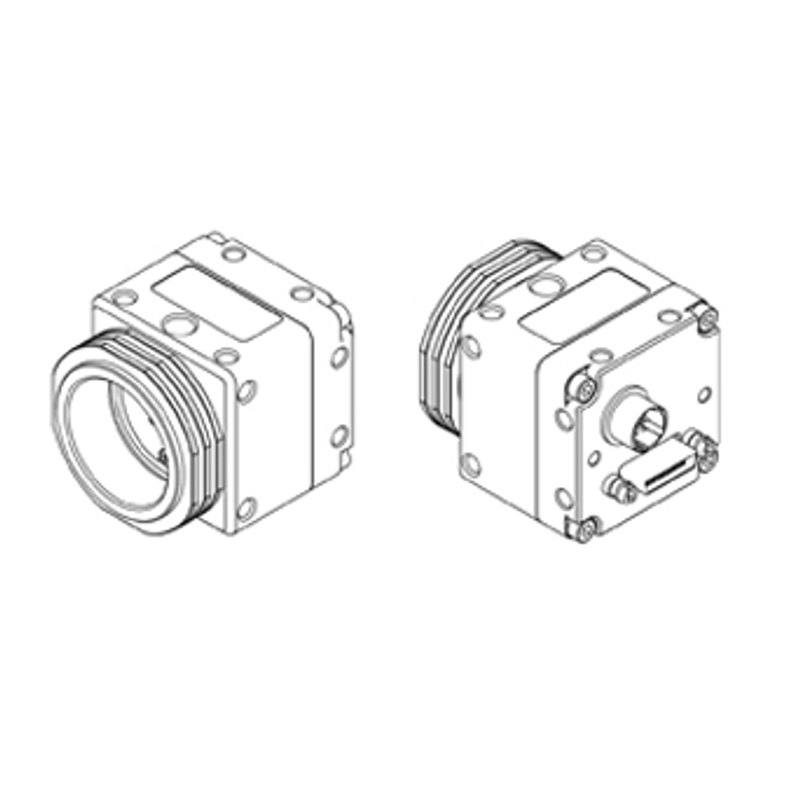
The STC-SPB122BPCL (mono) and STC-SPC122BPCL (color) are compact 12 MP Camera Link area scan cameras built around the Sony IMX304 1.1" global shutter CMOS sensor at 4096 x 3000 pixels and 3.45 µm pixel pitch. Both deliver 15 fps over a Camera Link Base 2.1 interface with PoCL or external 12 V DC power at under 2.8 W. The cameras support ROI, hardware trigger (edge preset and pulse width), programmable gamma, analog gain up to 18 dB, and digital gain up to 11.59x. The monochrome model outputs Mono8/10/12; the color model outputs BayerRG8/10/12 with manual white balance. Both share a compact 35 x 35 x 40.7 mm C-mount housing weighing approximately 69 g and are NDAA-compliant.
The STC-SPB122BPCL and STC-SPC122BPCL are 12-megapixel area-scan cameras built around Sony's IMX304, a 1.1-inch Pregius global-shutter CMOS sensor resolving 4096 x 3000 pixels at a 3.45 µm pixel pitch. The global shutter captures every pixel simultaneously, eliminating the motion-induced skew that rolling-shutter designs produce on moving parts or under strobe lighting — a critical property for dimensional gauging and surface inspection on production lines. At 15 fps over the full 12 MP frame the camera delivers meaningful throughput for part-rate inspection without sacrificing spatial resolution; tighter regions of interest can push frame rates higher, giving integrators headroom for faster conveyor speeds while keeping data bandwidth within the Camera Link Base 2.1 channel. Analog gain up to 18 dB and digital gain up to 11.59x, combined with programmable gamma, allow low-contrast surface features to be lifted without changing illumination hardware.
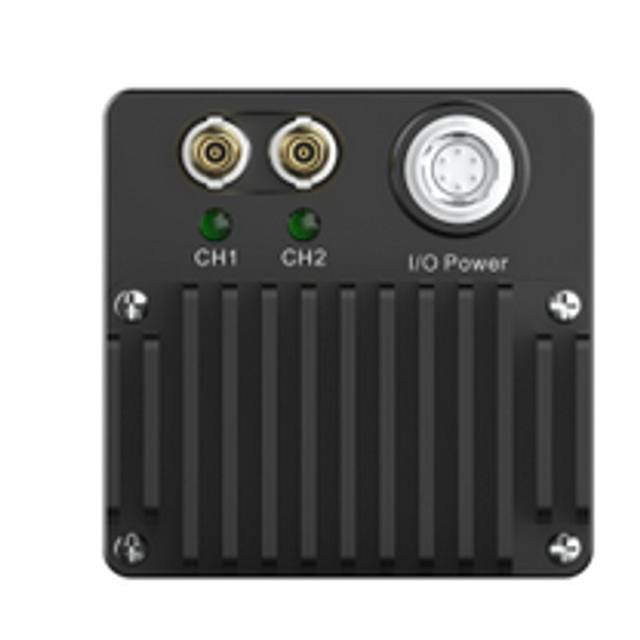
The Camera Link Base 2.1 interface uses a single SDR connector and supports Power over Camera Link (PoCL), which means the camera can draw its sub-2.8 W supply directly from the frame grabber cable, eliminating a separate power harness and simplifying enclosure wiring in space-constrained installations. Where PoCL is not available, an external +12 Vdc input is supported. The C-mount flange is compatible with the broad range of industrial C-mount lenses sized for 1.1-inch or larger image circles — integrators should verify that the chosen lens covers the full 4096 x 3000 pixel array at the 3.45 µm pitch to avoid corner softness. The 35 x 35 x 40.7 mm housing weighing 69 g fits in compact gantry or robot-arm end-effector assemblies.
The monochrome variant (STC-SPB122BPCL) outputs Mono8, Mono10, or Mono12 pixel formats, making it the preferred choice when maximum spatial acuity and sensitivity are required for surface defect detection or fine-pitch character reading, since no Bayer interpolation consumes resolution or reduces per-pixel light collection. The color variant (STC-SPC122BPCL) outputs BayerRG8/10/12 with manual white balance and suits applications where hue discrimination adds inspection value — color solder-mask inspection, label color verification, or pharmaceutical tablet sorting. Both variants support hardware trigger with edge-preset and pulse-width modes, enabling tight synchronization with strobe lighting controllers and PLC-driven part-present signals. The 0 to +45 °C operating range and NDAA compliance position these cameras for factory-floor deployments, including US government-adjacent supply chains that require NDAA-compliant components.
Best for
High-resolution surface defect inspection on flat or formed parts where 12 MP spatial coverage eliminates the need to stitch multiple lower-resolution frames, and where the global shutter prevents smear on moving substrates — particularly relevant in electronics PCB inspection and semiconductor wafer review.
Dimensional measurement tasks requiring fine pixel-level accuracy across wide fields of view: at 4096 x 3000 pixels and a 3.45 µm pitch the camera provides a dense sampling grid that, when paired with a calibrated telecentric or low-distortion C-mount lens, supports sub-pixel edge detection across a 1.1-inch sensor plane.
Industrial OCR and OCV on small-feature marking — laser-etched part numbers, dot-peen codes, or fine inkjet lot codes — where the 12 MP resolution spreads character strokes across many pixels, reducing the risk of mis-reads at line speed.
Packaging and label inspection in pharma or food lines where the color variant's BayerRG output enables simultaneous print-quality assessment and color conformance checking in a single camera pass without auxiliary color sensors.
Robot guidance and pick-and-place alignment on parts with low-contrast or specular features, leveraging the adjustable analog gain, programmable gamma, and hardware trigger to synchronise with strobe illumination and suppress ambient-light variation in open-frame cells.
Selection notes
Lens image-circle coverage: the 1.1-inch sensor is larger than the 2/3-inch and 1/1.8-inch formats common in older camera lines. Verify that any candidate C-mount lens is rated for at least 1.1-inch coverage at the target working distance; undersized lenses will vignette at the corners of the 4096 x 3000 array and degrade measurement accuracy near the field edges.
Camera Link frame grabber compatibility: Camera Link Base 2.1 with SDR connectors is the specified interface — confirm that the host frame grabber supports Base 2.1 and the SDR connector form factor. If the grabber provides PoCL, the camera's sub-2.8 W draw is comfortably within the PoCL budget, but verify that the cable length does not drop PoCL voltage below the camera's +12 Vdc minimum.
Monochrome vs. color variant selection: choose the mono STC-SPB122BPCL when maximum sensitivity or finest spatial resolution is the priority, since Bayer interpolation in the color variant sacrifices a fraction of effective resolution and reduces per-pixel photon collection. Reserve the color STC-SPC122BPCL for applications where hue differentiation is a hard inspection requirement rather than a convenience.
Thermal management and duty cycle: the 0 to +45 °C operating range requires that the mounting surface or enclosure keeps the camera body within this window during sustained production runs. At under 2.8 W the self-heating contribution is modest, but enclosures with poor ventilation or adjacent heat sources (servo drives, lighting power supplies) should be assessed before final installation.
Trigger and lighting synchronisation: hardware trigger supports both edge-preset and pulse-width modes; select pulse-width mode when strobe duration must be precisely controlled to freeze motion, and edge-preset when the part-present signal already has a well-defined dwell time. Ensure the strobe controller's GPIO input is compatible with the camera's trigger output voltage levels and that cable runs do not introduce timing jitter above the motion-blur budget.
Specifications: General
Brand
Omron / Sentech
Camera type
Area Scan
Specifications: Sensor
Resolution
12 MP
Horizontal resolution
4096 x 3000 px
Mono / color
Mono (STC-SPB122BPCL) / Color (STC-SPC122BPCL)
Sensor manufacturer
Sony Pregius
Sensor model
Sony IMX304
Shutter
Global Shutter
Sensor size
1.1 inch
Pixel size
3.45 x 3.45 µm
Specifications: Performance
FPS
15 fps (full scan)
Specifications: Interface
Interface
Camera Link Base 2.1 (SDR x1, PoCL)
Specifications: Optics
Mount
C-Mount
Specifications: Electrical
Power
PoCL or external +12 Vdc
Power consumption
2.8 W
Supply voltage
+12 Vdc (external) or PoCL
Specifications: Environment
Operating temperature
0 to +45 °C
Specifications: Mechanical
Dimensions
35 x 35 x 40.7 mm
Weight
69 g
Applications this camera is commonly selected for. Open one to see the full recommended hardware and approach.
These steps take an Omron Sentech (STC) camera from the box to a stable first image and on to your own application. They apply across the GigE Vision, USB3 Vision and CoaXPress STC families; the interface only changes how you cable and power the camera.
Download and install the Sentech SDK on the host PC. The package provides StViewer, the viewing and configuration software you use to bring the camera up, and StApi, the programming SDK you integrate later. Because the cameras are GenICam/GenTL-compliant, StApi also registers a GenTL producer, so any GenICam-compliant third-party vision software can discover and drive the camera as an alternative front end.
2. Cable, power and connect the camera
Connect according to the interface. GigE Vision: link to a Gigabit NIC (use PoE or the separate power input) and put the camera and host on the same subnet; for USB3 Vision use a USB 3.x port and a certified cable; for CoaXPress (STC) connect to a CoaXPress frame grabber, which also supplies Power-over-Coax. Then open StViewer and let it enumerate the camera. If a GigE camera does not appear, check the IP configuration and firewall, and on USB3 confirm the host bandwidth and driver.
3. Configure exposure, gain and white balance
Open the device in StViewer and start a live stream. Set exposure and gain for a well-exposed, low-noise image: raise exposure first and only add gain when more light or a faster shutter is not an option, keeping exposure short enough to freeze motion on global-shutter models. On colour cameras, run white balance under your actual production lighting. Adjust the lens aperture and focus on a representative target before tuning anything else.
4. Set the trigger and grab a first image
Start in free-run (continuous) acquisition to confirm a clean, stable image. For inline inspection switch to hardware or software triggering: select the trigger source, set the active edge and any delay, and wire the strobe or illumination to the camera's I/O so lighting fires with each exposure. Acquire and save a frame in StViewer; this saved image is your reference for the SDK stage and for downstream inspection.
5. Move to the StApi SDK (or any GenICam software)
Once the image is stable, reproduce the same settings in code. Use StApi to open the device, apply the GenICam features you validated in StViewer (exposure, gain, trigger, pixel format) and grab frames into your application via the bundled C++, C, C#/.NET or Python interfaces; the included samples are the fastest starting point. Prefer a different stack? The same GenICam/GenTL camera works with third-party vision libraries. With a reliable feed, you can route it into a deep-learning inspection such as Rosepetal for AI-based defect detection.
Frequently asked questions
At the full 4096 x 3000 pixel scan the camera delivers 15 fps over Camera Link Base 2.1. Reducing the active area via a region-of-interest setting decreases the number of rows transferred per frame, which raises the achievable frame rate — the exact increase depends on the ROI height selected. The specification does not define a maximum ROI frame rate, so characterise this on the actual frame grabber during integration.
Both variants support Power over Camera Link (PoCL) via the SDR Camera Link connector, drawing under 2.8 W — well within the PoCL specification. If the frame grabber does not provide PoCL, an external +12 Vdc supply connected to the camera's power input is the alternative. No additional power harness is needed when PoCL is available.
The STC-SPB122BPCL mono variant outputs Mono8, Mono10, or Mono12. For sub-pixel edge detection and dimensional measurement, Mono10 or Mono12 is preferred because the additional bit depth preserves gradient information in edge transition zones, improving the precision of centroid and edge-finding algorithms. Mono8 is suitable when bandwidth or storage is constrained and the contrast ratio of the scene is moderate.
Yes. Both the STC-SPB122BPCL and STC-SPC122BPCL are listed as NDAA-compliant, making them eligible for projects operating under US National Defense Authorization Act supply-chain requirements.
The Sony IMX304 sensor measures 1.1 inches diagonally. Any C-mount lens chosen must have an image circle rated for 1.1 inches or larger at the intended working distance and aperture. Using a lens designed for smaller formats — such as 2/3 inch — will cause corner vignetting across the full 4096 x 3000 pixel array and introduce radial shading that degrades uniformity-sensitive inspection tasks.