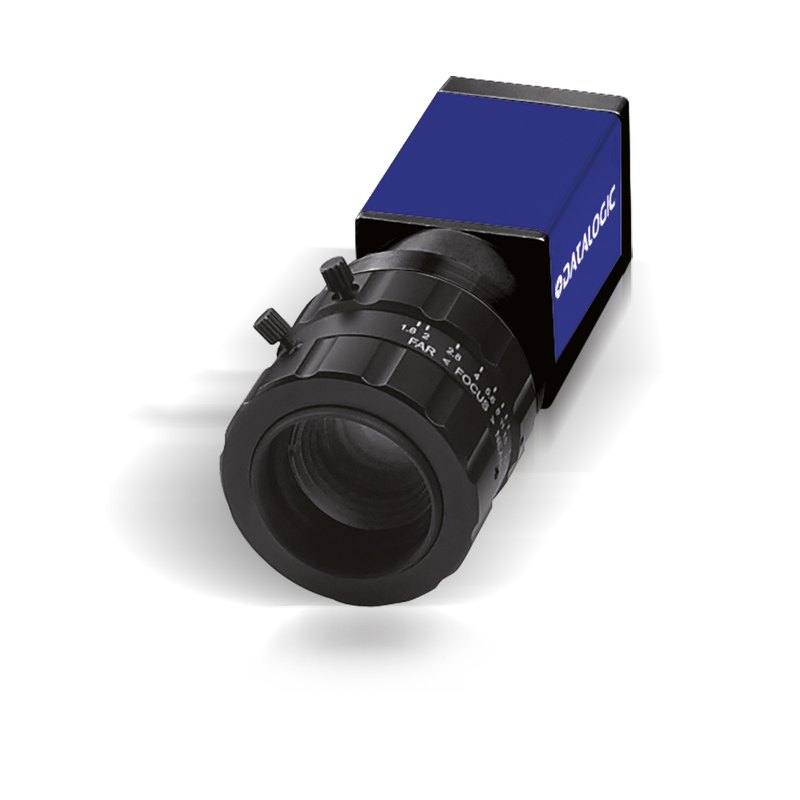
Datasensing CAM-M197C-GE — 5MP GigE Color Area Scan Camera
CAM-M197C-GE
The CAM-M197C-GE (P/N 959931011) belongs to Datalogic/Datasensing's M1xx GigE area scan camera series, offering 2592x1944 resolution at 14 full-resolution fps with a 1/2.5" progressive scan CMOS rolling shutter sensor and 2.2x2.2 µm pixel pitch. The camera connects via standard Gigabit Ethernet and is powered exclusively through Power over Ethernet, eliminating separate power cabling. It features a C-Mount lens interface and is rated IP30 for indoor industrial environments, operating between 0 and 50°C. The color variant uses a Bayer-filter CMOS imager and is compatible with Datalogic Impact Software Release 11.0.0 or greater.
The CAM-M197C-GE pairs a 5 MP (2592 x 1944 pixel) 1/2.5" progressive scan CMOS sensor with a 2.2 x 2.2 µm pixel pitch, delivering a high pixel density that translates directly into fine spatial resolution across a wide field of view. At 14 fps full-resolution over Gigabit Ethernet, the camera is well matched to inspection stations where parts arrive at moderate conveyor speeds and the priority is spatial detail — reading small 2D codes, resolving fine print on labels, or mapping surface texture — rather than capturing sub-millisecond motion. The rolling shutter architecture is appropriate wherever the scene can be illuminated with a continuous or gated strobe short enough to freeze any residual part motion; on stationary or slow-moving targets there is no practical shutter artifact. For applications where high-frequency mechanical vibration or instantaneous part movement must be frozen without artifact, an alternative global-shutter model from the same M1xx family warrants evaluation.
GigE Vision over standard Cat5e/Cat6 Ethernet is the connectivity backbone. The camera accepts either Power over Ethernet or a 12 VDC supply, giving installation flexibility: a PoE-capable switch port or midspan injector eliminates a separate power cable run and is the natural choice for overhead or robot-wrist mounting, while the 12 VDC input allows connection to an existing DC rail where a PoE switch is not available. Either way, the compact 42 x 29 x 29 mm, 90 g body keeps cable routing manageable inside tight fixtures. The GigE Vision protocol is supported by all major machine vision SDKs and third-party software environments, including Datalogic's own Impact Software (Release 11.0.0 or greater), ensuring straightforward integration into both new installations and existing GigE-based line architectures.
The Bayer-filter color CMOS imager distinguishes this variant from the monochrome M197M-GE and makes it the right choice wherever chromatic information adds inspection value — verifying label color correctness, detecting color-coded components on a PCB, distinguishing defect types by hue on food or pharmaceutical packaging, or differentiating ink from substrate on printed materials. The C-Mount lens interface covers the full breadth of industrial-grade C-Mount optics; because the sensor diagonal is 7.13 mm (1/2.5"), any C-Mount lens specified for 1/2.5" or larger image circles will cover the sensor without vignetting. The IP30 rating and 0–50 °C operating range place this camera squarely in controlled indoor factory environments; installations in washdown, dusty, or condensing-humidity zones require an external protective enclosure.
Best for
Label and packaging color verification on food, beverage, and pharmaceutical lines where both print legibility (OCR/OCV) and chromatic accuracy must be confirmed in a single camera pass at moderate conveyor speeds.
Traceability code reading — 2D Data Matrix, QR, and linear barcodes — on small-format labels or directly marked parts, where the 5 MP resolution provides sufficient pixels-per-module even at wider fields of view.
Dimensional measurement and presence/absence inspection of small components in electronics assembly or automotive supplier lines, where the high pixel count supports sub-millimetre feature detection across a useful field of view.
Surface and cosmetic defect inspection on flat or low-relief parts — scratches, stains, colour blotches — in packaging, consumer electronics, and general manufacturing, leveraging the colour sensor to separate defect signatures from background.
Compact integration into fixture or robot-mounted inspection cells where the small 42 x 29 x 29 mm body and flexible power options (PoE or 12 VDC) simplify mechanical and electrical design without sacrificing resolution.
Selection notes
Rolling shutter suitability: verify that part motion during exposure is acceptable. For applications with vibration, impact, or very fast conveyors, evaluate the monochrome or global-shutter variant in the M1xx series before committing to this model.
Power supply options: the camera accepts Power over Ethernet (PoE) or 12 VDC. PoE simplifies single-cable installation when a compatible switch port or midspan injector is available; 12 VDC is an alternative where PoE infrastructure is absent. Confirm which supply method suits the installation before finalising cabling.
Lens selection for the 1/2.5" sensor: choose C-Mount optics with an image circle rated for at least 1/2.5" (7.13 mm diagonal). Lenses designed only for 1/3" sensors will exhibit corner shading. Match focal length to working distance and required field of view using the 2.2 µm pixel pitch as the resolution baseline.
IP30 environmental rating covers only basic protection against solid objects greater than 12 mm; the camera is not splash-proof or dust-tight. For washdown, dusty grinding areas, or outdoor use, specify an appropriate IP65/67-rated enclosure.
Software compatibility: the camera requires Datalogic Impact Software Release 11.0.0 or greater for full feature support within the Datalogic ecosystem. Third-party GigE Vision-compliant SDKs (Cognex VisionPro, Halcon, OpenCV with GenICam transport) are also compatible, but verify trigger and chunk-data feature support against your chosen SDK.
Specifications: General
Brand
Datalogic / Datasensing
Camera type
Area Scan
Specifications: Sensor
Resolution
5 MP
Horizontal resolution
2592 x 1944 px
Mono / color
Color
Shutter
Rolling Shutter (Progressive Scan CMOS)
Sensor size
1/2.5" (7.13mm diagonal)
Pixel size
2.2 x 2.2 µm
Specifications: Performance
FPS
14 fps
Specifications: Interface
Interface
GigE (Gigabit Ethernet)
Protocols
GigE Vision
Specifications: Optics
Mount
C-Mount
Specifications: Electrical
Power
Power over Ethernet (PoE) or 12 VDC
Specifications: Environment
IP rating
IP30
Operating temperature
0 to +50°C
Specifications: Mechanical
Dimensions
42 x 29 x 29 mm
Weight
90 g
Applications this camera is commonly selected for. Open one to see the full recommended hardware and approach.
Matched automatically by: lens mount fits the camera mount · lens image circle covers the camera sensor — this camera: C-Mount · 1/2.5" (7.13mm diagonal) sensor.
By category
All 237C-mount lenses 172Telecentric lenses 62F-mount / large-format lenses 3
By brand
All 237Omron / Sentech 74iRAYPLE 66Basler 65Datalogic / Datasensing 32
1. Install the IMPACT Software Suite and connect the camera
Install the IMPACT Software Suite on your PC, which provides both the configuration/viewer tools and the SDK. For a GigE Vision model (E100, M or U series), connect it to a dedicated NIC and, for USB3 models, use a certified USB3 cable and port. Power the camera and confirm it enumerates.
2. Bring the camera online and verify the link
For GigE Vision, put the camera and the host NIC on the same subnet (a static IP on the camera matching the NIC range is the most reliable starting point); for USB3, confirm the device is recognized. Open the IMPACT viewer/device tool, discover the camera, and verify a stable connection before streaming. Enabling jumbo frames on the NIC helps GigE throughput.
3. Set exposure, gain and trigger, then grab a first image
In the IMPACT tools, start a live stream and adjust exposure and gain until the image is well-lit without saturation; set white balance on color models. Begin in free-run (continuous) mode to confirm imaging, then switch to hardware or software trigger as your application requires. Capture and save a reference image once the scene looks correct.
4. Build a vision tool or move to the SDK/API
Use the IMPACT point-and-click vision tools to assemble an inspection, or use the IMPACT SDK to access the camera and results programmatically and feed them into your HMI/PLC application. As these are GenICam/GenTL-compliant devices, you can alternatively drive them from any GenICam-compliant third-party vision library if your pipeline standardizes on one.
5. Route the stable feed to deep-learning inspection (optional)
Once you have a stable, repeatable image, the feed can be sent to a deep-learning inspection platform such as Rosepetal for defect detection or classification tasks that go beyond rule-based tooling. Keep lighting, optics and trigger timing fixed so the images reaching the model stay consistent.
Frequently asked questions
The CAM-M197C-GE delivers 14 fps at its full 2592 x 1944 resolution over GigE Vision. If a higher frame rate is needed, the effective rate can be increased by using a region of interest (ROI) to reduce the transmitted image height, subject to the capabilities of the GigE Vision driver.
The camera supports both Power over Ethernet (PoE) and 12 VDC power input. PoE is convenient for single-cable installation — a PoE-capable switch port or midspan injector provides both data and power over one Cat5e/Cat6 cable. Where PoE infrastructure is not available, a 12 VDC supply can be used instead.
Rolling shutter exposure means different rows of the sensor are exposed at slightly different instants. For parts moving quickly relative to the exposure time, this can introduce geometric skew. The practical impact depends on part velocity, working distance, and strobe duration. If the application involves high-speed lines or mechanically impacting parts, the global-shutter variant in the M1xx family is a lower-risk choice.
The camera uses a C-Mount lens interface. The sensor diagonal is 7.13 mm (1/2.5"), so any C-Mount lens rated for 1/2.5" or larger image circles — including lenses specified for 1/2", 2/3", or 1" formats — will provide full sensor coverage without vignetting.
The camera implements the GigE Vision standard, which is supported by all major machine vision SDKs including Halcon, Cognex VisionPro, NI Vision, and open-source GenICam-based libraries. Datalogic Impact Software Release 11.0.0 or greater is required for full integration within the Datalogic ecosystem, but the camera is not locked to that platform.