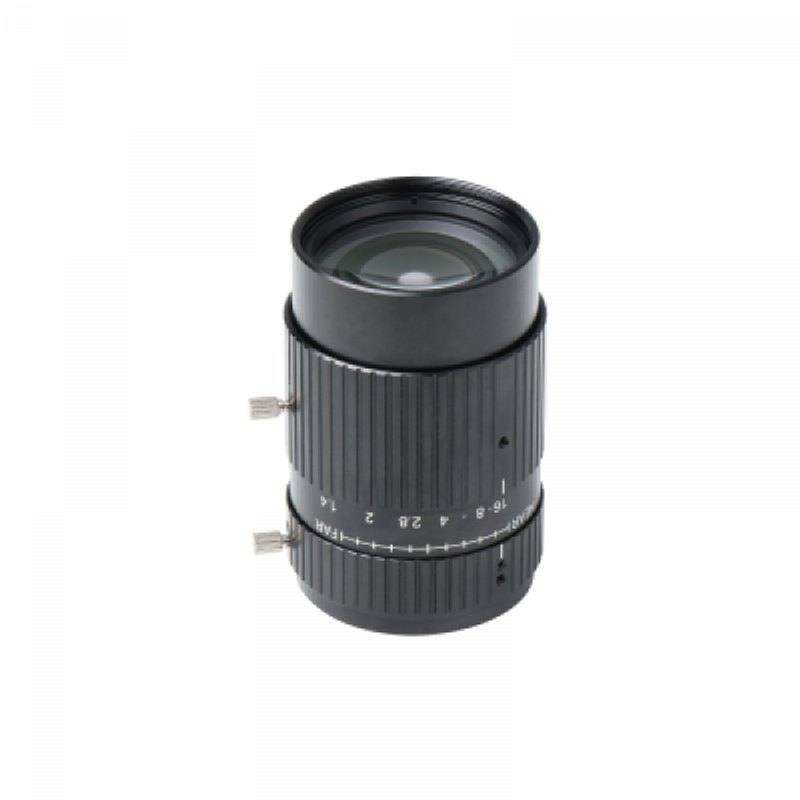
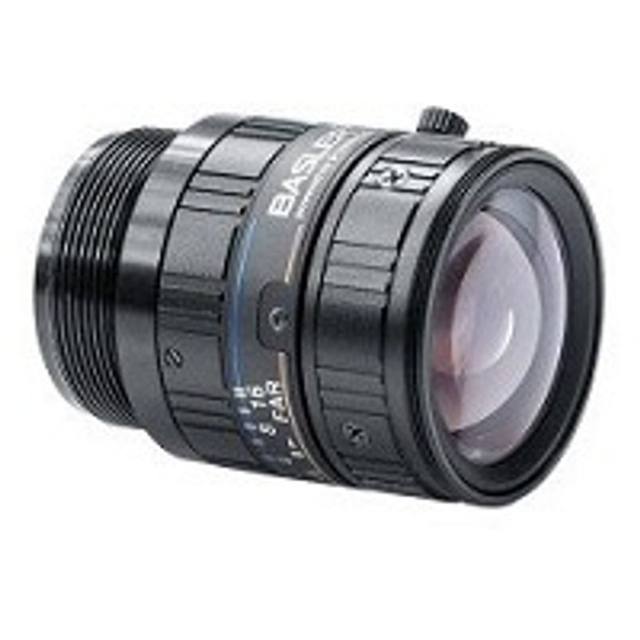
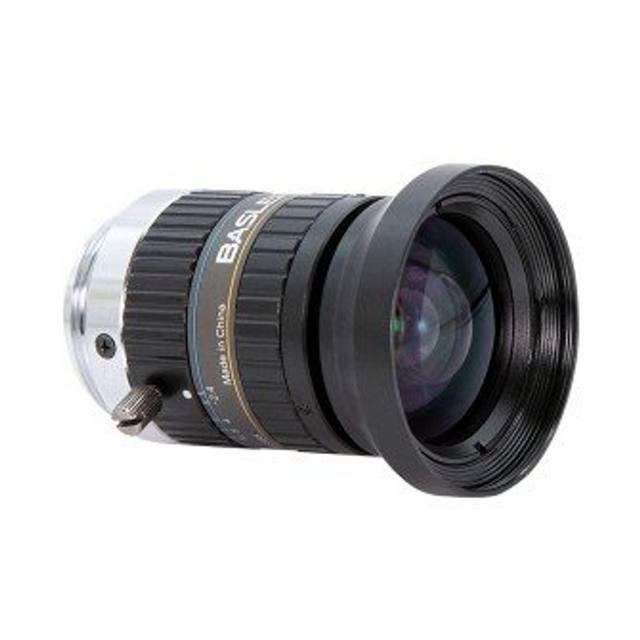
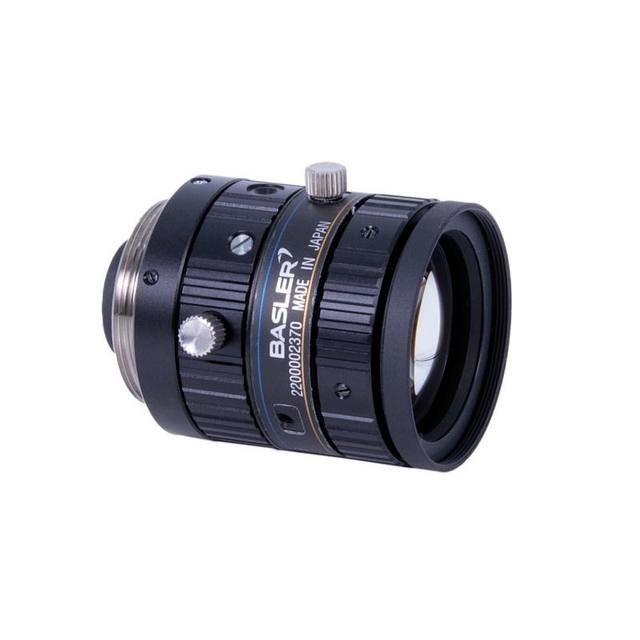
The iRAYPLE MH0814X (also marketed by parent company Dahua as DH-MH0814X / DH-MV-MH0814XE) is an industrial C-mount fixed-focal-length lens designed for 1" format sensors. It provides an 8mm focal length with a fast F1.4 maximum aperture, covering a diagonal field of view of 89.5° on a 1" sensor and delivering 10 MP optical resolution. The lens uses a large M58×P0.5 filter thread and manual controls for both focus and iris, operating across a 400–900 nm spectral range.
Brand
iRAYPLE
Focal length
8 mm
Lens mount
C-Mount
Aperture (f-number)
F1.4
Image circle / max sensor
1" (16 mm)
Optical resolution
8 MP (per document title) or 10MP (per spec table — ambiguous in source)
The iRAYPLE MH0814X is an 8 mm fixed-focal-length C-mount lens engineered for 1" format image sensors, with a 16 mm image circle that covers every pixel on current 1" area-scan cameras without vignetting. At 8 mm, the focal length produces a wide-angle perspective — the diagonal field of view reaches 89.5° on a 1" sensor — making it well suited to scenes where a large area must be captured from a short working distance, such as conveyor inspections, robotic pick-and-place cells, or panel-level electronics checks. The fast F1.4 maximum aperture gives installers extra light-gathering capacity: compared with an F2.8 lens, F1.4 delivers four times as much light to the sensor, which translates directly into shorter exposure times, higher frame-rate headroom, or the ability to use lower-intensity lighting without sacrificing signal quality. The lens resolves up to 10 MP across its image circle, meaning it will not be the resolving bottleneck even when paired with high-pixel-count 1" sensors in the 10 MP class.
Manual iris and manual focus controls let the installer lock aperture and focus once during commissioning, eliminating any risk of motorised drift in a vibration-prone factory environment. The M58×P0.5 filter thread enables the use of 58 mm bandpass, polarising, or neutral-density filters. The 400–900 nm spectral operating range spans the full visible spectrum and extends well into the near-infrared (NIR), so the lens can be used with both visible-light LED arrays and NIR illuminators without switching optics. The minimum working distance of 100 mm sets the practical close-focus limit; objects closer than 100 mm will not reach sharp focus, so applications requiring inspection of very small parts at extreme proximity will need an extension tube or a purpose-built macro optic instead. Physically, the lens measures 60.0 mm in diameter and 77.8 mm in length and weighs 369 g — heavier than compact board-level lenses but appropriate for a robust 1" industrial design — and it operates reliably between -10 °C and +50 °C, which covers most indoor and climate-controlled industrial environments.
Because this is a conventional (non-telecentric) lens, the magnification changes with object distance, which means dimensional measurements that require true perspective-free orthographic projection are not directly supported. For gauging tasks where sub-pixel geometric accuracy matters across the full field, the installer must either calibrate out perspective distortion in software or evaluate whether a telecentric design is required. For detection, presence/absence, surface inspection, or coarse dimensional checks, the non-telecentric design is entirely adequate. The C-mount interface is the most widely adopted mount standard in industrial machine vision, ensuring the MH0814X can slot into almost any existing or new camera-based vision cell with no adapter ring required for sensors up to 1".
Best for
Wide-area panel and PCB inspection on 1" cameras where an 89.5° field of view lets a single camera cover a large substrate from 100 mm working distance without a multi-camera array.
Robot guidance and bin-picking cells where the F1.4 aperture supports very short exposures to freeze motion without requiring extremely bright or expensive strobe lighting.
Surface and defect inspection under both visible LED and NIR illumination, enabled by the 400–900 nm spectral range that eliminates the need to swap lenses when changing illumination wavelength.
Logistics and packaging line vision stations where high ambient light variability benefits from a manually lockable wide-aperture iris, and where the C-mount interface simplifies camera interchange.
General-purpose machine vision builds on 1" sensors that need a cost-effective, high-resolution wide-angle prime lens with a standard filter thread for optional bandpass or polarising filter accessories.
Selection notes
Sensor format compatibility: the 16 mm image circle fully covers 1" sensors; if your camera uses a sensor with a diagonal larger than 16 mm, the image circle will not cover the corners — verify your sensor's diagonal before pairing.
Working distance floor: the 100 mm minimum working distance is a hard constraint at commissioning — measure your camera-to-object standoff before finalising bracket design, and add an extension tube only if you understand the effect on infinity focus.
Telecentric requirement: this lens is not telecentric, so edge-to-edge magnification is not constant. If your dimensional gauging specification requires perspective-free imaging across the full field, evaluate a telecentric alternative before committing to this optic.
Filter thread size: the M58×P0.5 thread accepts standard 58 mm photographic and industrial filters. If your optical path requires a specific filter outside that size, confirm adapter availability or plan for filter mounting upstream of the lens.
Temperature operating range: rated -10 °C to +50 °C, which suits climate-controlled factories and logistics warehouses; for outdoor or environments exceeding this range, additional housing or a different optic is required.
Specifications: General
Brand
iRAYPLE
Specifications: Optical
Focal length
8 mm
Lens mount
C-Mount
Aperture (f-number)
F1.4
Image circle / max sensor
1" (16 mm)
Optical resolution
8 MP (per document title) or 10MP (per spec table — ambiguous in source)
Telecentric
No
Working distance
100 mm to infinity
Specifications: Environment
Operating temperature
-10 °C to +50 °C
Specifications: Mechanical
Dimensions
Ø60.0 × 77.8 mm
Weight
369 g
Applications this camera is commonly selected for. Open one to see the full recommended hardware and approach.
Matched automatically by: camera mount fits the lens mount · camera sensor is covered by the lens image circle — this lens: C-Mount · 1" (16 mm) image circle.
Follow these steps to bring up your iRAYPLE camera, capture a first image, and move from the viewer to your own application. The flow is the same across the A, AE, AX and L series; only the physical interface differs.
Download and install the iRAYPLE machine-vision SDK together with its viewer client for your operating system. The installer provides the camera drivers, the GenTL producer, and the viewer you will use for first light. For GigE Vision models, also install or enable the bundled filter/performance driver on the network adapter to maximize throughput.
2. Connect the camera to the correct interface
Wire the camera to its matching host interface: a dedicated Gigabit (or 10 GigE) NIC for GigE Vision models, a USB3 Vision port with a quality cable for USB3 models, or a frame grabber for CoaXPress models. Power the camera (PoE, USB bus power, or PoCXP / external supply as applicable). For GigE Vision, put the NIC and camera on the same subnet and, where supported, enable jumbo frames.
3. Detect and open the camera in the viewer
Launch the iRAYPLE viewer, run device enumeration, and select your camera from the discovered list. Open it to load the device feature tree (GenICam node map). If a GigE camera is found but cannot be opened, correct the IP configuration so the camera and NIC are in the same address range.
4. Set exposure, gain and trigger, then grab a first image
Start with continuous (free-run) acquisition under stable lighting. Adjust exposure time and gain for a well-exposed, low-noise image, set the pixel format (e.g. Mono8 or a Bayer/RGB format), and tune white balance on color models. Once the live image looks correct, switch trigger mode to hardware or software trigger to synchronize capture with your process, and verify a single triggered frame.
5. Move from the viewer to the SDK or a GenICam library
With imaging confirmed, reproduce the same settings in code using the SDK's C/C++ or Python API: enumerate, open, configure the relevant GenICam features, register a frame callback or grab loop, and convert frames to your pipeline's buffer format. Since the cameras are GenICam/GenTL-compliant, you can alternatively drive them from a third-party GenICam vision library. From here a stable image stream can feed a deep-learning inspection step such as Rosepetal for automated quality control.
Frequently asked questions
The MH0814X has a 16 mm image circle, which corresponds to the 1" sensor format. Sensors with a diagonal up to 16 mm — including 1" and smaller formats — are fully covered. Sensors with a diagonal larger than 16 mm will exhibit corner darkening and should not be paired with this lens.
Yes. The specified spectral operating range is 400–900 nm, which spans visible light and extends into the NIR. The lens can be used with NIR LED illuminators in this range without optical performance degradation, and the same optic serves both visible and NIR setups.
The lens is rated to resolve 10 MP across the image circle. This means it will not be the limiting resolving factor when paired with cameras up to the 10 MP class on a 1" sensor.
The minimum working distance is 100 mm. Objects closer than 100 mm cannot be brought into focus without the addition of extension tubes, which would sacrifice infinity focus. For inspection of very small targets at short range, evaluate whether extension tubes are acceptable or whether a macro-capable lens is more appropriate.
The MH0814X uses a manual iris with no motorised or DC-iris variant described in the specifications. This is standard for fixed-station machine vision installations where aperture is set once at commissioning and does not need to change dynamically. The iris can be locked in position to prevent unintentional adjustment from vibration.