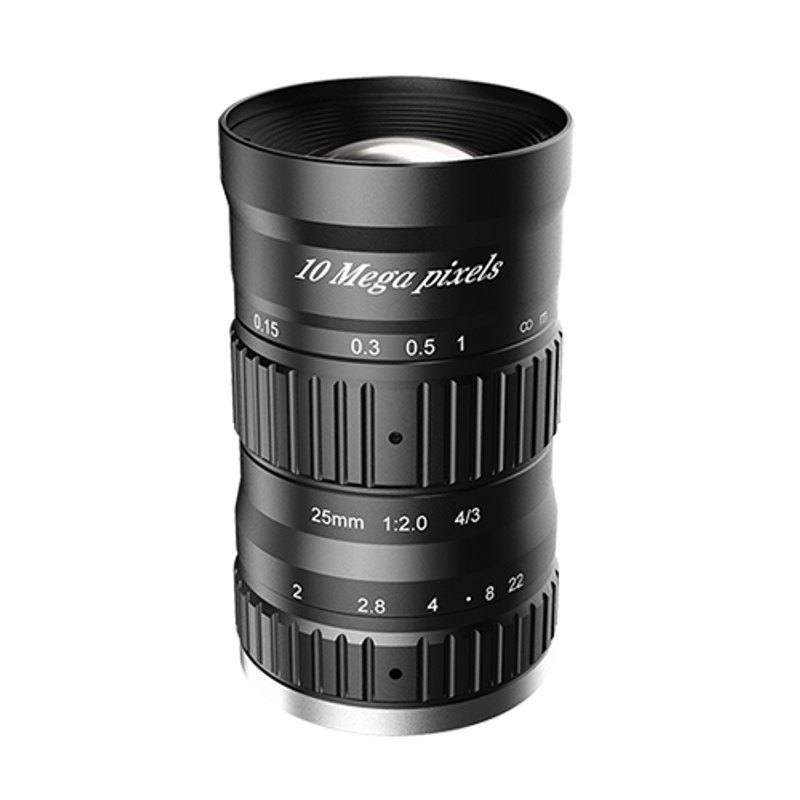
The MH2520K is part of iRAYPLE's MH-K series, offering a 25mm focal length with a large F2.0 aperture and a 23mm (4/3") image circle. It provides high resolution performance for up to 10MP cameras across the full field of view, with low optical distortion of -0.66% and a TV distortion of -0.25%. The lens features manual focus and iris control, operates over a wide temperature range of -20°C to +50°C, and includes a M46xP0.5 filter thread in a compact 82.7mm x Ø47.5mm body weighing 251g.
The iRAYPLE MH2520K is a 25mm fixed focal length, C-mount lens built around a 23mm image circle that fully covers 4/3" format sensors — the largest sensor class widely adopted in modern high-resolution machine vision cameras. At 10MP optical resolution sustained across the full field, it is engineered to pair with 10MP sensors without resolution becoming the bottleneck at the image corners, a failure mode that afflicts lower-grade optics when pushed to large formats. The maximum aperture of F2.0 is meaningfully bright for an industrial fixed-focal lens at this focal length, giving integrators headroom to reduce illuminator intensity, shorten exposure times on fast-moving parts, or operate in lower-contrast lighting environments while keeping signal above the noise floor. The iris closes to F22, providing a wide depth-of-field adjustment range for applications where working distance varies slightly or where simultaneous focus across a stepped surface is needed.
For coverage and field-of-view calculations, 25mm on a 4/3" sensor yields a moderate telephoto angle of view — narrower than a 16mm wide-angle but substantially wider than a 35mm or 50mm used for tighter inspection windows. This focal length is a reliable general-purpose choice for object-to-camera distances where the field of view must capture mid-sized parts without excessive perspective distortion. The minimum focus distance of 150mm to infinity means the lens can work quite close — useful for electronics board inspection or pharmaceutical blister packs — while the same optic scales up to conveyor-level stand-off without optical compromise. The distortion specification of -0.66% (geometric) and -0.25% (TV distortion) is low enough for dimensional measurement and gauging applications where sub-pixel accuracy is expected; most vision software calibration routines can reduce residual distortion below 0.1 pixels at these levels, preserving metrology integrity.
Mechanically, the 82.7mm length and 47.5mm barrel diameter keep the lens compact relative to its image circle coverage, and the 251g mass is compatible with standard C-mount camera housings without requiring additional lens support brackets on all but the most vibration-sensitive gantry systems. Manual focus and manual iris controls are appropriate for fixed-station machine vision — once set and locked, they remain stable across the -20°C to +50°C operating temperature range, which covers unheated factory floors, outdoor inspection enclosures, and internal oven-adjacent stations. The M46×P0.5 filter thread accepts standard industrial bandpass, polarizing, or neutral-density filters, enabling wavelength tuning to match LED illuminators or manage reflections without needing separate filter holders. C-mount flange compatibility is universal across the GigE, USB3, CoaXPress, and Camera Link camera ecosystems, so the lens integrates into existing infrastructure without adapter rings or flange-distance adjustments.
Best for
High-resolution surface and defect inspection on 10MP 4/3" cameras where edge-to-edge sharpness is required, such as flat-panel display glass, PCB copper layer inspection, or metal stamping surface review
Dimensional measurement and gauging applications where the -0.66% geometric distortion keeps coordinate accuracy within metrology tolerances after software calibration
Packaging and label inspection — pharmaceutical blister packs, food carton graphics, and label print verification — where the F2.0 aperture enables shorter exposures under moderate strobe illumination to freeze motion on mid-speed conveyors
OCR/OCV and barcode reading stations on 4/3" format cameras where maximum pixel density across the full image circle is needed to resolve fine character strokes or high-density 2D codes without letter-level blur at field edges
Automotive and electronics component inspection in temperature-variable environments (unheated assembly halls or near-process heat zones) where the -20°C to +50°C operating temperature rating eliminates the need for lens heaters or enclosure temperature control
Selection notes
Sensor format compatibility: the 23mm image circle is sized for 4/3" sensors. Pairing with smaller formats (1", 2/3", 1/2") is fully compatible and will simply use the sharper central zone of the optic; pairing with sensors larger than 4/3" will produce vignetting and resolution roll-off in corners, making the MH2520K unsuitable for larger-format cameras.
Resolution ceiling: at 10MP optical resolution the lens is matched to current 10MP 4/3" sensors. Cameras at 5MP or below will not stress the optic, but integrators planning a future upgrade path to higher resolution on the same format should verify with iRAYPLE's MTF curves whether resolution headroom is sufficient before committing the lens to that station.
Aperture and exposure trade-off: the F2.0 maximum aperture provides a brightness advantage but comes with shallower depth of field at close working distances. For parts with significant Z-height variation (tall connectors, irregular castings), stopping down to F5.6–F8 will recover depth of field at the cost of requiring brighter or longer-pulse illumination — factor this into illuminator selection and strobe controller power budget.
Filter thread utilization: the M46×P0.5 thread is a non-standard diameter; verify filter availability (bandpass, polarizer, ND) from your preferred supplier at this thread size before designing the optical stack, or plan for a step-up ring to a more common thread diameter.
Working distance minimum: the 150mm minimum focus distance sets the closest the lens can resolve sharply. For very small parts requiring macro-level magnification at sub-150mm stand-off, a macro spacer ring or alternative macro lens is needed — the MH2520K is not a macro optic and does not cover close-up gauging at sub-150mm distances.
Specifications: General
Brand
iRAYPLE
Specifications: Optical
Focal length
25mm
Lens mount
C-Mount
Aperture (f-number)
F2.0 - F22
Image circle / max sensor
23mm (4/3")
Optical resolution
10 MP
Telecentric
No
Working distance
150mm to ∞
Specifications: Environment
Operating temperature
-20°C to +50°C
Specifications: Mechanical
Dimensions
82.7mm x Ø47.5mm
Weight
251 g
Applications this camera is commonly selected for. Open one to see the full recommended hardware and approach.
Matched automatically by: camera mount fits the lens mount · camera sensor is covered by the lens image circle — this lens: C-Mount · 23mm (4/3") image circle.
Follow these steps to bring up your iRAYPLE camera, capture a first image, and move from the viewer to your own application. The flow is the same across the A, AE, AX and L series; only the physical interface differs.
Download and install the iRAYPLE machine-vision SDK together with its viewer client for your operating system. The installer provides the camera drivers, the GenTL producer, and the viewer you will use for first light. For GigE Vision models, also install or enable the bundled filter/performance driver on the network adapter to maximize throughput.
2. Connect the camera to the correct interface
Wire the camera to its matching host interface: a dedicated Gigabit (or 10 GigE) NIC for GigE Vision models, a USB3 Vision port with a quality cable for USB3 models, or a frame grabber for CoaXPress models. Power the camera (PoE, USB bus power, or PoCXP / external supply as applicable). For GigE Vision, put the NIC and camera on the same subnet and, where supported, enable jumbo frames.
3. Detect and open the camera in the viewer
Launch the iRAYPLE viewer, run device enumeration, and select your camera from the discovered list. Open it to load the device feature tree (GenICam node map). If a GigE camera is found but cannot be opened, correct the IP configuration so the camera and NIC are in the same address range.
4. Set exposure, gain and trigger, then grab a first image
Start with continuous (free-run) acquisition under stable lighting. Adjust exposure time and gain for a well-exposed, low-noise image, set the pixel format (e.g. Mono8 or a Bayer/RGB format), and tune white balance on color models. Once the live image looks correct, switch trigger mode to hardware or software trigger to synchronize capture with your process, and verify a single triggered frame.
5. Move from the viewer to the SDK or a GenICam library
With imaging confirmed, reproduce the same settings in code using the SDK's C/C++ or Python API: enumerate, open, configure the relevant GenICam features, register a frame callback or grab loop, and convert frames to your pipeline's buffer format. Since the cameras are GenICam/GenTL-compliant, you can alternatively drive them from a third-party GenICam vision library. From here a stable image stream can feed a deep-learning inspection step such as Rosepetal for automated quality control.
Frequently asked questions
The MH2520K has a 23mm image circle, which fully covers 4/3" format sensors. Sensors up to and including 4/3" format are supported. Sensors with a diagonal larger than 23mm will show vignetting toward the corners.
Geometric distortion is specified at -0.66% and TV distortion at -0.25%, both of which are low by general-purpose lens standards. Most machine vision software calibration routines can correct residual distortion to sub-pixel levels from this baseline, making the lens appropriate for dimensional measurement and gauging when a calibration target procedure is performed at installation.
The minimum focus distance is 150mm from the lens. Below this distance the image will not focus sharply. The MH2520K is not a macro lens; for inspection of very small features at under 150mm stand-off, a dedicated macro lens or close-focus spacer is required.
The operating temperature range is -20°C to +50°C. Within this range, manual focus and iris locks hold their set positions and the optical prescription remains stable. For installations at temperatures outside this range, additional thermal management of the lens housing would be necessary.
The lens accepts M46×P0.5 filters. This is a less common thread diameter than M52 or M58 found on larger industrial lenses. Confirm that your chosen bandpass, polarizing, or ND filter supplier offers M46 sizing, or plan for a step-up adapter ring to reach a more widely stocked thread diameter.