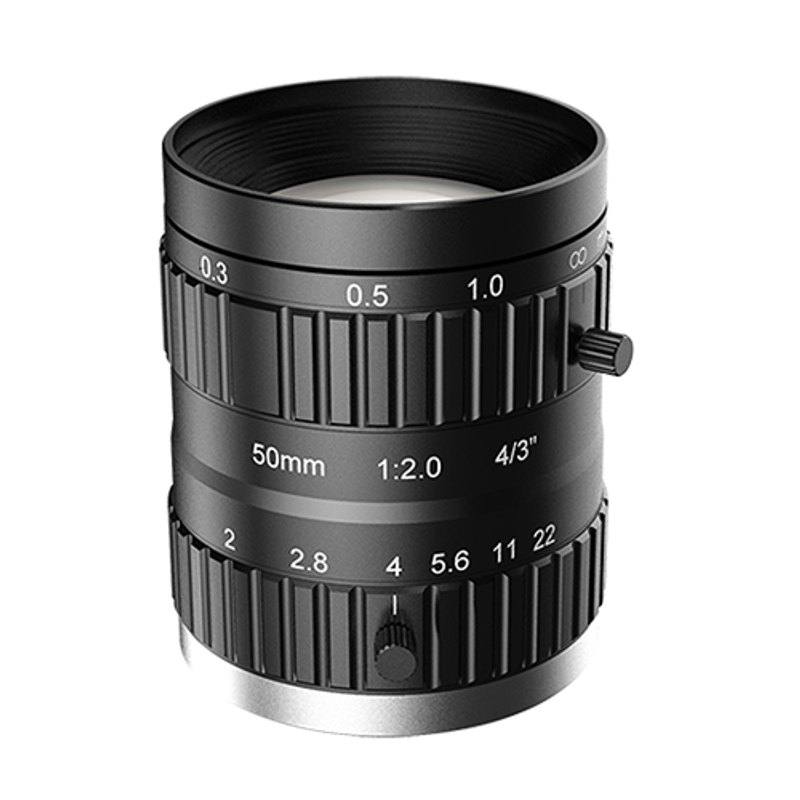
The MH5020K belongs to iRAYPLE's MH-K Series of area scan lenses, offering 50mm focal length with an F2.0–F22 aperture range and support for 4/3" (23mm diameter) image sensors. It delivers high resolution sufficient for 10MP cameras across the full field of view, with very low optical distortion of -0.14%. The lens features manual focus and iris controls, a C-mount interface, and is designed for stable optical performance across a temperature range of -20°C to +50°C.
The iRAYPLE MH5020K is a 50mm fixed focal length C-mount lens rated for sensors up to 4/3" (23mm image circle diameter) and resolving up to 10 megapixels across the full field. At 50mm, the focal length provides a moderate telephoto perspective compared to standard 25mm or 35mm machine-vision lenses, meaning for a given sensor-to-subject distance you capture a narrower, more magnified field of view — a practical advantage when the camera must be mounted well back from the part, or when you need to isolate a small region of interest without cropping resolution. The F2.0 maximum aperture gives useful light-gathering headroom for dim targets or fast strobing without opening so wide that depth of field becomes unmanageable; stopping down toward F4–F8 on a production line brings MTF performance into the flat, high-contrast region of the lens while still keeping exposure times workable with conventional LED lighting.
The 23mm image circle fully illuminates 4/3" sensors — a format now common in 10MP and 12MP area-scan cameras from mainstream GigE and USB3 Vision platforms. Using this lens on smaller sensors (1" or 2/3") is optically safe and exploits only the sharpest central portion of the field; using it on sensors larger than 4/3" will introduce vignetting at the corners and should be avoided. The minimum working distance of 300mm is the near-focus limit at which the lens can still form a sharp image; for most bench-top or over-conveyor inspection heads this is comfortably achievable. Mechanical dimensions of 60.9mm length by 42.6mm diameter and a mass of 170g are mid-range for a 10MP-class C-mount — the lens will not overload standard camera-mount brackets but installers should verify that the combined camera-plus-lens center-of-gravity does not induce vibration-related focus drift on lightweight gantries.
Optical distortion is specified at -0.14%, a very low barrel distortion figure that keeps straight edges nearly straight across the frame. For dimensional gauging, this means sub-pixel geometric correction is often sufficient and the correction LUT is shallow, preserving measurement confidence near the image periphery. Manual focus and manual iris rings give the integrator direct mechanical control without any electrical dependency — adjustment lock screws (standard practice on C-mount lenses of this class) should be used once focus and f-stop are set at commissioning to prevent drift from vibration. The operating temperature range of -20°C to +50°C covers both refrigerated production environments (food, pharmaceutical cold rooms) and warm factory floors, though the manual iris should be rechecked after any significant ambient temperature swing since thermal expansion can marginally shift the parfocal point.
Best for
High-resolution surface and defect inspection on 10MP cameras where the camera must be mounted 300mm or more from the part and a narrow field of view is required to resolve fine features — for example, PCB trace inspection, pharmaceutical blister-pack print verification, or label text validation.
Dimensional measurement tasks on 4/3" sensor cameras where low geometric distortion (-0.14%) is essential for accurate edge-based gauging near the image periphery — such as connector pin pitch, stamped-part outline, or pharmaceutical tablet diameter on a flat belt.
OCR and OCV on small print fields: the 50mm focal length combined with a 10MP sensor provides a high pixels-per-character count over a narrow FOV, making it well suited to reading date codes, lot numbers, or data-matrix symbols on labels or directly-marked parts.
Inspection stations with constrained optics access where a longer working distance (beyond the 300mm minimum) is needed to keep the lens clear of guarding, conveyors, or hot surfaces — the 50mm focal length naturally delivers a smaller FOV per unit of working distance compared to shorter lenses, avoiding the need for extension tubes.
Multi-sector traceability and packaging lines — the broad sector coverage (automotive, electronics, semiconductor, pharma, packaging, logistics, printing) reflects that this is a general-purpose, high-resolution fixed lens suited wherever a compact C-mount body, full 4/3" coverage, and very low distortion are more important than zoom flexibility or telecentric geometry.
Selection notes
Sensor size compatibility is a firm constraint: the 23mm image circle fully covers 4/3" sensors. Confirm the target camera's sensor format before ordering — cameras with sensors larger than 4/3" (such as full-frame or APS-C variants appearing in some high-resolution smart cameras) will show corner vignetting.
Telecentricity: the MH5020K is a conventional (non-telecentric) lens. Magnification changes with object distance, so any part-height variation or Z-axis vibration introduces a measurable scaling error. For gauging applications where part stand-off is not tightly controlled, a telecentric lens should be evaluated instead; for inspection and reading tasks where this perspective error is acceptable, the MH5020K is a cost-effective choice.
Resolution budget: the lens is rated for 10MP. Pairing it with cameras above 10MP (12MP, 20MP) on a 4/3" sensor will likely reveal the lens as the limiting element — resolving power at the corners may fall below the sensor's Nyquist limit at wide apertures. Test center-vs-corner MTF at the intended working aperture before committing to a >10MP camera pairing.
Working distance and FOV planning: 300mm is the near-focus limit. Use a standard thin-lens FOV calculator with the 50mm focal length and your camera's actual sensor dimensions to determine the field of view at the intended working distance before mechanical installation. Increasing working distance proportionally increases FOV — plan the stand-off to match the target part size.
Locking down manual controls: both the focus ring and iris ring are manual with an F2.0–F22 aperture range. After setting focus and aperture at commissioning temperature, apply the lens's lock-screw mechanism and document the f-stop value. Vibration over time can shift an unlocked iris, altering exposure and depth of field in ways that may not be immediately obvious from image brightness alone.
Specifications: General
Brand
iRAYPLE
Specifications: Optical
Focal length
50mm
Lens mount
C-Mount
Aperture (f-number)
F2.0–F22
Image circle / max sensor
23mm (4/3")
Optical resolution
10MP
Telecentric
No
Working distance
300mm to ∞
Specifications: Environment
Operating temperature
-20°C to +50°C
Specifications: Mechanical
Dimensions
60.9mm × Ø42.6mm
Weight
170 g
Applications this camera is commonly selected for. Open one to see the full recommended hardware and approach.
Matched automatically by: camera mount fits the lens mount · camera sensor is covered by the lens image circle — this lens: C-Mount · 23mm (4/3") image circle.
Follow these steps to bring up your iRAYPLE camera, capture a first image, and move from the viewer to your own application. The flow is the same across the A, AE, AX and L series; only the physical interface differs.
Download and install the iRAYPLE machine-vision SDK together with its viewer client for your operating system. The installer provides the camera drivers, the GenTL producer, and the viewer you will use for first light. For GigE Vision models, also install or enable the bundled filter/performance driver on the network adapter to maximize throughput.
2. Connect the camera to the correct interface
Wire the camera to its matching host interface: a dedicated Gigabit (or 10 GigE) NIC for GigE Vision models, a USB3 Vision port with a quality cable for USB3 models, or a frame grabber for CoaXPress models. Power the camera (PoE, USB bus power, or PoCXP / external supply as applicable). For GigE Vision, put the NIC and camera on the same subnet and, where supported, enable jumbo frames.
3. Detect and open the camera in the viewer
Launch the iRAYPLE viewer, run device enumeration, and select your camera from the discovered list. Open it to load the device feature tree (GenICam node map). If a GigE camera is found but cannot be opened, correct the IP configuration so the camera and NIC are in the same address range.
4. Set exposure, gain and trigger, then grab a first image
Start with continuous (free-run) acquisition under stable lighting. Adjust exposure time and gain for a well-exposed, low-noise image, set the pixel format (e.g. Mono8 or a Bayer/RGB format), and tune white balance on color models. Once the live image looks correct, switch trigger mode to hardware or software trigger to synchronize capture with your process, and verify a single triggered frame.
5. Move from the viewer to the SDK or a GenICam library
With imaging confirmed, reproduce the same settings in code using the SDK's C/C++ or Python API: enumerate, open, configure the relevant GenICam features, register a frame callback or grab loop, and convert frames to your pipeline's buffer format. Since the cameras are GenICam/GenTL-compliant, you can alternatively drive them from a third-party GenICam vision library. From here a stable image stream can feed a deep-learning inspection step such as Rosepetal for automated quality control.
Frequently asked questions
The MH5020K has a 23mm image circle, which corresponds to the 4/3" sensor format. Sensors up to and including 4/3" are fully covered. Using the lens on sensors larger than 4/3" will produce darkened or vignetted corners and is not recommended.
It is well suited to measurement tasks where perspective-induced magnification change is acceptable. Optical distortion is specified at -0.14% — an extremely low figure that minimises geometric error across the frame. However, the lens is non-telecentric, so part-height variation causes magnification change. For gauging where part Z-position cannot be tightly controlled, a telecentric alternative should be considered.
The minimum working distance is 300mm. Below this distance the lens cannot form a focused image. There is no specified maximum — the lens focuses to infinity, making it appropriate for both close-range inspection and longer stand-off installations.
The MH5020K is designed and rated for cameras up to 10MP. Pairing it with sensors above 10MP on the 4/3" format may result in the lens becoming the resolution bottleneck, particularly toward the image corners. A full performance evaluation at the intended aperture is advisable before finalising a >10MP camera pairing.
The aperture range is F2.0 to F22. Both the focus ring and the iris ring are manual — there is no electronic iris or DC-iris control. Once the working aperture is set at commissioning, the lock-screw should be applied to prevent drift from vibration.
Yes. The operating temperature range is -20°C to +50°C, which covers refrigerated food and pharmaceutical production environments as well as warm factory floors. Installers should re-verify focus after initial thermal stabilisation in cold environments, as thermal contraction can marginally shift the focus point from the setting established at room temperature.