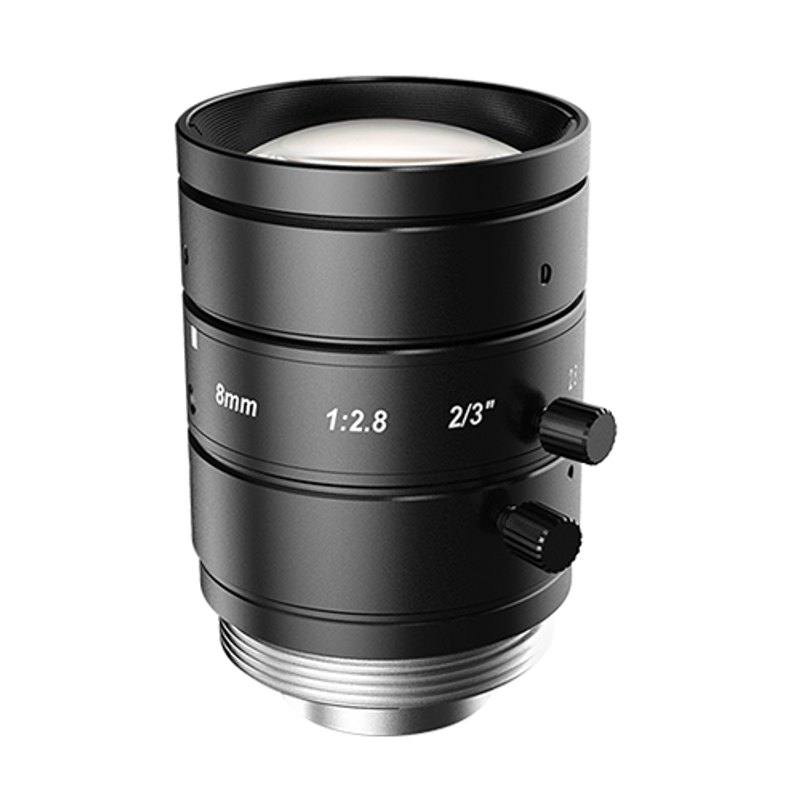
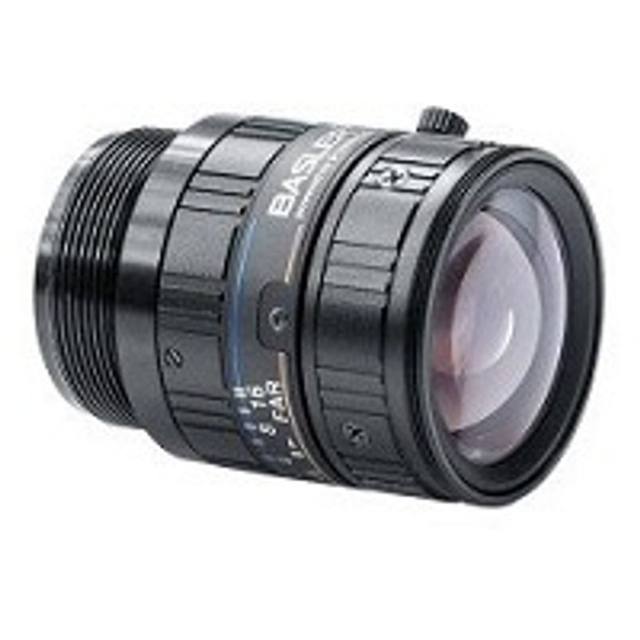
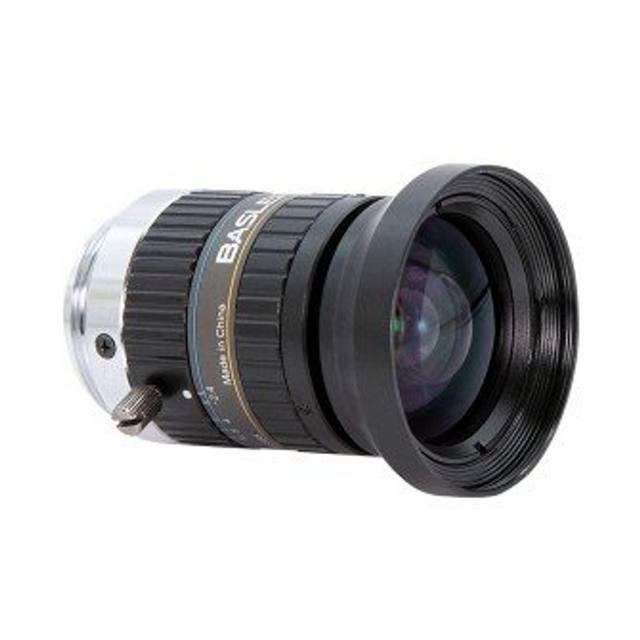
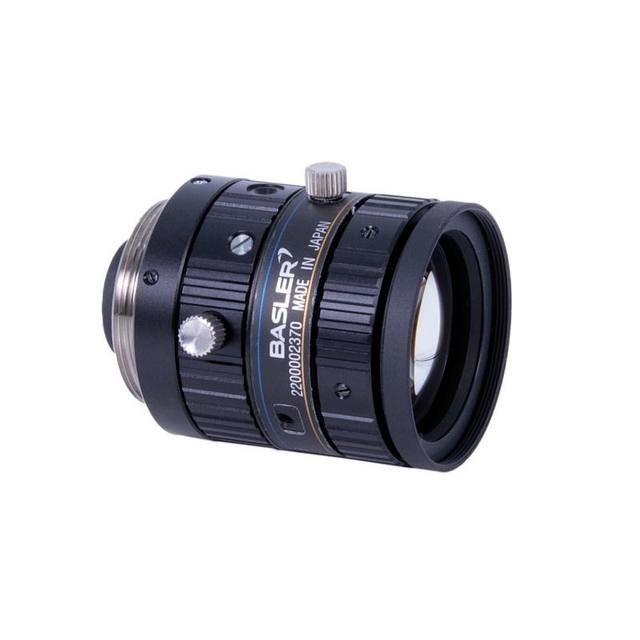
The MHR0828M belongs to iRAYPLE's MH-M Series and delivers high-resolution imaging for 8MP cameras with clear and uniform imaging across the full field of view. It covers 2/3" sensors (Ø11.4mm image circle) with a wide 67.2° horizontal field of view at a minimum focus distance of 0.1m. The lens features manual focus and iris control, low distortion of -0.89% (optical) / -0.77% (TV), and thermally stable optical performance from -20°C to 50°C. The C-mount interface with 1"-32UNF thread and a back focal length of 17.526mm is confirmed by the dimensional drawing.
The iRAYPLE MHR0828M is an 8mm fixed focal length C-mount lens rated for 8MP sensors, covering a 2/3" image circle (11.4mm diameter). At 8mm focal length the horizontal field of view reaches 67.2°, making this a moderately wide-angle optic well suited to applications where the camera must image a broad scene from a relatively close working distance. The C-mount thread (1"-32UNF) and 17.526mm back focal length make it directly compatible with the extensive ecosystem of GigE and USB3 area-scan cameras that use C-mount bodies with up to 2/3" sensors. Installers should confirm their camera's sensor size does not exceed 2/3"; using this lens on a larger sensor will produce vignetting at the corners.
The aperture range of F2.8 to F16 gives the installer meaningful depth-of-field control. Wide open at F2.8 the lens gathers maximum light, which benefits fast-strobe or low-illumination setups, but depth of field is shallowest. Stopping down toward F8–F11 improves edge-to-edge uniformity and deepens focus — important for slightly curved or non-planar surfaces such as blister packs or sheet-metal panels. Distortion is held to -0.89% optical and -0.77% TV distortion, which is low enough for dimensional measurement tasks when software-based distortion correction is applied, though this lens is not telecentric and therefore exhibits perspective error when part height varies. The minimum working distance of 100mm defines the closest focus plane; for most conveyor or overhead inspection rigs this is easily satisfied, and the lens focuses to infinity for longer stand-off distances. Manual focus and iris adjustment mean the lens must be set and locked mechanically at commissioning — there is no motorised or remotely controlled focus, so stable fixturing is essential.
The lens measures 35.35mm long and 29mm in diameter and weighs 68.49g — a compact, lightweight form factor that integrates cleanly into C-mount camera housings without imposing significant cantilevered load on the camera PCB mount. The operating temperature range of -20°C to +50°C covers most factory environments including unheated warehouses and outdoor enclosures in temperate climates, and iRAYPLE specifies thermally stable optical performance across that range, meaning focus shift from temperature excursion is controlled. For high-accuracy gauging applications this thermal stability matters: a lens that shifts focus as the line warms up will introduce measurement drift. Paired with an 8MP sensor and appropriate ring or dome lighting, this optic can resolve fine surface texture for AI-based defect detection or OCR on small character heights.
Best for
Wide-field surface inspection on conveyors where a 67.2° horizontal FOV allows a single camera to cover a broad web or panel at modest stand-off distances from the minimum 100mm up to several hundred millimetres
8MP-camera setups inspecting packaging labels, blister packs, or printed circuit boards where moderate distortion (under 1%) is acceptable and software correction handles the remainder
Robot-guidance cells using 2/3" GigE or USB3 cameras that require a compact C-mount lens with known thermal stability to avoid recalibration during warm-up
Industrial OCR and OCV on product surfaces, where the 8MP resolution budget resolves small text characters across a wide field without needing a higher-cost telecentric optic
General-purpose overhead inspection rigs in automotive, electronics, and food-and-beverage lines that need a cost-effective fixed focal length lens compatible with mainstream 8MP C-mount cameras
Selection notes
Sensor size ceiling is 2/3" (11.4mm image circle): cameras with larger sensors — 1", 4/3", or 35mm — will vignette and this lens must not be selected for them regardless of megapixel count
This lens is not telecentric, so height variation in the part introduces magnification error; for precision dimensional gauging of tall features, a telecentric lens should be evaluated instead
Focus and iris are manual-only — the installation must provide a rigid, vibration-free lens mount and a repeatable locking procedure; any post-installation vibration that shifts the iris ring will alter exposure and require recommissioning
At F2.8 the lens delivers maximum light transmission, which suits short strobe pulses to freeze motion, but depth of field narrows significantly; in applications with part-height variation exceeding a few millimetres, stopping down to F8 or smaller is advisable and the lighting power budget must be increased accordingly
The -0.77% TV distortion is low but not zero; measurement applications requiring sub-pixel accuracy must include a lens-distortion calibration step (e.g. using a calibration grid) — the spec gives the system integrator the correction target to validate against
Specifications: General
Brand
iRAYPLE
Specifications: Optical
Focal length
8 mm
Lens mount
C-Mount
Aperture (f-number)
F2.8 – F16
Image circle / max sensor
11.4 mm (2/3")
Optical resolution
8 MP
Telecentric
No
Working distance
100 mm to ∞
Specifications: Environment
Operating temperature
-20°C to +50°C
Specifications: Mechanical
Dimensions
35.35 mm × Ø29 mm
Weight
68.49 g
Applications this camera is commonly selected for. Open one to see the full recommended hardware and approach.
Matched automatically by: camera mount fits the lens mount · camera sensor is covered by the lens image circle — this lens: C-Mount · 11.4 mm (2/3") image circle.
By category
All 759Area scan cameras 622High-speed cameras 108High-resolution cameras 29
By brand
All 759Omron / Sentech 297Basler 242iRAYPLE 201Datalogic / Datasensing 19
Follow these steps to bring up your iRAYPLE camera, capture a first image, and move from the viewer to your own application. The flow is the same across the A, AE, AX and L series; only the physical interface differs.
Download and install the iRAYPLE machine-vision SDK together with its viewer client for your operating system. The installer provides the camera drivers, the GenTL producer, and the viewer you will use for first light. For GigE Vision models, also install or enable the bundled filter/performance driver on the network adapter to maximize throughput.
2. Connect the camera to the correct interface
Wire the camera to its matching host interface: a dedicated Gigabit (or 10 GigE) NIC for GigE Vision models, a USB3 Vision port with a quality cable for USB3 models, or a frame grabber for CoaXPress models. Power the camera (PoE, USB bus power, or PoCXP / external supply as applicable). For GigE Vision, put the NIC and camera on the same subnet and, where supported, enable jumbo frames.
3. Detect and open the camera in the viewer
Launch the iRAYPLE viewer, run device enumeration, and select your camera from the discovered list. Open it to load the device feature tree (GenICam node map). If a GigE camera is found but cannot be opened, correct the IP configuration so the camera and NIC are in the same address range.
4. Set exposure, gain and trigger, then grab a first image
Start with continuous (free-run) acquisition under stable lighting. Adjust exposure time and gain for a well-exposed, low-noise image, set the pixel format (e.g. Mono8 or a Bayer/RGB format), and tune white balance on color models. Once the live image looks correct, switch trigger mode to hardware or software trigger to synchronize capture with your process, and verify a single triggered frame.
5. Move from the viewer to the SDK or a GenICam library
With imaging confirmed, reproduce the same settings in code using the SDK's C/C++ or Python API: enumerate, open, configure the relevant GenICam features, register a frame callback or grab loop, and convert frames to your pipeline's buffer format. Since the cameras are GenICam/GenTL-compliant, you can alternatively drive them from a third-party GenICam vision library. From here a stable image stream can feed a deep-learning inspection step such as Rosepetal for automated quality control.
Frequently asked questions
The MHR0828M covers a 2/3" image circle (11.4mm diameter). It is compatible with sensors up to and including 2/3" — common formats such as 1/2", 1/2.5", and 1/3" are also covered with a narrower effective FOV. Sensors larger than 2/3" (e.g. 1" or larger) will see vignetting and should not be used with this lens.
The specified horizontal field of view is 67.2° on a 2/3" sensor. The minimum working distance is 100mm, and the lens focuses to infinity above that. Actual field width at a given working distance depends on this angular FOV and can be calculated using standard trigonometry for the specific stand-off distance in your application.
It can be used for measurement with software distortion correction applied — TV distortion is specified at -0.77%, which is low for a wide-angle lens. However, the lens is not telecentric, meaning objects at different heights in the scene will appear at different magnifications. For gauging where part height is variable or tolerances are tight, a telecentric lens is the more appropriate choice.
No. Both focus and iris are manually adjusted and must be set mechanically at installation. There is no electronic or remote control of either parameter. Once set, the rings should be locked to prevent drift.
The lens is rated for -20°C to +50°C, and iRAYPLE specifies thermally stable optical performance across that range. This means focus shift due to thermal expansion is controlled, reducing the risk of measurement drift as the production environment warms up during a shift.