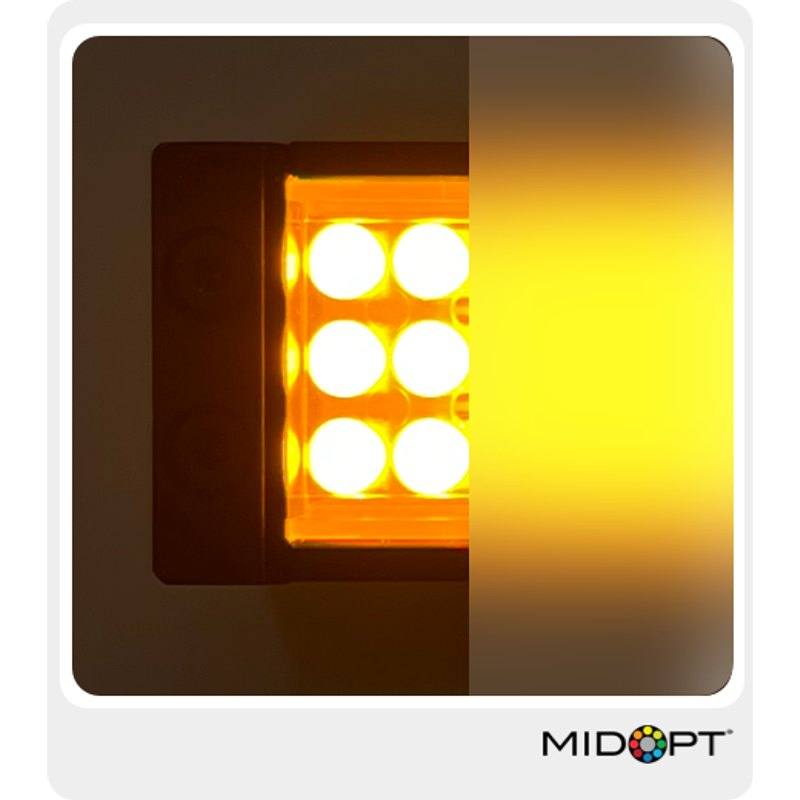
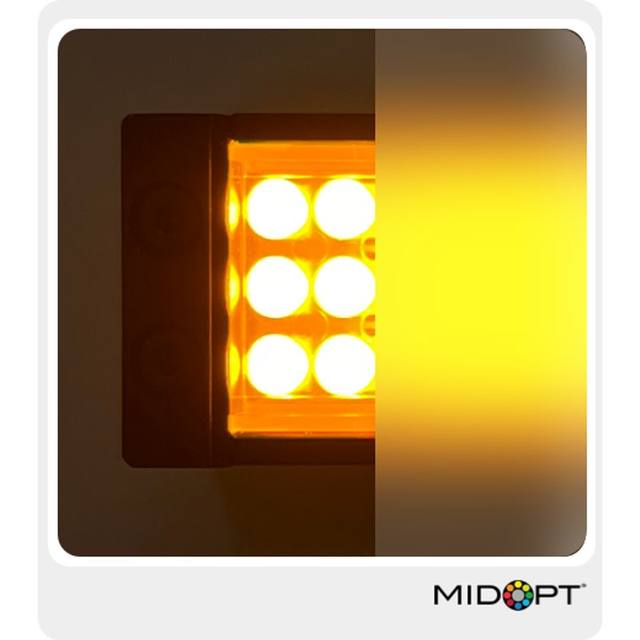
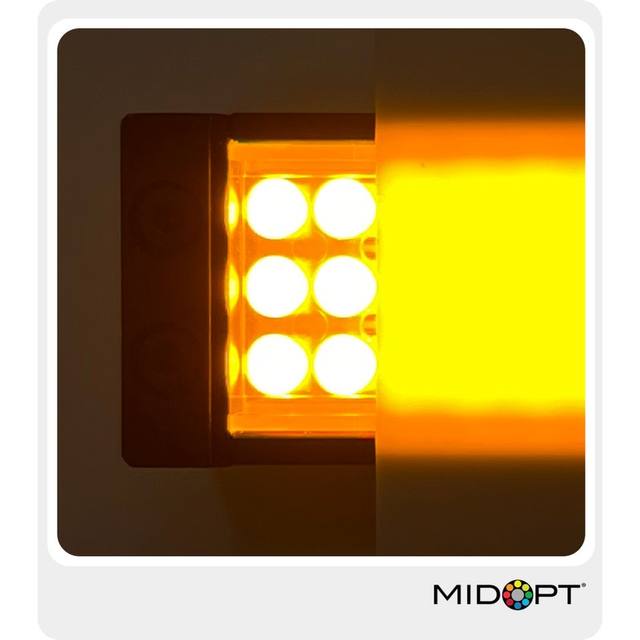
The MidOpt DF070 is an acrylic diffuser filter, 1mm thick, with a listed total light transmission of 70% and a useful range of 400-1100nm. That range runs from the visible band into the near-infrared, so the diffuser can be paired with light sources whose output falls anywhere in that span. The manufacturer describes diffusers as protective windows for lighting that also diffuse and scatter light coming from a point source such as an LED, lamp filament or laser diode. That is the role this part plays when it sits in front of an illuminator.
The 70% transmission figure is the main design trade-off. Most of the light reaching the diffuser passes through, but the remainder is not transmitted, so the illumination power or exposure needed to reach a target image brightness has to be planned with that loss included. Because the piece is only 1mm thick, its placement is partly a mechanical decision: the gap between the diffuser and the source, and the way the holder seats it, shape how evenly the scattered light falls on the inspection area.
The DF070 is listed as available as unmounted or custom sizes, so the piece can be specified to fit the aperture of the light housing you are building. Its listed color temperature is 6750 K. When designing with it, read the transmission and the 400-1100nm range together: the transmission sets the light budget, and the wavelength range confirms whether the diffuser suits the emission of your source.
Best for
Softening the output of a point-source LED, lamp filament or laser diode before it reaches the inspection area.
Front protection for a lighting module that also needs its light diffused, matching the protective-window role the manufacturer describes.
Visible or near-infrared illumination whose wavelength falls inside the listed 400-1100nm range.
Custom lighting builds that need a diffuser sized to a specific housing aperture.
Setups where the light lost in the diffuser is acceptable within the overall light budget.
Selection notes
Plan the light budget around 70% transmission: the share of light that is not transmitted has to be made up with added illumination power or exposure.
Confirm that the source's emission falls within 400-1100nm before specifying the part; outside that range the listed useful range does not apply.
Measure the housing aperture first, because the diffuser is offered as unmounted or custom sizes and can be sized to fit it.
Allow for the 1mm thickness when designing the holder, so the diffuser sits at the intended distance from the source.