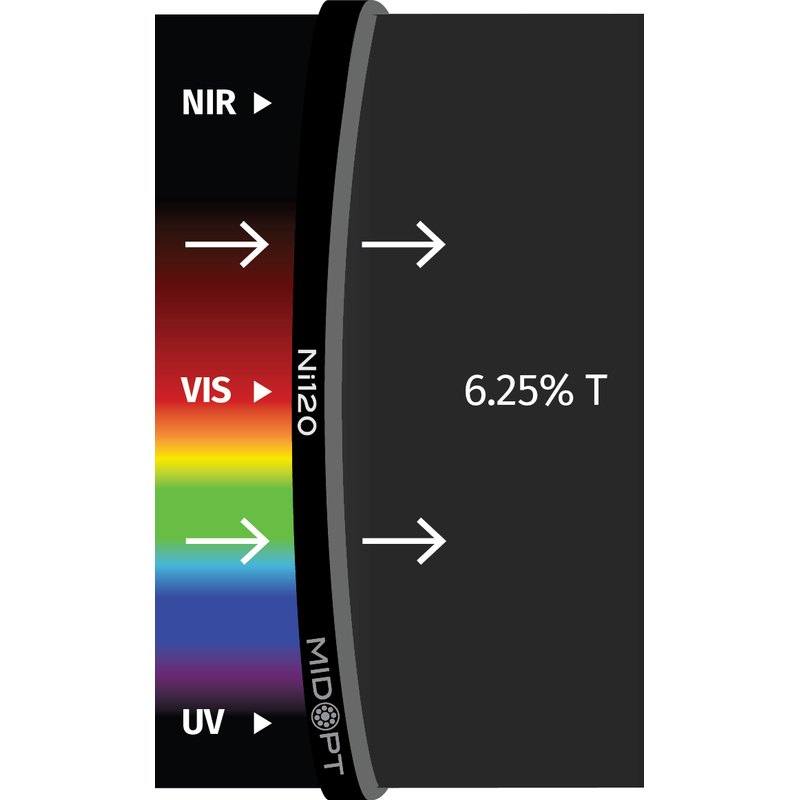
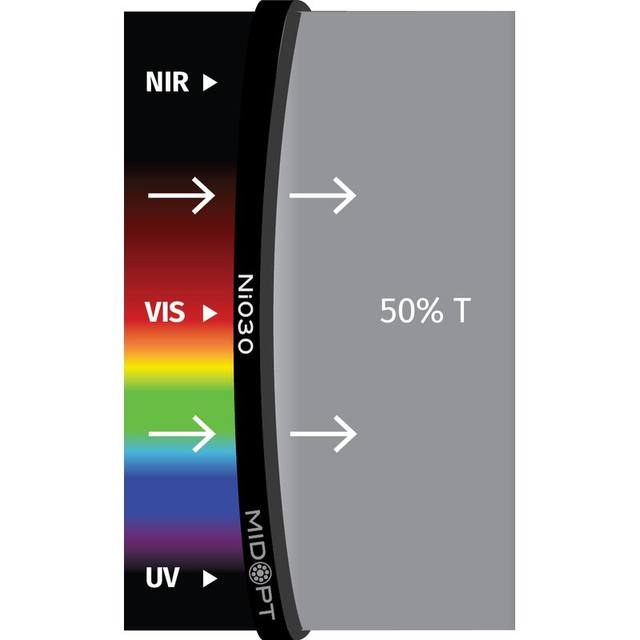
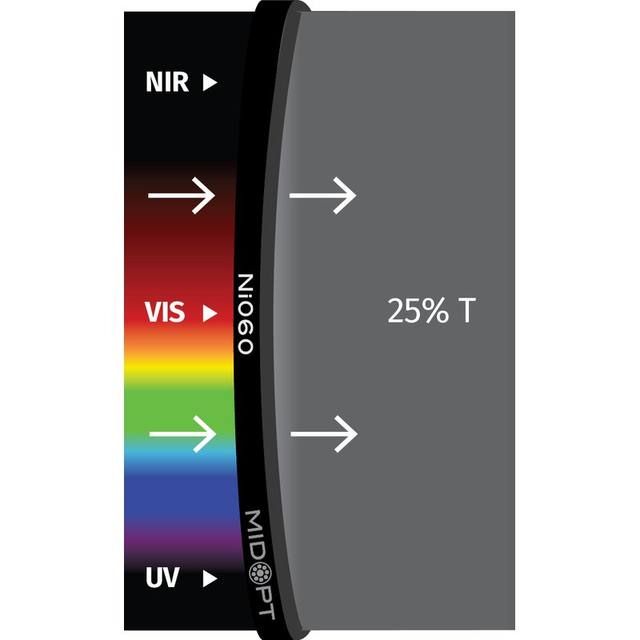
The MidOpt Ni120 is a neutral density (ND) filter from the Ni Series (VIS/SWIR) with a useful range of 400-2000nm, an optical density of 1.2 and a surface quality of 40/20. Its product name gives 6.25% transmission, so the filter passes 6.25% of the incoming light without changing the image geometry. For an installer this is a pure light-level reduction: the lens forms the same image, but far less light reaches the sensor.
The reason to specify it is exposure control. The manufacturer links this attenuation to longer exposure times and reduced depth of field. With the light cut to 6.25%, a camera that would otherwise saturate at the aperture you need can keep that aperture and use a longer shutter. Equally, the filter lets the lens open wider while the sensor stays in range, which narrows the depth of field. That makes the Ni120 suited to bright lighting and to setups where the aperture is set by depth of field rather than by light. Its 400-2000nm rating means it is intended for systems that span visible and short-wave infrared imaging rather than one narrow colour band.
Mechanically, the Ni120 is offered in 27 threaded size options from M13.25–M105, in a 25.4® C-Mount format, as a slip mount, or unmounted in custom sizes. The thread is the first decision, because it has to match the lens or holder the filter sits in front of. The name also carries Low Reflectivity, which matters when bright light sources sit near the optical axis because less light is returned from the filter surface.
Best for
Bright scenes where the sensor saturates at the lens setting the image needs, with the light cut to 6.25%.
Longer exposure times in bright conditions, as the manufacturer describes.
Reduced depth of field, by opening the lens wider while the filter holds the exposure in range.
Broadband visible-to-SWIR imaging across the 400-2000nm useful range.
Lens-mounted setups that use one of the 27 threaded sizes (M13.25–M105) or a 25.4® C-Mount format.
Selection notes
Choose the thread from the 27 M13.25–M105 options to match the lens or holder. The slip mount and unmounted custom sizes cover optics that do not take a standard thread.
At 6.25% transmission the light budget falls sharply. Plan added illumination or longer exposures so the image stays usable.
Keep the working wavelengths inside the 400-2000nm useful range the filter is rated for.
Set the lens aperture and shutter together with the filter in place, because adding or removing the ND changes the exposure balance the system is set for.
Specifications: General
Brand
MidOpt
Specifications: Optical
Filter type
Neutral density (ND)
Filter wavelength
400-2000nm (useful range)
Specifications: Mechanical
Thread / filter size
M13.25–M105 (27 threaded size options)
This product groups every purchasable order code that shares the same sensing method, range and output. Cable length, connector type and operation mode (Light-ON/Dark-ON, NO/NC) vary by order code below.
Family variants with highlighted differences
Model
Availability
25.4® C-Mount (threads between lens & sensor) / threaded M25.4 Base
The product name gives 6.25% transmission, and its optical density is 1.2.
Its useful range is 400-2000nm, covering visible and short-wave infrared as part of the Ni Series VIS/SWIR range.
27 threaded size options from M13.25 to M105, a 25.4® C-Mount format, a slip mount, and unmounted or custom sizes.
The manufacturer links it to longer exposure times and reduced depth of field, which suits bright conditions where the lens or shutter would otherwise be pushed past the setting the image needs.