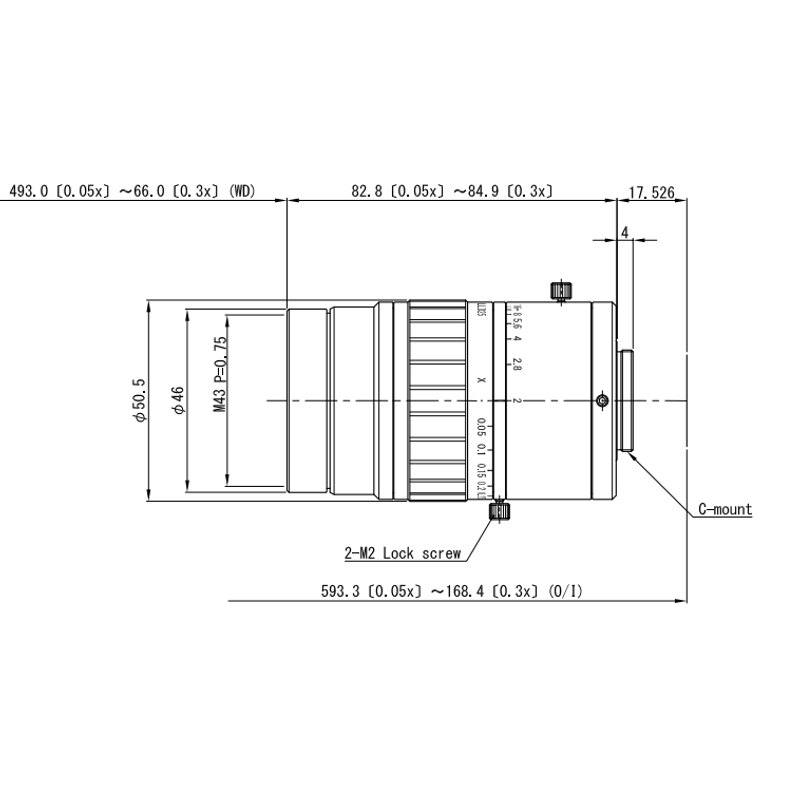
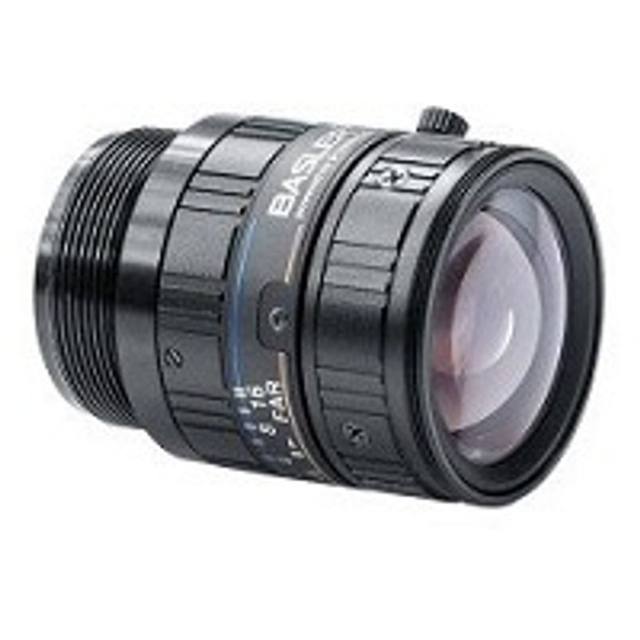
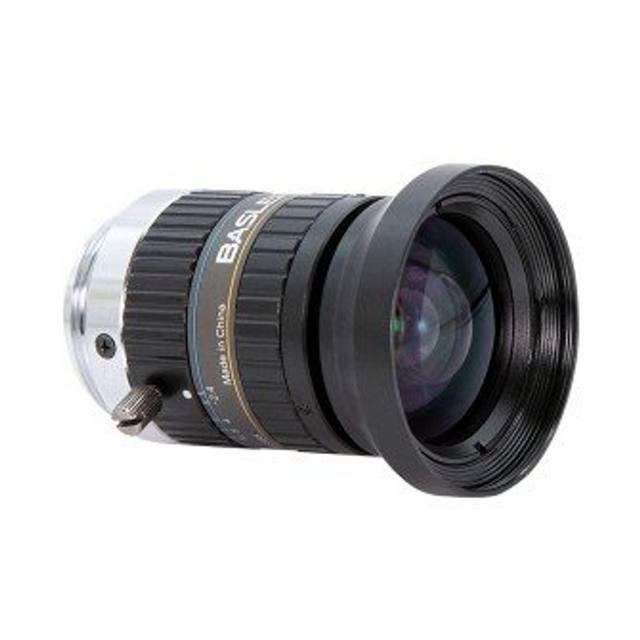
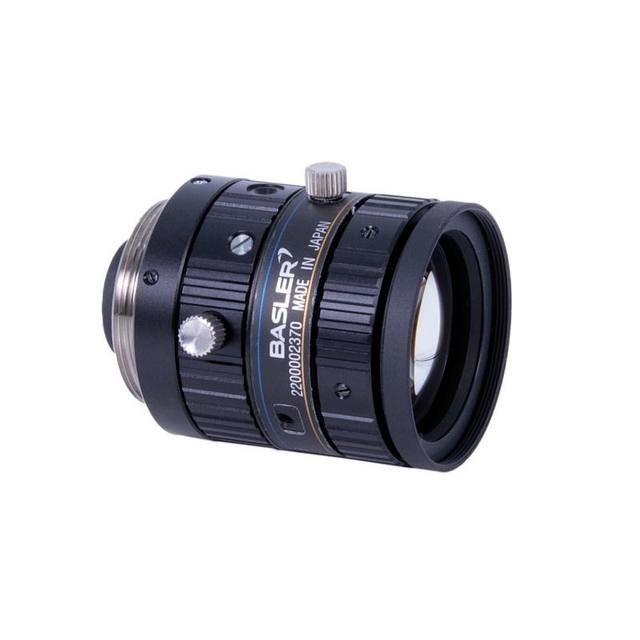
The VS-LLD25 is an ultra-high-resolution, low-distortion macro lens designed for 4/3" format C-mount cameras, covering sensors up to 21 megapixels. It employs a floating optical element system that maintains high resolution and minimal distortion (−0.13% to −0.24%) at any magnification between 0.05× and 0.30×. Working distance ranges from 66 mm (at 0.30×) to 493 mm (at 0.05×), making it suitable for a wide range of industrial inspection tasks. Focus and iris are manually adjustable with lock screws, and the lens accepts M43 P=0.75 filters.
Brand
VS Technology
Focal length
25 mm
Lens mount
C-mount
Aperture (f-number)
F2.0 (nominal max; effective aperture F2.1–F2.5 across magnification range)
The VS-LLD25 is a 25 mm F2.0 C-mount macro lens engineered around a floating optical element design — a construction where one or more internal groups shift independently as focus is changed, rather than moving the entire optical assembly. This matters in practice because conventional fixed-group designs suffer a measurable degradation in resolution and distortion when focused away from their design distance. With the floating system, the VS-LLD25 holds ultra-low distortion of −0.13 % to −0.24 % across the entire 0.05× to 0.30× magnification range, meaning the error introduced by the optic itself is a small fraction of a pixel even on a high-density sensor — a critical property whenever the image will feed dimensional measurement or precision gauging algorithms rather than simple pass/fail detection.
The lens is rated to 21 megapixels and covers a 4/3" image circle (21.6 mm diagonal), matching it directly to the largest single-sensor format currently common in high-resolution area-scan cameras. Smaller C-mount sensors — 1", 2/3", 1/2" — are all illuminated without vignetting, and the optical resolution budget is never the bottleneck on those formats. The effective aperture tracks from F2.1 at the lowest magnification out to F2.5 at 0.30×, which is important when calculating depth of field and exposure: at the longest working distance of 493 mm the lens is at its brightest, while close in at 66 mm the light loss is modest and predictable. Manual focus and iris rings with lock screws allow the installer to set and mechanically freeze the operating point, eliminating drift from vibration — a detail that matters on production lines running 24/7.
Working distance spans 66 mm to 493 mm across the supported magnification range, giving integrators flexibility that a fixed-distance macro typically does not offer. At 0.30× and 66 mm the field of view on a 4/3" sensor (17.3 mm × 13 mm active area) is roughly 57 mm × 43 mm — suitable for PCB section inspection, pharmaceutical blister strips, or fine connector arrays. At 0.05× and 493 mm the field expands to approximately 346 mm × 260 mm, covering larger panels or packaging labels from a safe stand-off. The M43 P=0.75 filter thread allows bandpass or polarising filters to be added without adapters, and the 50.5 mm body diameter and 285 g mass are compatible with standard C-mount camera heads. Because the design is not telecentric, the lens is best paired with flat or near-flat subjects where perspective error is negligible; for stepped or three-dimensional targets, the non-telecentric geometry should be accounted for in calibration.
Best for
High-resolution PCB and electronic component inspection where 21 MP sensor coverage and sub-0.25% distortion deliver the pixel density and geometric fidelity needed to measure pad pitch, trace width, or solder joint area reliably.
Pharmaceutical blister-pack and label inspection at mid-range working distances (100–300 mm), where the floating design ensures consistent resolution and distortion across the full label area without software distortion correction absorbing resolution budget.
Dimensional measurement of machined metal or plastic parts at a controlled stand-off, exploiting the locked iris and focus rings to freeze the optical state once calibrated and maintain measurement repeatability shift after shift.
Packaging print and OCR/OCV verification on medium-format cartons or pouches, where the wide magnification range lets a single lens serve both close-up date-code inspection and wider panel reads by adjusting working distance.
Semiconductor wafer or substrate macro-inspection where the combination of 21 MP resolution rating, low distortion, and filter-thread compatibility with narrowband illumination supports both defect detection and overlay measurement tasks.
Selection notes
Sensor format compatibility: the 21.6 mm image circle fills a 4/3" sensor with no vignetting, and smaller formats (1", 2/3", 1/2") are all supported. If your camera uses a sensor larger than 4/3", this lens will not cover the full sensor and should not be selected.
The lens is not telecentric. For targets that are not flat — such as machined parts with steps or recesses — parallax error will scale with the height deviation and the field angle. Either restrict use to flat targets, keep the depth variation small relative to working distance, or apply a per-plane calibration; do not treat it as a telecentric substitute for gauging three-dimensional profiles.
Working distance and magnification are coupled: you cannot independently set both. Confirm your required field of view and the physical clearance available above the target, then verify the combination falls within the 0.05×/493 mm to 0.30×/66 mm envelope before specifying this lens.
Filter thread is M43 P=0.75. Polarising filters for specular surface inspection, or narrowband bandpass filters for colour-independent illumination, can be threaded on directly. Factor the added filter glass into the optical path length if focus latitude is tight at your selected magnification.
Effective aperture changes with magnification (F2.1 at 0.05× to F2.5 at 0.30×), which affects exposure time and depth of field calculations. When switching magnification between products on the same line, recalculate strobe duration or lighting intensity to maintain consistent grey-level response.
Specifications: General
Brand
VS Technology
Specifications: Optical
Focal length
25 mm
Lens mount
C-mount
Aperture (f-number)
F2.0 (nominal max; effective aperture F2.1–F2.5 across magnification range)
Image circle / max sensor
4/3" (21.6 mm diagonal)
Optical resolution
21 MP
Telecentric
No
Magnification
0.05× – 0.30×
Working distance
66 – 493 mm (magnification-dependent)
Specifications: Mechanical
Weight
285 g
Dimensions
φ50.5 × 82.8 – 84.9 mm
Applications this camera is commonly selected for. Open one to see the full recommended hardware and approach.
Matched automatically by: camera mount fits the lens mount · camera sensor is covered by the lens image circle — this lens: C-mount · 4/3" (21.6 mm diagonal) image circle.
These steps take an Omron Sentech (STC) camera from the box to a stable first image and on to your own application. They apply across the GigE Vision, USB3 Vision and CoaXPress STC families; the interface only changes how you cable and power the camera.
Download and install the Sentech SDK on the host PC. The package provides StViewer, the viewing and configuration software you use to bring the camera up, and StApi, the programming SDK you integrate later. Because the cameras are GenICam/GenTL-compliant, StApi also registers a GenTL producer, so any GenICam-compliant third-party vision software can discover and drive the camera as an alternative front end.
2. Cable, power and connect the camera
Connect according to the interface. GigE Vision: link to a Gigabit NIC (use PoE or the separate power input) and put the camera and host on the same subnet; for USB3 Vision use a USB 3.x port and a certified cable; for CoaXPress (STC) connect to a CoaXPress frame grabber, which also supplies Power-over-Coax. Then open StViewer and let it enumerate the camera. If a GigE camera does not appear, check the IP configuration and firewall, and on USB3 confirm the host bandwidth and driver.
3. Configure exposure, gain and white balance
Open the device in StViewer and start a live stream. Set exposure and gain for a well-exposed, low-noise image: raise exposure first and only add gain when more light or a faster shutter is not an option, keeping exposure short enough to freeze motion on global-shutter models. On colour cameras, run white balance under your actual production lighting. Adjust the lens aperture and focus on a representative target before tuning anything else.
4. Set the trigger and grab a first image
Start in free-run (continuous) acquisition to confirm a clean, stable image. For inline inspection switch to hardware or software triggering: select the trigger source, set the active edge and any delay, and wire the strobe or illumination to the camera's I/O so lighting fires with each exposure. Acquire and save a frame in StViewer; this saved image is your reference for the SDK stage and for downstream inspection.
5. Move to the StApi SDK (or any GenICam software)
Once the image is stable, reproduce the same settings in code. Use StApi to open the device, apply the GenICam features you validated in StViewer (exposure, gain, trigger, pixel format) and grab frames into your application via the bundled C++, C, C#/.NET or Python interfaces; the included samples are the fastest starting point. Prefer a different stack? The same GenICam/GenTL camera works with third-party vision libraries. With a reliable feed, you can route it into a deep-learning inspection such as Rosepetal for AI-based defect detection.
Frequently asked questions
The VS-LLD25 has a 4/3" image circle with a 21.6 mm diagonal. It fully covers 4/3" sensors (the largest format it is rated for) and all smaller C-mount sensor formats including 1", 2/3", and 1/2". It is not suitable for sensors larger than 4/3".
Distortion stays within −0.13 % to −0.24 % across the entire supported magnification range of 0.05× to 0.30×, owing to the floating optical element design. This is substantially better than conventional macro lenses that may see distortion shift by several tenths of a percent between extremes of focus travel.
Field of view depends on sensor size and the magnification in use. On a 4/3" sensor (17.3 mm × 13 mm active area), at 0.30× magnification and 66 mm working distance the field is approximately 57 mm × 43 mm; at 0.05× and 493 mm it expands to approximately 346 mm × 260 mm. Intermediate working distances yield proportionally intermediate fields.
Yes. The lens has an M43 P=0.75 filter thread at the front, accepting standard 43 mm diameter filters directly. Polarising filters, narrowband bandpass filters, and UV-cut filters in this thread size can all be fitted without additional adapters.
Both focus and iris rings include lock screws intended to mechanically fix the set position once the installation is calibrated. Locking does not alter the optical alignment; it prevents unintended movement from vibration or accidental contact, which is important for maintaining measurement repeatability in continuous production environments.