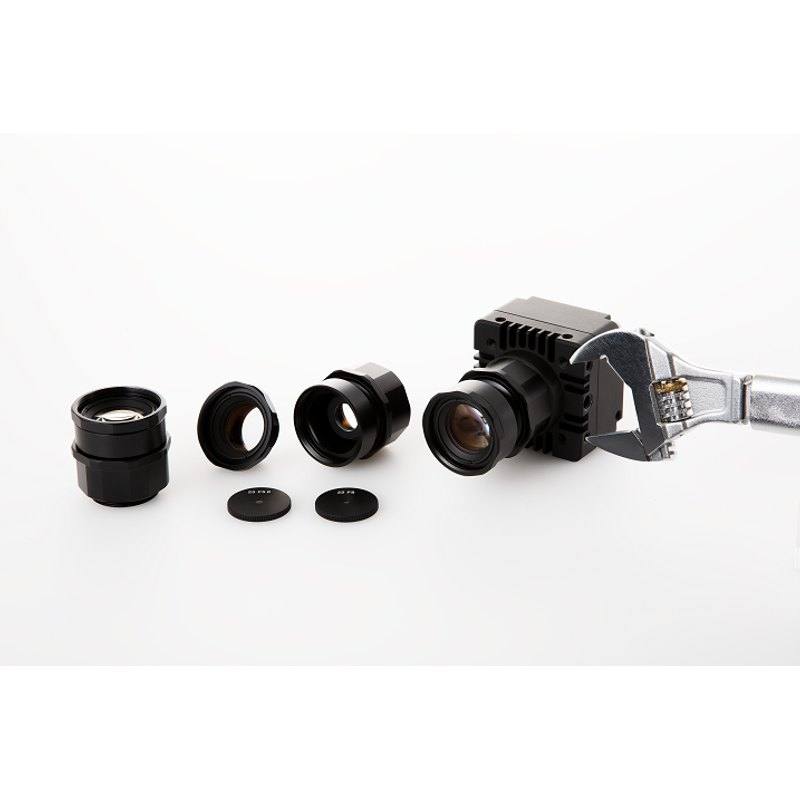
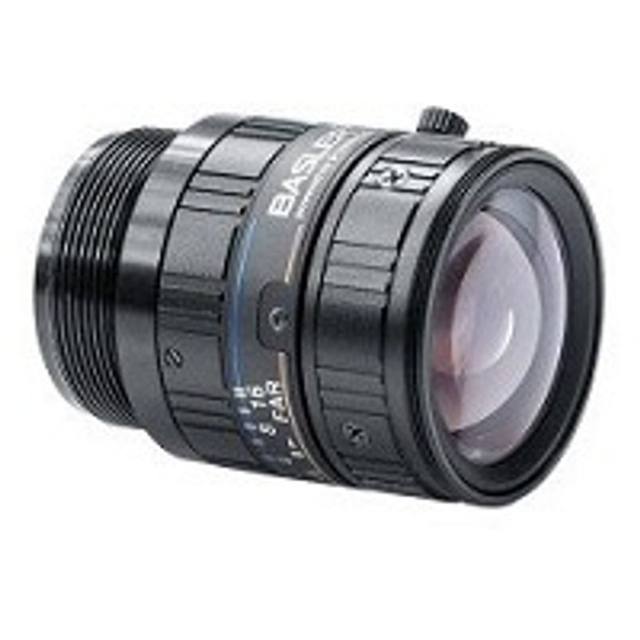
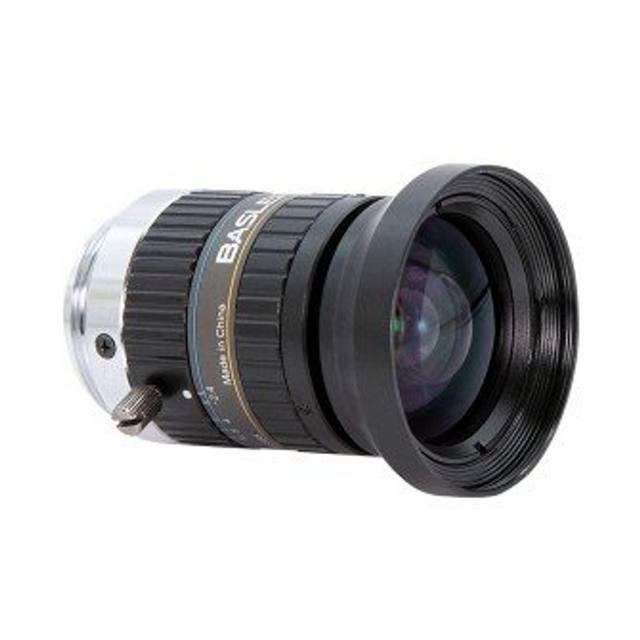
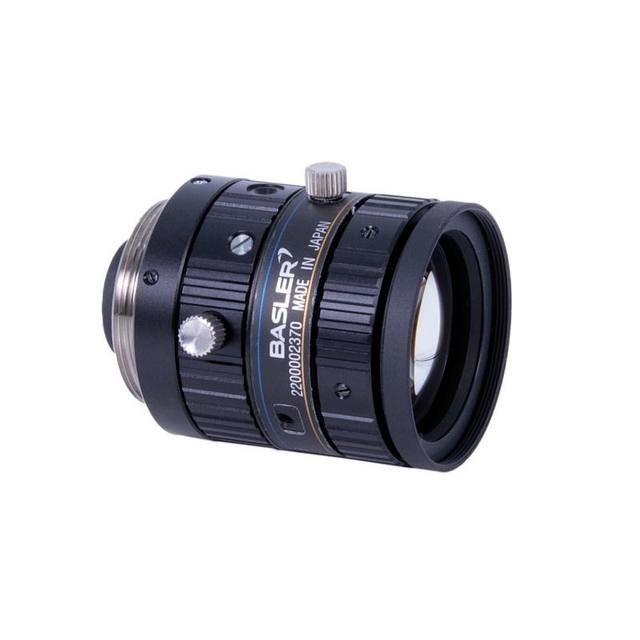
The VS-MC16H1 belongs to the VS-MCH1 series from VS Technology, sold under the Omron 3Z4S-LE platform as a ruggedized machine vision lens rated for 5 megapixel sensors in 1" format. It uses a unique changeable iris plate system with three discrete F-number settings (F1.4, F5.6, F8) locked by a threaded mechanism to prevent dust generation from vibration. The lens body incorporates a torque body design for controlled mounting and operates over visible wavelengths with manual focus adjustment. Physical construction is compact at Φ38 mm × 45 mm length, with a standard C-mount flange back of 17.526 mm and M30.5×P0.5 filter thread.
The VS-MC16H1 is a 16 mm fixed focal length C-mount lens engineered for 1" format sensors (16 mm image circle) and rated to resolve 5 megapixel imagery. At 16 mm, the angle of view sits in the moderate-wide territory that suits mid-range working distances where fields of view from roughly 50 mm to several hundred millimetres are typical on machine-vision stands. The minimum usable working distance of 300 mm keeps the lens well clear of parts on a conveyor or fixture, which also allows room for co-axial or ring lighting to be positioned without vignetting. Because the lens is not telecentric, there is a measurable perspective error when objects stand at different heights within the depth of field — installers doing precise dimensional gauging at this focal length should account for that in calibration, or choose a telecentric alternative; for defect inspection, code reading, packaging verification, and robot guidance the non-telecentric design is entirely conventional and cost-effective.
The aperture system is the most distinctive engineering feature of this lens. Rather than a continuously variable iris, the VS-MC16H1 uses a physically swapped iris plate that locks into one of three discrete F-stops: F1.4, F5.6, or F8. The threaded locking mechanism is intentional — it eliminates the particle contamination that a traditional iris wiper generates when the assembly vibrates. This makes the lens particularly well suited to equipment installed in factories with significant vibration (press lines, conveyor-heavy cells, robotic welding areas) or where cleanliness is paramount (semiconductor front-end, pharma packaging). In practice, the integrator selects the iris plate at installation time: F1.4 maximises light throughput for dimly lit or fast-shutter applications; F5.6 and F8 provide progressively greater depth of field and reduced spherical aberration at the cost of requiring more illumination. Focus is adjusted manually and then locked, consistent with fixed-mount machine vision practice.
The physical package — 38 mm maximum diameter, 45 mm length, 100 g — fits inside standard C-mount camera housings and is compatible with the full range of 1" and smaller sensors behind a standard 17.526 mm C-mount flange back. An M30.5×P0.5 front filter thread accommodates polarising, bandpass, or neutral-density filters, which gives integrators flexibility when managing reflections or tuning spectral response without changing the optical design. The operating temperature range of -5 to 50 °C covers most controlled factory environments but rules out outdoor or freezer applications without additional thermal management. Within the Omron 3Z4S-LE lens platform the VS-MC16H1 is positioned as the high-resolution ruggedised option for 5 MP cameras, making it a natural pairing with any C-mount area-scan camera fitted with a 1" or smaller sensor.
Best for
Defect and surface inspection on assembly lines with significant mechanical vibration, where conventional iris blades would shed particles and drift out of adjustment.
Barcode, DataMatrix, and QR code reading at fixed working distances from 300 mm upward, where a 16 mm focal length produces adequate code pixel density across a broad label or panel.
Packaging and label verification on high-speed lines where F1.4 throughput supports the short exposure times needed to freeze motion without overwhelming the lighting budget.
Robot-guidance and pick-and-place applications requiring a compact lens that will not be knocked out of alignment by robot vibration or end-of-arm tool impacts.
Pharmaceutical and semiconductor inspection stations where cleanliness is critical and a dust-generating continuous iris would be disqualifying.
Selection notes
Sensor format compatibility: the 16 mm image circle fully covers 1" sensors. It also covers 2/3", 1/1.8", and 1/2" formats with no vignetting, making it reusable across camera upgrades as long as the replacement camera stays at or below 1".
Iris plate selection is a one-time installation decision, not an in-service adjustment. Choose F1.4 if the lighting system is constrained or exposure time must be kept very short; choose F5.6 or F8 if depth of field across parts of varying height is more important than raw light throughput.
The 300 mm minimum working distance is a hard lower bound. Applications requiring shorter working distances — close-up component inspection or micro-feature gauging — need a different focal length or a macro extension ring, which will also shift the effective flange distance.
The lens is not telecentric. Dimensional measurements of raised or recessed features will carry perspective error proportional to the height variation. For gauging tasks where sub-pixel accuracy is required across the full field, plan a calibration routine (e.g. a calibration grid) to compensate, or specify a telecentric lens instead.
Filter thread is M30.5×P0.5. Verify filter availability from your preferred supplier before committing to a polarised or bandpass filtering strategy; alternatively use a filter holder mounted on the illuminator rather than the lens.
Specifications: General
Brand
Omron / Sentech
Specifications: Optical
Focal length
16 mm
Lens mount
C-mount
Aperture (f-number)
F1.4 / F5.6 / F8 (changeable iris plates)
Image circle / max sensor
16 mm (1" format)
Optical resolution
5 MP
Telecentric
No
Working distance
300 mm ~ ∞
Specifications: Environment
Operating temperature
-5 to 50°C
Specifications: Mechanical
Weight
100 g
Dimensions
Φ38 (max.) × L=45 mm
Applications this camera is commonly selected for. Open one to see the full recommended hardware and approach.
Matched automatically by: camera mount fits the lens mount · camera sensor is covered by the lens image circle — this lens: C-mount · 16 mm (1" format) image circle.
These steps take an Omron Sentech (STC) camera from the box to a stable first image and on to your own application. They apply across the GigE Vision, USB3 Vision and CoaXPress STC families; the interface only changes how you cable and power the camera.
Download and install the Sentech SDK on the host PC. The package provides StViewer, the viewing and configuration software you use to bring the camera up, and StApi, the programming SDK you integrate later. Because the cameras are GenICam/GenTL-compliant, StApi also registers a GenTL producer, so any GenICam-compliant third-party vision software can discover and drive the camera as an alternative front end.
2. Cable, power and connect the camera
Connect according to the interface. GigE Vision: link to a Gigabit NIC (use PoE or the separate power input) and put the camera and host on the same subnet; for USB3 Vision use a USB 3.x port and a certified cable; for CoaXPress (STC) connect to a CoaXPress frame grabber, which also supplies Power-over-Coax. Then open StViewer and let it enumerate the camera. If a GigE camera does not appear, check the IP configuration and firewall, and on USB3 confirm the host bandwidth and driver.
3. Configure exposure, gain and white balance
Open the device in StViewer and start a live stream. Set exposure and gain for a well-exposed, low-noise image: raise exposure first and only add gain when more light or a faster shutter is not an option, keeping exposure short enough to freeze motion on global-shutter models. On colour cameras, run white balance under your actual production lighting. Adjust the lens aperture and focus on a representative target before tuning anything else.
4. Set the trigger and grab a first image
Start in free-run (continuous) acquisition to confirm a clean, stable image. For inline inspection switch to hardware or software triggering: select the trigger source, set the active edge and any delay, and wire the strobe or illumination to the camera's I/O so lighting fires with each exposure. Acquire and save a frame in StViewer; this saved image is your reference for the SDK stage and for downstream inspection.
5. Move to the StApi SDK (or any GenICam software)
Once the image is stable, reproduce the same settings in code. Use StApi to open the device, apply the GenICam features you validated in StViewer (exposure, gain, trigger, pixel format) and grab frames into your application via the bundled C++, C, C#/.NET or Python interfaces; the included samples are the fastest starting point. Prefer a different stack? The same GenICam/GenTL camera works with third-party vision libraries. With a reliable feed, you can route it into a deep-learning inspection such as Rosepetal for AI-based defect detection.
Frequently asked questions
The lens projects a 16 mm image circle, which covers 1" (the maximum rated format) and all smaller common formats including 2/3", 1/1.8", and 1/2". It is not designed for sensors larger than 1".
The iris is set by physically swapping a threaded iris plate — the lens ships with F1.4, F5.6, and F8 plates. This is an installation-time operation, not an in-service one. The locking thread prevents the plate from shifting or generating particles during normal operation.
The specified minimum working distance is 300 mm. The lens does not focus at shorter distances in its standard configuration. If your application requires a closer working distance, an extension ring can be added, but this changes the effective infinity focus and increases magnification at the cost of some light throughput.
The VS-MC16H1 is a conventional (non-telecentric) lens. At working distances beyond 300 mm the perspective error is small relative to most inspection tolerances, but it is not zero. For applications requiring sub-pixel gauging accuracy across features at different heights, a telecentric lens is more appropriate. For applications where parts are essentially flat or where calibration can compensate for perspective distortion, this lens performs well.
The VS-MC16H1 uses a standard C-mount with a 17.526 mm flange back distance and is rated for 5 MP sensors in 1" format. It is compatible with any Omron 3Z4S-LE or third-party camera that has a C-mount interface and a sensor at or smaller than 1". Confirm sensor pixel pitch against the 5 MP optical resolution rating to ensure the lens is not the resolution bottleneck.