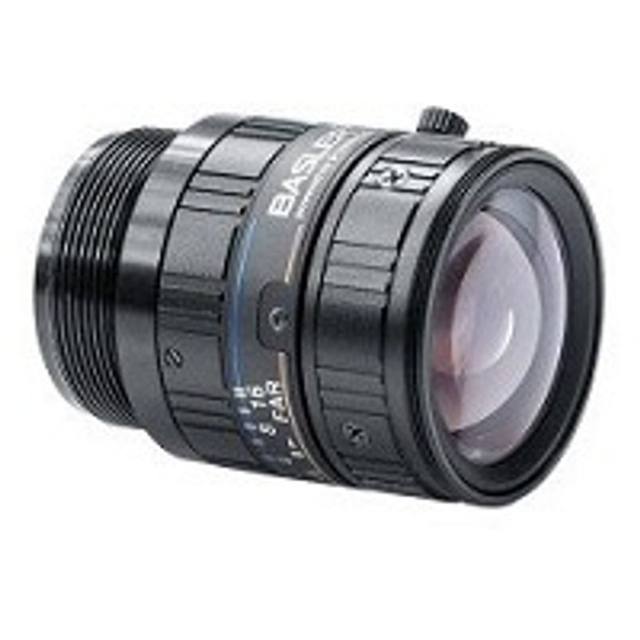
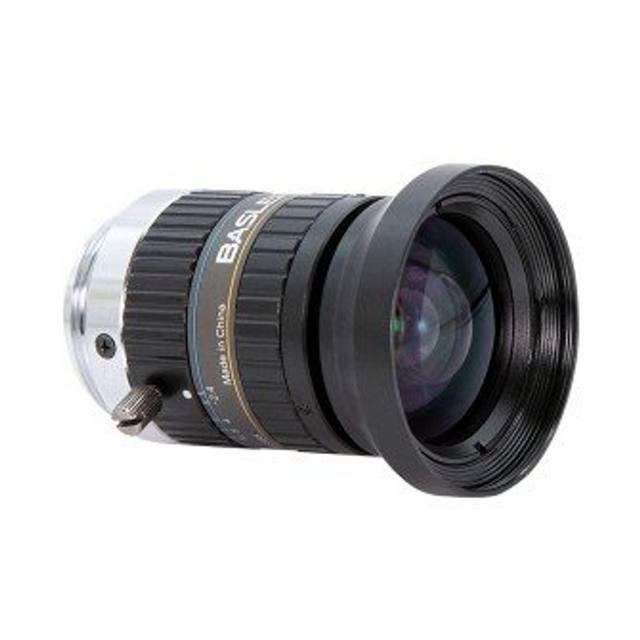
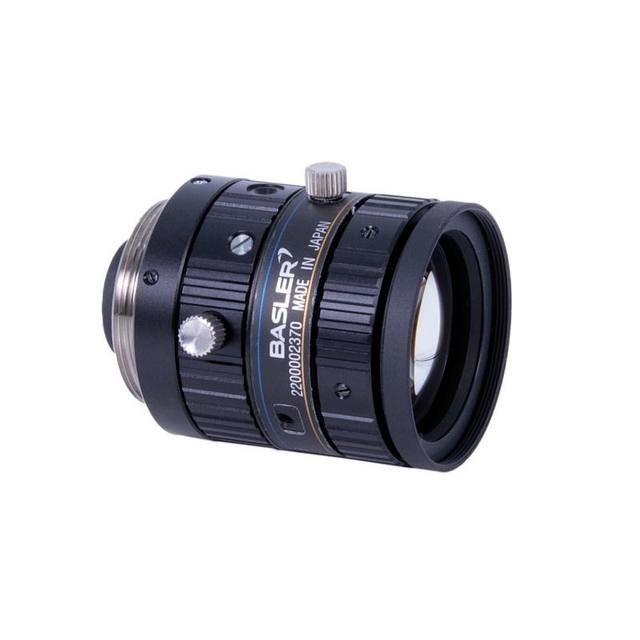
The VS-MCA30 is part of Omron's 3Z4S-LE VS-MCA series of vibration- and shock-resistant C-mount lenses. It delivers a 30 mm focal length with a maximum aperture of F2.0 (manual iris settings 2 / 5.6 / 8) and supports sensors up to 2/3 inch, rated for 3 megapixel resolution. The optical magnification range spans 0.06× to 0.45×, yielding working distances from 513.5 mm down to 80.1 mm respectively, with TV distortion held to within ±0.11%. A screw-lock focus mechanism and fixed-iris design maintain image quality under continuous industrial vibration and shock cycles.
The VS-MCA30 is a 30 mm fixed-focal-length C-mount lens engineered specifically for demanding industrial environments where vibration and mechanical shock are a constant concern. Its screw-lock focus mechanism and fixed-iris design — with discrete manual settings at F2.0, F5.6, and F8 — ensure that once set up on the line, the optical configuration remains locked regardless of machine vibration cycles. The maximum aperture of F2.0 makes this lens notably light-efficient for a macro-range optic, allowing integrators to operate with shorter strobe durations or lower illumination power without sacrificing exposure. At 39 g and a body diameter of 31 mm max with a length that varies between 24.5 mm and 36.2 mm depending on focus position, it integrates cleanly into compact camera housings and tight mounting arrangements.
The lens covers sensor formats up to 2/3 inch and is rated for 3 megapixel resolution, placing it firmly in the mainstream of current GigE and USB3 Vision area-scan cameras in that resolution class. The optical magnification range runs from 0.06× to 0.45×, with corresponding working distances spanning 513.5 mm down to 80.1 mm — a practical envelope that suits both stand-off inspection of medium-sized parts and close-up macro work on small components or markings. TV distortion is held to within ±0.11%, which is tightly controlled for a non-telecentric lens at these magnifications and makes it suitable for dimensional gauging tasks where straight-edge fidelity matters. Installers should note that the lens is not telecentric, so magnification will shift with any axial displacement of the part; for applications where height variation is significant, a dedicated telecentric lens should be considered instead.
For pairing and integration, the C-mount interface is universally compatible with the broad installed base of 2/3-inch and smaller GigE Vision, USB3 Vision, and Camera Link area-scan cameras. The fixed-iris design means there is no iris ring to drift or be accidentally knocked out of position during routine maintenance — a meaningful reliability advantage in automotive press shops, electronics SMT lines, or pharmaceutical blister-pack inspection stations. Lighting pairing should account for the F2.0 maximum aperture: ring lights or coaxial illuminators aligned with the optical axis work well for flat-surface defect detection, while low-angle or dome lighting can be dialed in via the F5.6 or F8 settings to control specular reflections from glossy surfaces. Strobe-mode controllers are compatible since the lens itself imposes no constraints on illumination timing.
Best for
Close-up dimensional measurement of small machined or molded parts at working distances between 80 and 515 mm, where the ±0.11% TV distortion keeps edge-detection accuracy within acceptable tolerance budgets.
Surface defect inspection on electronics PCBs, semiconductor packages, or pharmaceutical tablet faces, exploiting the 3 MP resolution ceiling and F2.0 light-gathering at macro magnifications up to 0.45×.
OCR/OCV and 2-D code reading on component labels or date-code markings in automotive or electronics traceability lines, where the macro magnification range brings small characters to full-sensor coverage.
Inline packaging inspection in food, beverage, or pharma lines mounted on vibrating conveyors or indexing machinery, where the screw-lock focus and fixed iris maintain image quality without periodic re-calibration.
Any application requiring a compact, light camera-lens assembly (lens weighs only 39 g) in a space-constrained fixture, such as a multi-camera array for simultaneous multi-face inspection.
Selection notes
Sensor format compatibility: the 2/3-inch image circle is the maximum supported format. Cameras with 1-inch or larger sensors will vignette; verify your camera's sensor diagonal before ordering.
Resolution budget: the lens is rated for 3 MP. Pairing it with a 5 MP or higher camera will not extract more optical resolution from this lens — the glass becomes the limiting factor. Match the camera to the 3 MP rating for cost-optimal system design.
Non-telecentric geometry: magnification varies with working distance. If parts have height variation (e.g., components seated at different heights on a PCB), expect apparent size change in the image. For sub-pixel dimensional gauging of tall features, evaluate a telecentric alternative.
Working distance selection drives magnification and field of view: at 513.5 mm WD the magnification is 0.06×, giving a large field; at 80.1 mm WD it is 0.45×, giving a small, highly magnified field. Confirm your required field of view against the sensor size and these magnification endpoints before fixing the mount position.
The fixed-iris design simplifies mechanical integration but removes in-situ exposure control via aperture. Exposure management must come entirely from illumination intensity, integration time, or gain — ensure your lighting controller and camera together have sufficient dynamic range for the target surface reflectance.
Specifications: General
Brand
VS Technology
Specifications: Optical
Focal length
30 mm
Lens mount
C-mount
Aperture (f-number)
F2.0 (fixed iris)
Image circle / max sensor
2/3" (max sensor format)
Optical resolution
3 MP
Telecentric
No
Working distance
80.1–513.5 mm (magnification-dependent)
Specifications: Mechanical
Dimensions
Φ31 mm (max) × L 24.5–36.2 mm
Weight
39 g
Applications this camera is commonly selected for. Open one to see the full recommended hardware and approach.
Matched automatically by: camera mount fits the lens mount · camera sensor is covered by the lens image circle — this lens: C-mount · 2/3" (max sensor format) image circle.
By category
All 758Area scan cameras 622High-speed cameras 108High-resolution cameras 28
By brand
All 758Omron / Sentech 297Basler 242iRAYPLE 200Datalogic / Datasensing 19
These steps take an Omron Sentech (STC) camera from the box to a stable first image and on to your own application. They apply across the GigE Vision, USB3 Vision and CoaXPress STC families; the interface only changes how you cable and power the camera.
Download and install the Sentech SDK on the host PC. The package provides StViewer, the viewing and configuration software you use to bring the camera up, and StApi, the programming SDK you integrate later. Because the cameras are GenICam/GenTL-compliant, StApi also registers a GenTL producer, so any GenICam-compliant third-party vision software can discover and drive the camera as an alternative front end.
2. Cable, power and connect the camera
Connect according to the interface. GigE Vision: link to a Gigabit NIC (use PoE or the separate power input) and put the camera and host on the same subnet; for USB3 Vision use a USB 3.x port and a certified cable; for CoaXPress (STC) connect to a CoaXPress frame grabber, which also supplies Power-over-Coax. Then open StViewer and let it enumerate the camera. If a GigE camera does not appear, check the IP configuration and firewall, and on USB3 confirm the host bandwidth and driver.
3. Configure exposure, gain and white balance
Open the device in StViewer and start a live stream. Set exposure and gain for a well-exposed, low-noise image: raise exposure first and only add gain when more light or a faster shutter is not an option, keeping exposure short enough to freeze motion on global-shutter models. On colour cameras, run white balance under your actual production lighting. Adjust the lens aperture and focus on a representative target before tuning anything else.
4. Set the trigger and grab a first image
Start in free-run (continuous) acquisition to confirm a clean, stable image. For inline inspection switch to hardware or software triggering: select the trigger source, set the active edge and any delay, and wire the strobe or illumination to the camera's I/O so lighting fires with each exposure. Acquire and save a frame in StViewer; this saved image is your reference for the SDK stage and for downstream inspection.
5. Move to the StApi SDK (or any GenICam software)
Once the image is stable, reproduce the same settings in code. Use StApi to open the device, apply the GenICam features you validated in StViewer (exposure, gain, trigger, pixel format) and grab frames into your application via the bundled C++, C, C#/.NET or Python interfaces; the included samples are the fastest starting point. Prefer a different stack? The same GenICam/GenTL camera works with third-party vision libraries. With a reliable feed, you can route it into a deep-learning inspection such as Rosepetal for AI-based defect detection.
Frequently asked questions
The VS-MCA30 has an image circle rated for 2/3-inch sensors. Cameras with sensors larger than 2/3 inch will show vignetting at the image corners and should not be used with this lens.
The iris is fixed — it cannot be continuously adjusted. Three discrete manual settings are available: F2.0, F5.6, and F8. These are set at installation; the screw-lock focus mechanism ensures the chosen setting remains stable under vibration. There is no motorized or automated iris control.
Working distance ranges from 80.1 mm (at 0.45× magnification) to 513.5 mm (at 0.06× magnification). The field of view at any given distance is determined by dividing your sensor's physical dimensions by the magnification at that distance — for example, a 2/3-inch sensor (8.8 × 6.6 mm) at 0.45× magnification yields a field of approximately 19.6 × 14.7 mm.
TV distortion is specified at within ±0.11%, which is well-controlled for a non-telecentric macro lens. This level is generally acceptable for dimensional gauging tasks that do not require sub-micron accuracy. However, the lens is not telecentric, so any part height variation will introduce a magnification change that must be accounted for separately in the measurement algorithm.
The C-mount thread is a universal standard. The lens is compatible with any C-mount camera regardless of interface — GigE Vision, USB3 Vision, Camera Link, CoaXPress, or others — provided the camera's sensor format does not exceed 2/3 inch. No adapter is required for standard C-mount camera bodies.