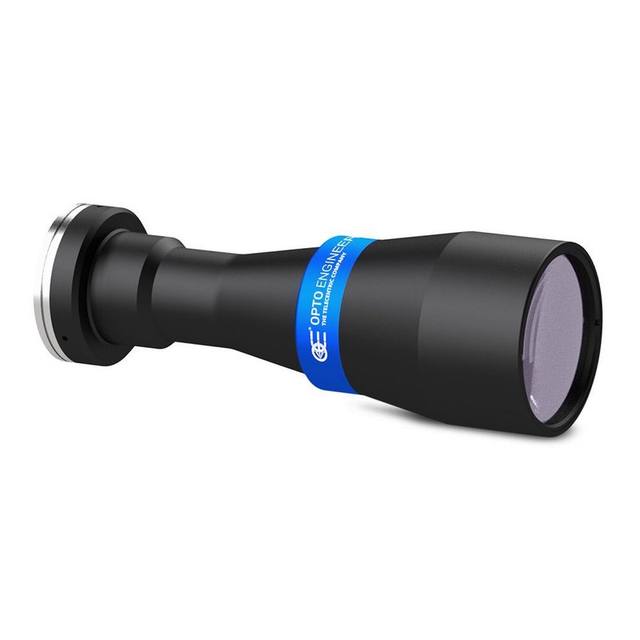
The Opto Engineering TCCR4MP048-F is a telecentric CORE lens from the TC4MHR series, which the manufacturer describes as compact telecentric lenses for sensors up to 4/3″. It uses an F-mount, works at 0.366× magnification and has a working distance of 132.9 mm. At 0.366× the sensor images a field only a few times larger than its own dimensions, so the lens is aimed at detailed measurement of small features rather than wide coverage of a large part.
The working f-number is 8 (wF/# 8). At 0.366× the field is a few times the sensor size, so the part must sit at the 132.9 mm working distance and stay there consistently. The illumination should be bright and even enough to support short exposures across the small field, and strobe or intense LED lighting is a common choice for moving parts.
Distortion is rated typical <0.05 % with a 0.10 % maximum, and telecentricity typical <0.08° with a 0.10° maximum. Those figures keep feature sizes consistent as the part moves slightly, which is what makes the lens suitable for repeatable dimensional measurement. The F-mount is the interface that determines which camera bodies the lens fits.
Best for
Precision measurement of small features at a fixed 132.9 mm working distance
Dimensional gauging of small machined or moulded parts on F-mount camera systems
Hole, pin and edge position checks where telecentric measurement is required
Inspection of small printed marks or components where fine detail matters
Backlit silhouette measurement using a telecentric backlight
Selection notes
Confirm the camera body has an F-mount to match the lens before ordering.
Match the sensor to the 4/3″ maximum sensor rating. Larger sensors will not be fully covered by the image circle.
Hold the part at 132.9 mm. With a small field of view, even small positioning errors show up clearly in the measurement.
Plan bright, even lighting for wF/# 8, and set gauging tolerances against the 0.10 % distortion and 0.10° telecentricity maxima.
Calibrate the system at the working distance before production use.
Specifications: General
Brand
Opto Engineering
Specifications: Optical
Lens mount
F-mount
Image circle / max sensor
4/3″ max sensor
Magnification
0.366×
Working distance
132.9 mm
Telecentric
Yes
Applications this product is commonly selected for. Open one to see the full recommended hardware and approach.
Matched automatically by: camera mount fits the lens mount · camera sensor is covered by the lens image circle — this lens: F-mount · 4/3″ max sensor image circle.