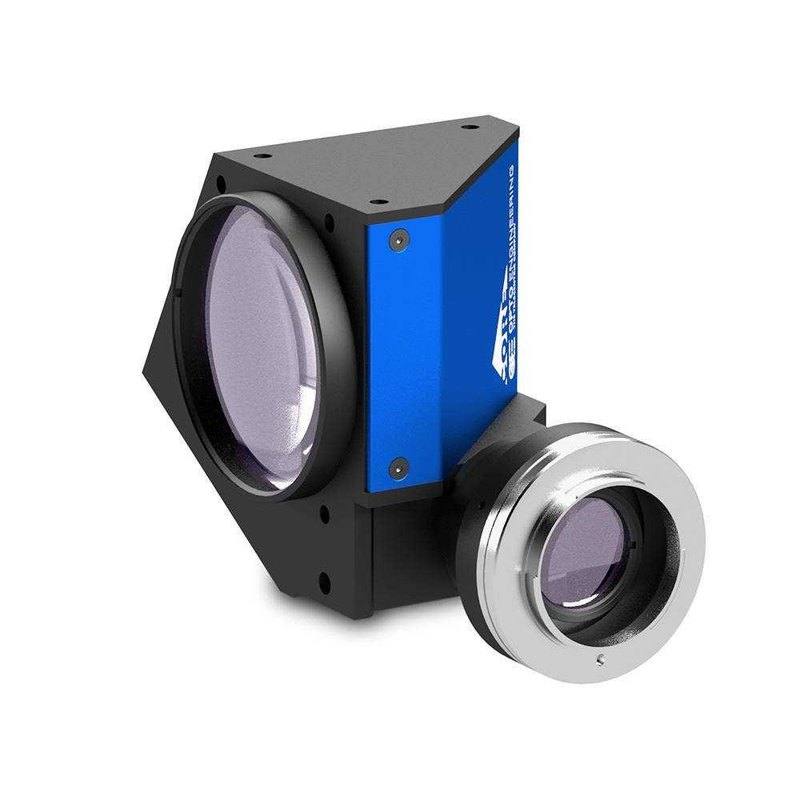
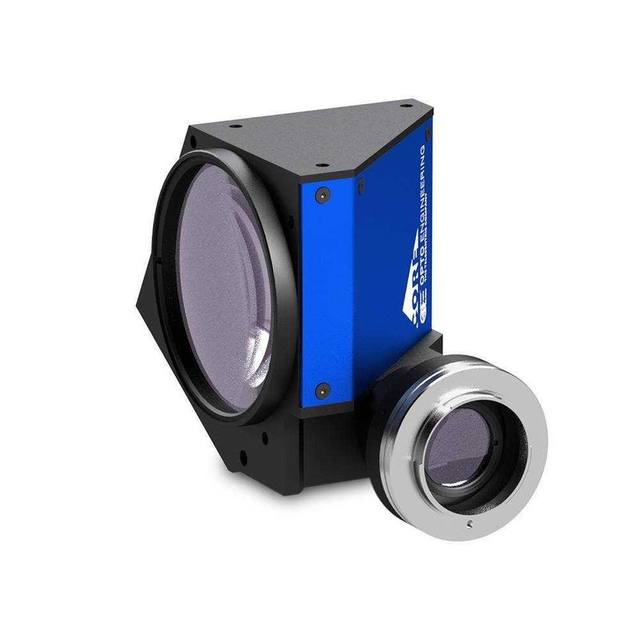
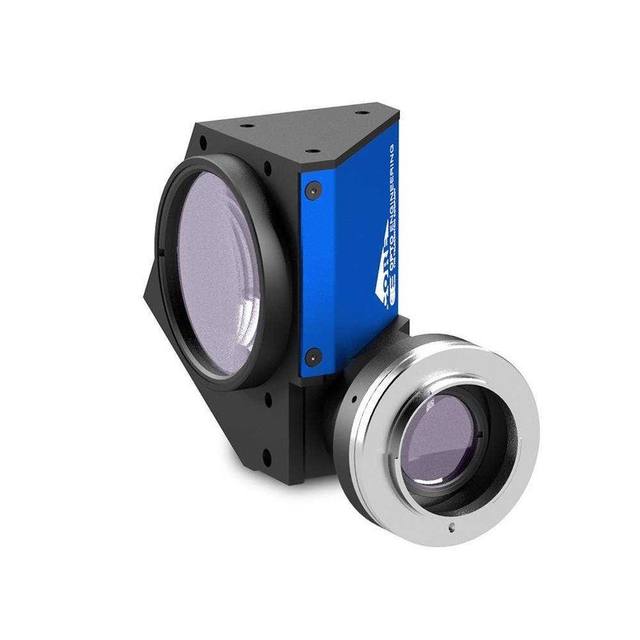
The Opto Engineering TCCR4MP056-F is a telecentric CORE lens from the TC4MHR series, which the manufacturer describes as compact telecentric lenses for sensors up to 4/3″. It uses an F-mount, works at 0.313× magnification and has a working distance of 157.8 mm. At this magnification the sensor images a field a few times larger than its own dimensions, which suits detailed measurement of small parts with the whole part in view. The lens is built for the 4/3″ sensor class described for this series, so the sensor should stay within that rating.
The working f-number is 8 (wF/# 8). At 0.313× the field is a few times the sensor size, so the part should sit at the 157.8 mm working distance on every cycle. Because the aperture is relatively closed, the illumination needs to be bright and stable enough to support short exposures.
The rated distortion is typical <0.07 % with a 0.10 % maximum, and telecentricity is typical <0.05° with a 0.10° maximum. These values keep feature size stable as the part moves slightly and keep straight edges straight across the image, which is what makes the lens useful for repeatable dimensional measurement.
Best for
Precision gauging of small parts at a 157.8 mm working distance
Hole, pin and edge position checks where telecentric measurement is required
Inspection of components on F-mount camera systems with a 4/3″ sensor
Backlit silhouette measurement using a telecentric backlight
Verification of printed marks and small machined features
Selection notes
Confirm the camera body has an F-mount to match the lens.
Stay within the 4/3″ maximum sensor rating. Sensors larger than this will show dark corners.
Hold the part at 157.8 mm during each capture, with a fixture that keeps this distance repeatable.
Use bright, stable illumination to support wF/# 8 and short exposures.
Set gauging tolerances against the 0.10 % distortion and 0.10° telecentricity maxima, and calibrate at the working distance.
Specifications: General
Brand
Opto Engineering
Specifications: Optical
Lens mount
F-mount
Image circle / max sensor
4/3″ max sensor
Magnification
0.313×
Working distance
157.8 mm
Telecentric
Yes
Applications this product is commonly selected for. Open one to see the full recommended hardware and approach.
Matched automatically by: camera mount fits the lens mount · camera sensor is covered by the lens image circle — this lens: F-mount · 4/3″ max sensor image circle.