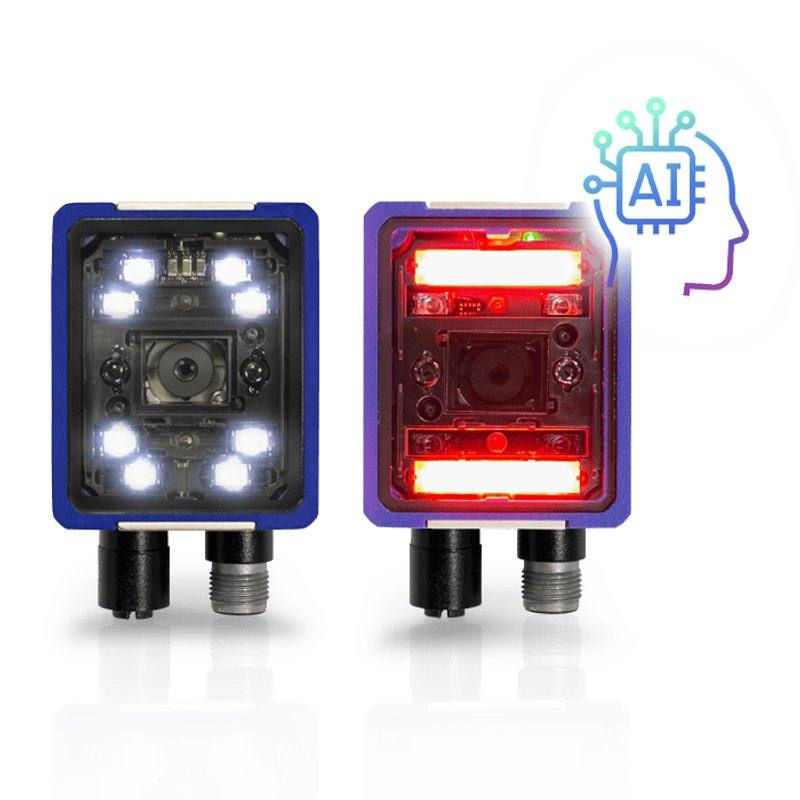
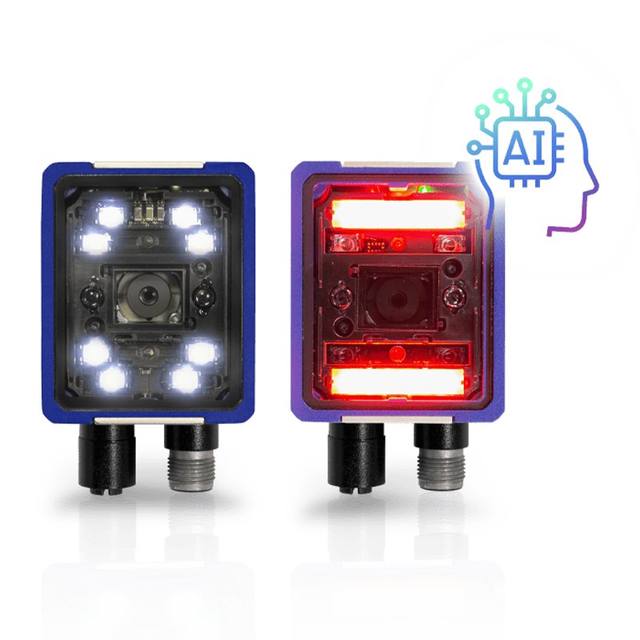
A 38.3° viewing angle and a 40–400 mm reading range make this the version for parts whose distance to the reader varies. Taking the angle as horizontal, the field is 2 × 40 mm × tan 19.15° ≈ 28 mm wide at the near limit and 2 × 400 mm × tan 19.15° ≈ 278 mm at the far limit, so one pixel on the 1280 px width covers about 0.022 mm near and 0.22 mm far. At an example 4 px per module the smallest module is therefore about 0.09 mm near and 0.87 mm far: pixel size, not the reading range, decides how small a mark can be.
This XAI model decodes with DecodeX, an AI-based decoder using machine learning for DPM codes. The 1/3-inch global-shutter CMOS sensor exposes the whole frame at once, so parts can be read in motion without skew, and the integrated high-power red light with polarizer saves finding room for an illuminator at close standoffs.
Best for
Fixtures or conveyors where the part-to-reader distance changes by tens or hundreds of millimetres, since the 40–400 mm reading range and electronic focus control cover that spread.
Tight cells with little space, where the built-in light and a connector turned to 90° (body 57 × 47 × 58 mm) keep the reading head compact.
Atmospheres containing sulfur gases, for example in rubber processing: all Matrix 220 models are rated for sulfur gas resistance to ISO EN 60068-2-43.
Selection notes
Do not mount at the far end of the range for small marks: at 400 mm a pixel covers about 0.22 mm, so a 0.3 mm module is only 0.3 ÷ 0.22 ≈ 1.4 px wide, too coarse for dependable DPM decoding.
The polarizer reduces specular glare, but dark, rough or textured marks still need tests with the actual marking to confirm contrast.
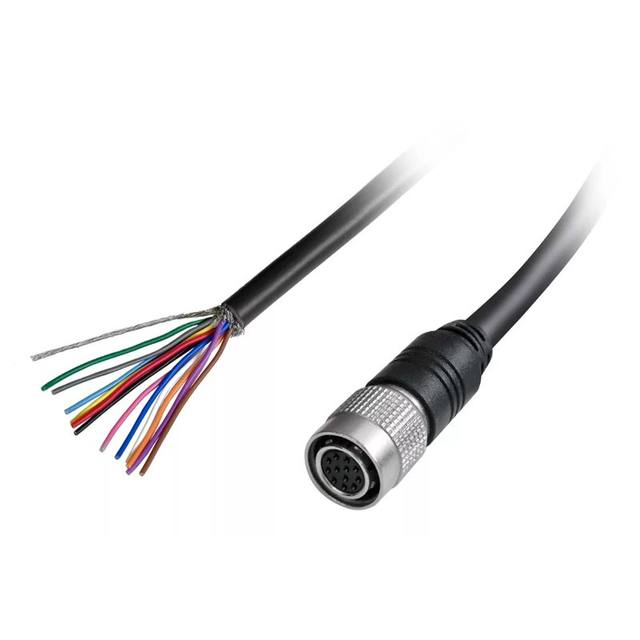
Two inputs for triggering and 3 outputs for results are on the M12 17-pin connector, with Ethernet on its own port.
Specifications: General
Brand
Datalogic
Reader type
Code reader
Form factor
Compact fixed-mount 2D imager
AI / deep learning
Yes — DecodeX, AI-based decoding (machine learning) for DPM codes; up to 2.5× faster decoding
40 – 400 mm (DPM-R HP, 7 mm lens; high-speed applications)
Specifications: Mechanical
Dimensions
78 x 47 x 38 mm (connector at 0°); 57 x 47 x 58 mm (connector at 90°)
Weight
173 g
Housing material
Aluminium case, plastic protective window cover
This product groups every purchasable order code that shares the same sensing method, range and output. Cable length, connector type and operation mode (Light-ON/Dark-ON, NO/NC) vary by order code below.
Family variants with highlighted differences
Model
Illumination colour
Availability
MATRIX 220 302-110 XAI DPM-R 7MM HP Base
Red (DPM)
On request
MATRIX 220 302-110 XAI DPM-R 7MM HP ESD
Red (DPM)
On request
Applications this product is commonly selected for. Open one to see the full recommended hardware and approach.
1. Install the IMPACT Software Suite and connect the camera
Install the IMPACT Software Suite on your PC, which provides both the configuration/viewer tools and the SDK. For a GigE Vision model (E100, M or U series), connect it to a dedicated NIC and, for USB3 models, use a certified USB3 cable and port. Power the camera and confirm it enumerates.
2. Bring the camera online and verify the link
For GigE Vision, put the camera and the host NIC on the same subnet (a static IP on the camera matching the NIC range is the most reliable starting point); for USB3, confirm the device is recognized. Open the IMPACT viewer/device tool, discover the camera, and verify a stable connection before streaming. Enabling jumbo frames on the NIC helps GigE throughput.
3. Set exposure, gain and trigger, then grab a first image
In the IMPACT tools, start a live stream and adjust exposure and gain until the image is well-lit without saturation; set white balance on color models. Begin in free-run (continuous) mode to confirm imaging, then switch to hardware or software trigger as your application requires. Capture and save a reference image once the scene looks correct.
4. Build a vision tool or move to the SDK/API
Use the IMPACT point-and-click vision tools to assemble an inspection, or use the IMPACT SDK to access the camera and results programmatically and feed them into your HMI/PLC application. As these are GenICam/GenTL-compliant devices, you can alternatively drive them from any GenICam-compliant third-party vision library if your pipeline standardizes on one.
5. Route the stable feed to deep-learning inspection (optional)
Once you have a stable, repeatable image, the feed can be sent to a deep-learning inspection platform such as Rosepetal for defect detection or classification tasks that go beyond rule-based tooling. Keep lighting, optics and trigger timing fixed so the images reaching the model stay consistent.
Frequently asked questions
The sensor, light and interfaces are the same; the optic decides. For a given field width the 12 mm (24.1°) stands about 1.6 times farther back than this 38.3° lens (tan 19.15° ÷ tan 12.05° ≈ 1.63), which suits small marks seen from a distance. The 40–400 mm range is quoted for this 7 mm version, so confirm the range of the 12 mm before choosing it.
The sensor runs at 45 frames/s, and with DecodeX every DPM code is specified to be captured within 100 ms. On moving parts, check that the exposure is short enough for the line speed.
Camera Housing: Basler Camera housing ace 2 GigE, Basler Camera housing ace 2 USB / CXP / GMSL, Basler Camera housing ace USB, Basler Camera housing ace GigE