VS-MCL100-FNO80/M42-10 Vibrations and Shocks Resistant Lens
3Z4S-LE VS-MCL100-FNO80
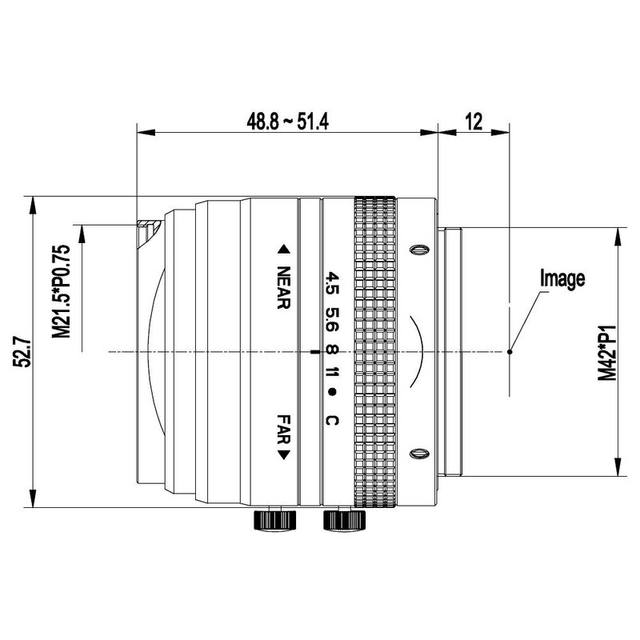
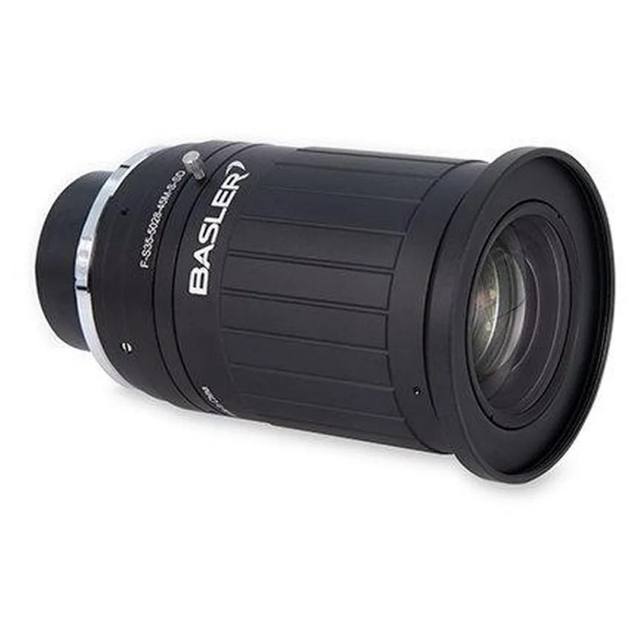
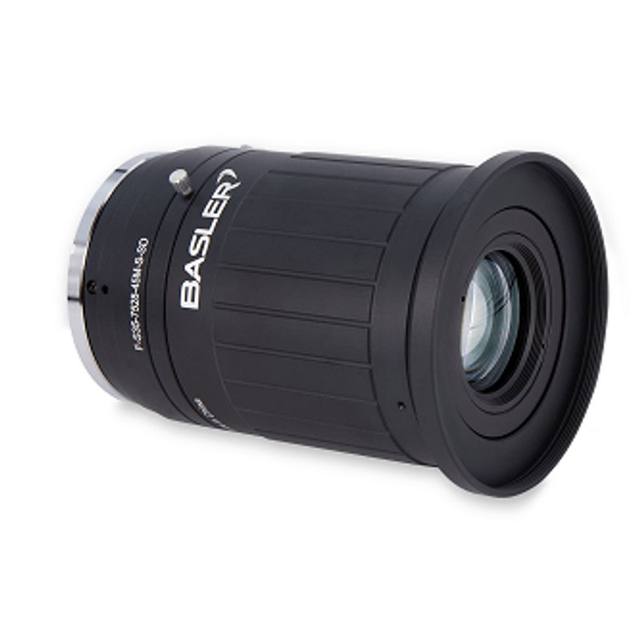
The Omron 3Z4S-LE VS-MCL100-FNO80/M42-10 is a 100 mm fixed-focal-length lens from the VS-MCL/M42-10 series, designed for M42-mount machine vision cameras and optimized for use with 12 MP sensors up to 1.8 inches. It achieves vibration and shock resistance through a lock ring that secures the focus surface and an improved internal structure, making it suitable for deployment in environments subject to ambient vibration. The working distance range spans 408.5 mm to 2050.2 mm with a depth of field of 9.2 mm to 269.0 mm at F8.0. The lens body is 52 mm in outer diameter and adjusts in total length between 110 mm and 135 mm as focus is changed, with an M46 P0.75 front filter thread.
The Omron VS-MCL100-FNO80/M42-10 is a 100 mm fixed-focal-length lens engineered specifically for large-format machine vision cameras equipped with the M42 mount (pitch 1 mm). Its most distinctive design feature is a lock-ring mechanism that secures the focus surface once set, combined with a reinforced internal structure — together these deliver genuine vibration and shock resistance rather than the soft-lock arrangements found on standard C-mount lenses. For installers working on press lines, conveyor-side gantries, or any station where floor-transmitted vibration is a daily reality, this means the focus plane stays exactly where it was set during commissioning, eliminating the need for periodic re-qualification. The lens covers image circles up to 1.8 inches, making it fully compatible with the 12 MP large-format sensors that have become common in high-resolution area-scan cameras for precision inspection and measurement work.
At F8.0 maximum aperture, the lens trades raw light-gathering ability for a tighter, more uniform point-spread function across the full 1.8-inch image circle — a deliberate choice for inspection applications where sharpness uniformity corner-to-corner matters more than low-light sensitivity. The working distance spans 408.5 mm to 2050.2 mm, giving installers genuine flexibility in mounting height: a camera positioned roughly 400 mm above a component yields a tighter field suited to small-feature inspection, while pulling back beyond two metres opens up the depth of field to 269 mm at F8.0, useful for profiling tall or irregular objects. The total body length adjusts between 110 mm and 135 mm as focus is racked, so camera-to-lens-front clearance must be reserved during enclosure design. A front M46 P0.75 filter thread is provided, allowing bandpass or polarising filters to be fitted without adapters.
With a 100 mm focal length on a 1.8-inch sensor, this lens produces a relatively narrow, telephoto-like field of view that inherently reduces perspective error compared to shorter focal lengths — useful for dimensional measurement tasks where angular distortion at image edges would corrupt width or gap readings. Although the lens is not telecentric (telecentricity is explicitly not a feature), the combination of long focal length, small maximum aperture, and a fixed-prime design (no zoom mechanics to introduce repeatability variability) means it performs reliably in gauging and surface-inspection workflows when camera-to-object distance is held constant by mechanical fixturing. The operating temperature range of -5 to +50 °C covers typical factory-floor and outdoor-shelter environments without additional thermal management.
Best for
High-resolution surface and defect inspection on 12 MP large-format cameras where corner-to-corner sharpness across a 1.8-inch sensor is required
Dimensional measurement of components at working distances between 400 mm and 2050 mm, particularly where a longer focal length reduces perspective error on width and gap features
Vibration-prone installations — press rooms, conveyor sidelines, or robotic cells — where focus drift from ambient shock would otherwise require periodic recalibration
OCR/OCV and traceability code reading on parts requiring fine character or DataMatrix detail resolved across a wide field at a controlled standoff
Pharmaceutical and electronics packaging inspection lines where the 100 mm focal length and lock-ring stability support validated, repeatable imaging under quality-system requirements
Selection notes
Mount compatibility is strictly M42 pitch 1 mm — confirm the camera body accepts M42 before ordering, as M42 and C-mount are not interchangeable and no adapter is included in the product listing
Maximum aperture is F8.0: the lens will not open wider, so lighting design must compensate fully. Strobe or high-intensity continuous illumination is strongly recommended rather than relying on ambient light, especially when exposure times must be short to freeze motion
Body length varies from 110 mm to 135 mm with focus adjustment — reserve at least 135 mm of axial space between the camera sensor plane and any enclosure wall, light baffle, or protective glass in front of the lens
Working distance minimum is 408.5 mm: this lens cannot be focused closer. Applications requiring fields of view at distances below ~400 mm should consider a shorter focal length from the same VS-MCL/M42-10 series
The front filter thread is M46 P0.75 — if optical filters are part of the inspection setup (e.g., bandpass filters matched to a monochromatic LED ring light), specify M46 filters or the correct step-up/step-down adapter at design-in time
Specifications: General
Brand
Omron / Sentech
Specifications: Optical
Focal length
100 mm
Lens mount
M42 (pitch 1 mm)
Aperture (f-number)
F8.0 (maximum)
Image circle / max sensor
1.8 inch (max compatible CCD)
Working distance
408.5 – 2050.2 mm
Telecentric
No
Specifications: Environment
Operating temperature
-5 to +50 °C
Applications this camera is commonly selected for. Open one to see the full recommended hardware and approach.
Matched automatically by: camera mount fits the lens mount · camera sensor is covered by the lens image circle — this lens: M42 (pitch 1 mm) · 1.8 inch (max compatible CCD) image circle.
By category
All 21High-speed cameras 9High-resolution cameras 7Area scan cameras 5
These steps take an Omron Sentech (STC) camera from the box to a stable first image and on to your own application. They apply across the GigE Vision, USB3 Vision and CoaXPress STC families; the interface only changes how you cable and power the camera.
Download and install the Sentech SDK on the host PC. The package provides StViewer, the viewing and configuration software you use to bring the camera up, and StApi, the programming SDK you integrate later. Because the cameras are GenICam/GenTL-compliant, StApi also registers a GenTL producer, so any GenICam-compliant third-party vision software can discover and drive the camera as an alternative front end.
2. Cable, power and connect the camera
Connect according to the interface. GigE Vision: link to a Gigabit NIC (use PoE or the separate power input) and put the camera and host on the same subnet; for USB3 Vision use a USB 3.x port and a certified cable; for CoaXPress (STC) connect to a CoaXPress frame grabber, which also supplies Power-over-Coax. Then open StViewer and let it enumerate the camera. If a GigE camera does not appear, check the IP configuration and firewall, and on USB3 confirm the host bandwidth and driver.
3. Configure exposure, gain and white balance
Open the device in StViewer and start a live stream. Set exposure and gain for a well-exposed, low-noise image: raise exposure first and only add gain when more light or a faster shutter is not an option, keeping exposure short enough to freeze motion on global-shutter models. On colour cameras, run white balance under your actual production lighting. Adjust the lens aperture and focus on a representative target before tuning anything else.
4. Set the trigger and grab a first image
Start in free-run (continuous) acquisition to confirm a clean, stable image. For inline inspection switch to hardware or software triggering: select the trigger source, set the active edge and any delay, and wire the strobe or illumination to the camera's I/O so lighting fires with each exposure. Acquire and save a frame in StViewer; this saved image is your reference for the SDK stage and for downstream inspection.
5. Move to the StApi SDK (or any GenICam software)
Once the image is stable, reproduce the same settings in code. Use StApi to open the device, apply the GenICam features you validated in StViewer (exposure, gain, trigger, pixel format) and grab frames into your application via the bundled C++, C, C#/.NET or Python interfaces; the included samples are the fastest starting point. Prefer a different stack? The same GenICam/GenTL camera works with third-party vision libraries. With a reliable feed, you can route it into a deep-learning inspection such as Rosepetal for AI-based defect detection.
Frequently asked questions
The lens is rated for image circles up to 1.8 inches, which corresponds to the sensor diagonal of 12 MP large-format area-scan cameras in that class. Sensors smaller than 1.8 inches are fully covered with margin to spare.
No. The lens uses an M42 mount with 1 mm pitch. C-mount, F-mount, and other thread or bayonet standards are mechanically incompatible. An M42-to-C adapter would introduce focus-distance errors and defeat the lock-ring vibration resistance feature.
The focus range runs from 408.5 mm to 2050.2 mm object distance. At the close end, the field of view on a 1.8-inch sensor is at its smallest (highest magnification); at 2050 mm the field is at its widest and depth of field reaches 269 mm at F8.0. Exact field dimensions depend on the sensor size of the specific camera used.
The lock ring is a mechanical clamping ring that, once tightened, prevents the focus barrel from rotating or drifting under vibration or shock. It must be loosened to refocus, then re-tightened after any focus adjustment — a one-time action during installation and again if the working distance changes.
The front element uses an M46 P0.75 thread. Standard 46 mm photographic filters and machine-vision bandpass filters specified as M46 P0.75 attach directly without adapters.