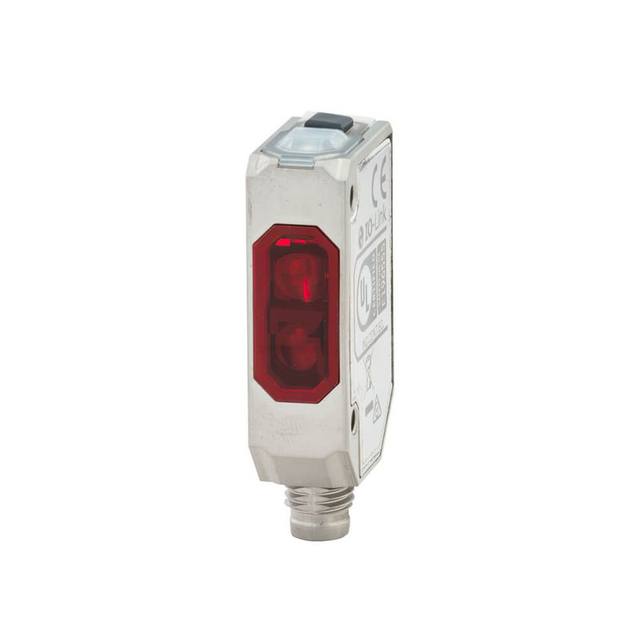
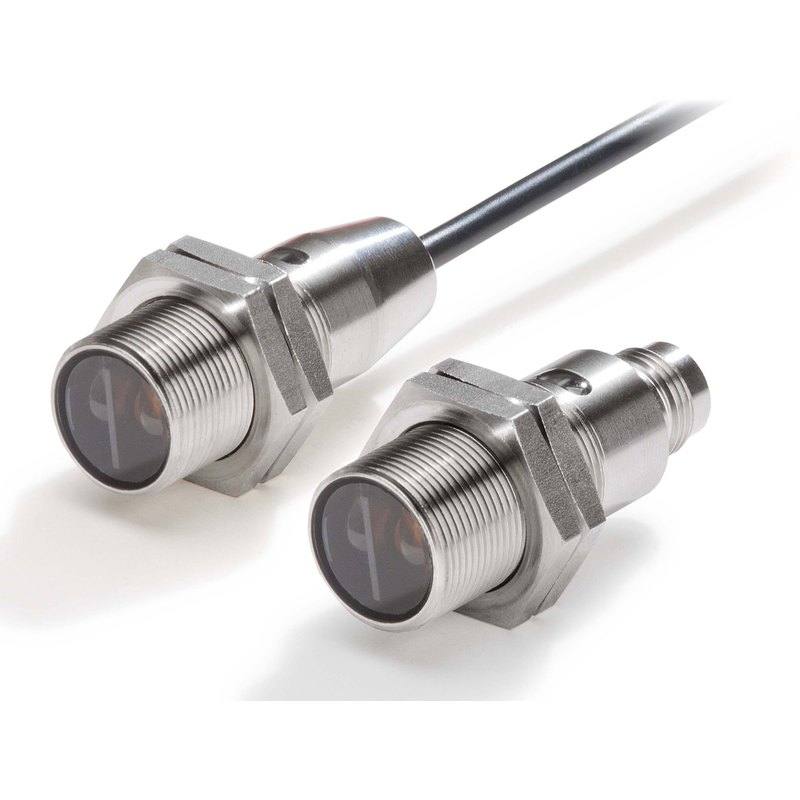
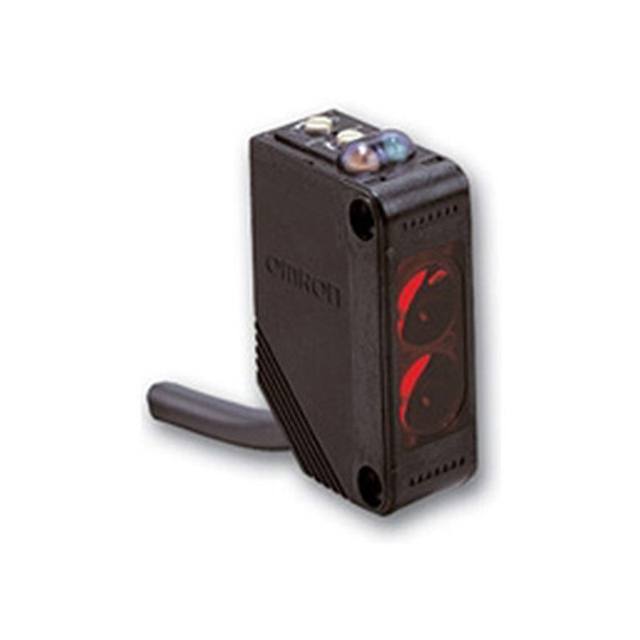
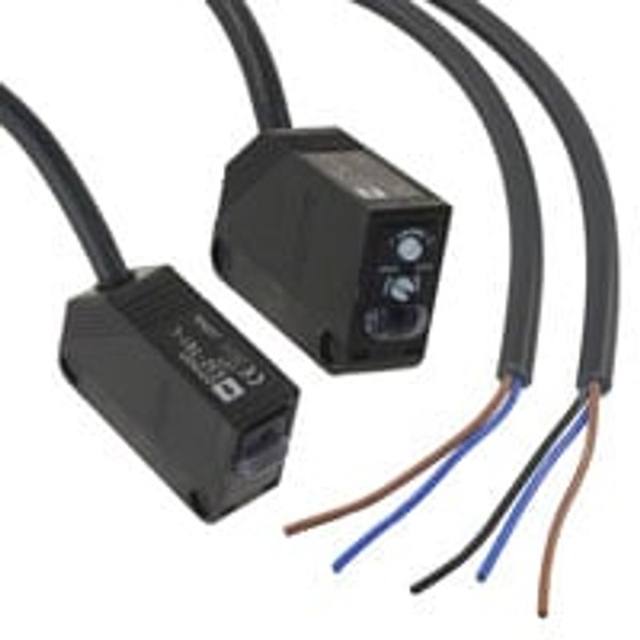
The Omron E3FC is a compact M18 cylindrical photoelectric sensor series housed in SUS316L (1.4404) stainless steel, offering five sensing methods: through-beam (20 m), retro-reflective with MSR (0.1–4 m), diffuse-reflective (300 mm or 1 m), background suppression (100–200 mm), and transparent object detection (100–500 mm). The sensor operates from 10–30 VDC with NPN or PNP open-collector outputs, a 0.5 ms response time, and 100 mA maximum load current. It achieves IEC IP67, IP68 (heat-shock tested), and DIN 40050-9 IP69K protection ratings, making it suitable for high-pressure hot-water cleaning with tested compatibility against Ecolab and Diversey industrial detergents. All models share a 48 mm body length and are available with pre-wired 2 m cable or M12 connector.
The Omron E3FC is an M18 cylindrical photoelectric sensor built around a SUS316L (1.4404) stainless steel housing — the same alloy used in pharmaceutical process piping — and it carries the full triple protection stack of IP67, IP68 (heat-shock tested), and DIN 40050-9 IP69K. That last rating is the decisive one for wash-down installations: it certifies survival under high-pressure hot-water jets at elevated temperature, conditions typical of CIP-adjacent line cleaning. The sensor has also been tested against Ecolab and Diversey industrial detergents, which removes a common qualification burden from integrators working in food, beverage, and pharma. The 48 mm body length and M18 × 1 thread fit standard barrel-sensor cutouts with no adapter, and the choice of pre-wired 2 m cable or M12 connector allows the same mechanical design to serve both direct-wiring panels and quick-disconnect field-bus drops.
The E3FC series covers five distinct sensing methods in one housing family, which matters for multi-point line designs where stocking a single series simplifies spares. Through-beam models reach 20,000 mm — useful for cross-conveyor presence detection on wide packaging lines or pallet verification at staging lanes. Retro-reflective with MSR (mutual suppression of reflections) covers 100 mm to 4,000 mm and suppresses shiny-surface false triggers that plague standard retro models. Diffuse-reflective models are rated to 300 mm or 1,000 mm depending on variant, and background-suppression (BGS) models are confined to 100–200 mm for precise near-field detection where the target must be distinguished from a moving conveyor belt or fixture plate. A transparent-object detection variant works from 100 mm to 500 mm, providing enough contrast against clear PET bottles, glass vials, or blister-film to produce reliable switching without additional optics. All models share a 0.5 ms response time — fast enough for conveyor speeds commonly encountered in secondary packaging and sortation without requiring a dedicated high-speed model.
Output wiring follows standard industrial photoelectric conventions: NPN or PNP open-collector at up to 100 mA load current, supplied from any 10–30 VDC rail. This broad voltage window covers both 12 V and 24 V DC architectures, and the open-collector topology interfaces directly to PLC sink or source inputs without level-translation. Because the output is discrete (presence/absence switching) rather than analog, integration into a trigger chain for a downstream vision system is straightforward — the sensor signal can gate a camera's hardware trigger line directly. Operating temperature spans −25 °C to 55 °C (storage to 70 °C), which accommodates both blast-chilled food environments and unventilated enclosures in summer. The 76 g pre-wired model and the 22 g M12 connector model share identical sensing performance; the weight difference is purely cable versus connector mass, so mount torque and bracket design need not change between variants.
Best for
Wash-down presence detection on food and beverage conveyor lines where high-pressure hot-water cleaning cycles occur daily and chemical compatibility with Ecolab or Diversey formulations is a procurement requirement.
Pharmaceutical packaging and medical-device assembly lines requiring stainless steel sensor bodies that conform to hygienic design standards and can survive IPA or hydrogen-peroxide wipe-down procedures.
Transparent container verification — clear PET bottles, glass vials, blister packs — using the 100–500 mm transparent-object detection variant to achieve contrast without modifying line optics.
Camera trigger generation in vision-integrated conveyor systems: the 0.5 ms switching speed and discrete PNP/NPN open-collector output connect directly to a machine-vision camera's hardware trigger input for repeatable exposure timing.
Long-range cross-conveyor or pallet-presence detection in logistics sortation where the 20,000 mm through-beam range eliminates the need for passive reflectors on both sides of a wide sortation lane.
Selection notes
Match sensing method to target and background before ordering: the BGS variant (100–200 mm) is the correct choice when the target sits close to a moving belt or reflective fixture; the transparent-object variant is required for unprinted clear packaging; standard diffuse or retro-reflective models will false-trigger on shiny surfaces unless the MSR retro-reflective variant is selected.
Choose the M12 connector variant (22 g) for installations with frequent sensor replacement cycles or where cable runs are managed by a field-bus harness system; choose the pre-wired 2 m model only when direct panel wiring is fixed at installation time, because re-cabling a potted pre-wired sensor in a wash-down zone is disruptive.
Confirm PLC input polarity before specifying NPN versus PNP: the two output variants are not field-selectable on this series, so ordering the wrong polarity requires a sensor swap rather than a wiring change.
The IP69K rating requires that all mating surfaces — bracket, nut, and (for M12 models) the mating connector — also carry appropriate sealing ratings; an unrated M12 cable assembly will degrade the system IP level even if the sensor body is fully compliant.
Operating temperature ceiling is 55 °C; in enclosed stainless steel housings near steam or heat-seal equipment, verify that ambient at the sensor does not exceed this limit — a locally elevated zone can cause premature LED aging that degrades sensing range before the sensor registers a hard fault.
Specifications: General
Brand
Omron / Sentech
Sensor type
Photoelectric
Specifications: Performance
Range / distance
Up to 20,000 mm (through-beam); 300–1,000 mm diffuse; 100–200 mm BGS
These steps take an Omron Sentech (STC) camera from the box to a stable first image and on to your own application. They apply across the GigE Vision, USB3 Vision and CoaXPress STC families; the interface only changes how you cable and power the camera.
Download and install the Sentech SDK on the host PC. The package provides StViewer, the viewing and configuration software you use to bring the camera up, and StApi, the programming SDK you integrate later. Because the cameras are GenICam/GenTL-compliant, StApi also registers a GenTL producer, so any GenICam-compliant third-party vision software can discover and drive the camera as an alternative front end.
2. Cable, power and connect the camera
Connect according to the interface. GigE Vision: link to a Gigabit NIC (use PoE or the separate power input) and put the camera and host on the same subnet; for USB3 Vision use a USB 3.x port and a certified cable; for CoaXPress (STC) connect to a CoaXPress frame grabber, which also supplies Power-over-Coax. Then open StViewer and let it enumerate the camera. If a GigE camera does not appear, check the IP configuration and firewall, and on USB3 confirm the host bandwidth and driver.
3. Configure exposure, gain and white balance
Open the device in StViewer and start a live stream. Set exposure and gain for a well-exposed, low-noise image: raise exposure first and only add gain when more light or a faster shutter is not an option, keeping exposure short enough to freeze motion on global-shutter models. On colour cameras, run white balance under your actual production lighting. Adjust the lens aperture and focus on a representative target before tuning anything else.
4. Set the trigger and grab a first image
Start in free-run (continuous) acquisition to confirm a clean, stable image. For inline inspection switch to hardware or software triggering: select the trigger source, set the active edge and any delay, and wire the strobe or illumination to the camera's I/O so lighting fires with each exposure. Acquire and save a frame in StViewer; this saved image is your reference for the SDK stage and for downstream inspection.
5. Move to the StApi SDK (or any GenICam software)
Once the image is stable, reproduce the same settings in code. Use StApi to open the device, apply the GenICam features you validated in StViewer (exposure, gain, trigger, pixel format) and grab frames into your application via the bundled C++, C, C#/.NET or Python interfaces; the included samples are the fastest starting point. Prefer a different stack? The same GenICam/GenTL camera works with third-party vision libraries. With a reliable feed, you can route it into a deep-learning inspection such as Rosepetal for AI-based defect detection.
Frequently asked questions
Yes. The sensor carries IP67, IP68 (heat-shock tested), and DIN 40050-9 IP69K ratings, and Omron has specifically tested the housing against Ecolab and Diversey industrial cleaning agents. IP69K certifies resistance to high-pressure, high-temperature water jets — the standard CIP cleaning condition.
Range depends entirely on the sensing method chosen. Through-beam models reach 20,000 mm. Retro-reflective with MSR covers 100–4,000 mm. Standard diffuse-reflective models are rated to 300 mm or 1,000 mm (variant-dependent). Background-suppression models work from 100–200 mm. Transparent-object detection is rated at 100–500 mm.
Each model is factory-configured as either NPN or PNP open-collector output — this is not field-selectable. Both variants support up to 100 mA load current and operate on any 10–30 VDC supply. Select the output polarity that matches your PLC input module at the time of ordering.
The body is SUS316L stainless steel, equivalent to EN 1.4404. This is the same low-carbon molybdenum-bearing alloy specified for pharmaceutical process equipment and food-contact surfaces. The 48 mm barrel format and M18 thread also keep wetted surface area to a minimum, which aligns with hygienic installation guidelines.
Yes. The discrete NPN or PNP open-collector output with a 0.5 ms response time is well-suited for direct connection to a camera's hardware trigger input. Most industrial cameras accept a 24 VDC open-collector signal on their trigger terminal, so no additional logic or level translation is required for a standard PLC-voltage installation.