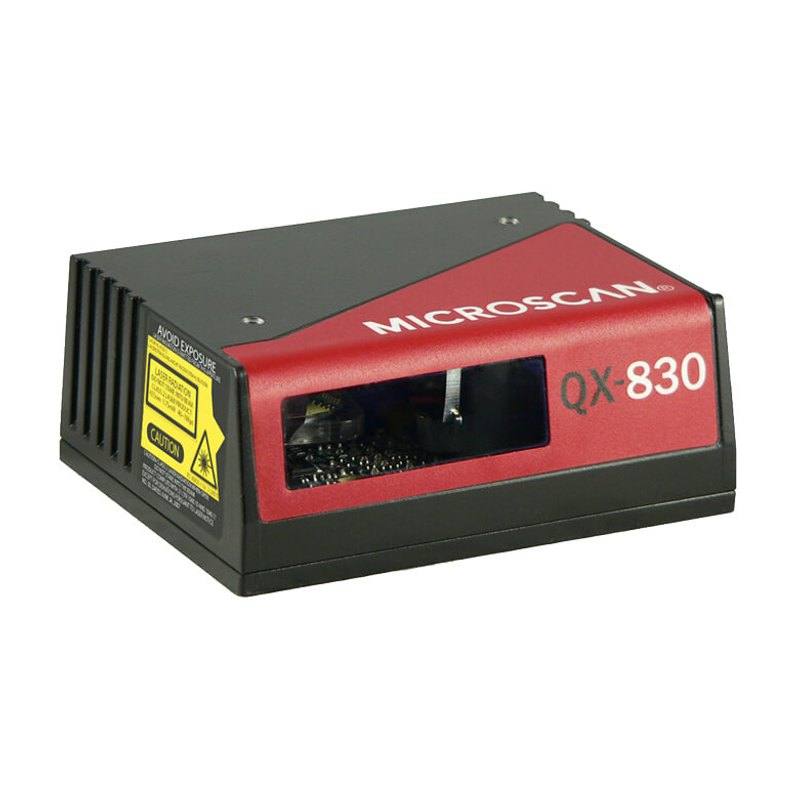
The density class decides what the QX-830 can read: Low Density covers 102–762 mm, Standard Density 25–304 mm and High Density 82–228 mm, which are depths of field of 762 − 102 = 660 mm, 304 − 25 = 279 mm and 228 − 82 = 146 mm. The 25–762 mm headline is the range across classes and no single order code covers it, so choose the class from your finest bar and the distance you can hold.
Scan rate is adjustable from 300 to 1400 scans/s. For an example 50 mm tall label moving at 1 m/s, the label stays in the beam for 0.05 m ÷ 1 m/s = 50 ms, which gives 50 ms × 300 scans/s = 15 sweeps at the slowest setting and 50 ms × 1400 scans/s = 70 at the fastest.
Best for
Conveyors carrying cartons of mixed height with wide-bar labels, where the Low Density class keeps the label readable across a 660 mm depth of field.
Fine-bar labels held at a fixed bracket distance, where the 82–228 mm High Density window matches the narrow bars.
Plants that mix EtherNet/IP controllers with equipment that still speaks RS-232 or RS-485, since the network option is chosen per order code.
Labels in poor print condition, where X-Mode decoding of damaged, poorly printed or misaligned 1D codes saves rejects.
Selection notes
Check the order code: two raster versions (Low and Standard Density) are serial-only, while the other five add Ethernet and EtherNet/IP. Single-line versions exist in Standard and High Density only.
It reads 1D barcodes only; Data Matrix and QR need an imager.
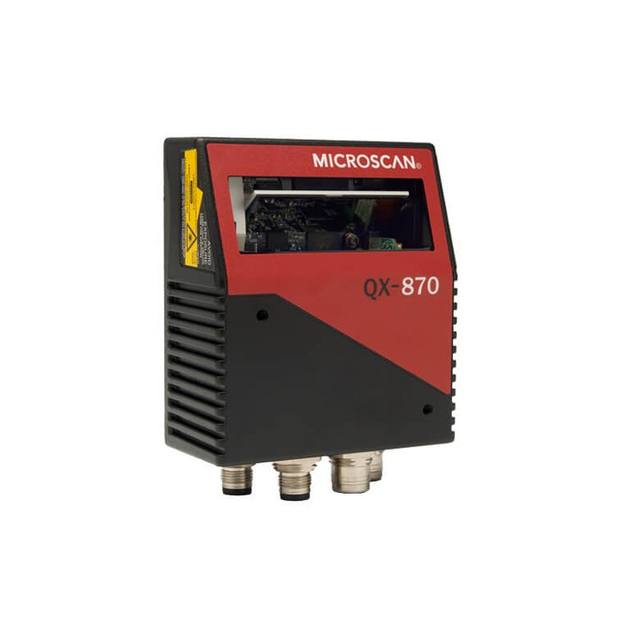
IP54 covers dust and splashes but not washdown. The QX-870 is IP65, with Ethernet, EtherNet/IP and RS-232, and is raster only.
A laser aimed square-on at a glossy label can be blinded by the specular reflection: mount the scanner with a slight tilt and test at both ends of the read window.
Specifications: General
Brand
Omron
Reader type
Code reader
Form factor
Fixed-mount
Specifications: Performance
Scan rate
300–1400 scans/s (adjustable)
Specifications: Interface
Communication
Ethernet, EtherNet/IP, RS-232, RS-485 (+ RS-422 on serial models), digital I/O (PNP/NPN outputs)
Specifications: Optical
Focus
Fixed focus
Specifications: Environment
IP rating
IP54 enclosure
Specifications: Reading
Scan technology
Laser scanner (1D)
Supported codes
1D barcodes
Read distance
25–762 mm (Low Density 102–762 mm, Standard Density 25–304 mm, High Density 82–228 mm)
Scan pattern
Raster line / Single line
This product groups every purchasable order code that shares the same sensing method, range and output. Cable length, connector type and operation mode (Light-ON/Dark-ON, NO/NC) vary by order code below.
Family variants with highlighted differences
Model
optics_class ●
Scan pattern ●
Read distance ●
Communication ●
Availability
QX-830 Scanner, Raster Line, LD, Serial Base
Low Density
Raster line
102–762 mm
Serial RS-232C, Serial RS-422, Serial RS-485
On request
QX-830 Scanner, Raster Line, MD, Serial
Standard Density
Raster line
25–304 mm
Serial RS-232C, Serial RS-422, Serial RS-485
On request
QX-830 Scanner, Single Line, MD, Serial & Ethernet
Standard Density
Single line
25–304 mm
EtherNet/IP, Ethernet TCP/IP, Serial RS-232C
On request
QX-830 Scanner, Single Line, HD, Serial & Ethernet
These steps take an Omron Sentech (STC) camera from the box to a stable first image and on to your own application. They apply across the GigE Vision, USB3 Vision and CoaXPress STC families; the interface only changes how you cable and power the camera.
Download and install the Sentech SDK on the host PC. The package provides StViewer, the viewing and configuration software you use to bring the camera up, and StApi, the programming SDK you integrate later. Because the cameras are GenICam/GenTL-compliant, StApi also registers a GenTL producer, so any GenICam-compliant third-party vision software can discover and drive the camera as an alternative front end.
2. Cable, power and connect the camera
Connect according to the interface. GigE Vision: link to a Gigabit NIC (use PoE or the separate power input) and put the camera and host on the same subnet; for USB3 Vision use a USB 3.x port and a certified cable; for CoaXPress (STC) connect to a CoaXPress frame grabber, which also supplies Power-over-Coax. Then open StViewer and let it enumerate the camera. If a GigE camera does not appear, check the IP configuration and firewall, and on USB3 confirm the host bandwidth and driver.
3. Configure exposure, gain and white balance
Open the device in StViewer and start a live stream. Set exposure and gain for a well-exposed, low-noise image: raise exposure first and only add gain when more light or a faster shutter is not an option, keeping exposure short enough to freeze motion on global-shutter models. On colour cameras, run white balance under your actual production lighting. Adjust the lens aperture and focus on a representative target before tuning anything else.
4. Set the trigger and grab a first image
Start in free-run (continuous) acquisition to confirm a clean, stable image. For inline inspection switch to hardware or software triggering: select the trigger source, set the active edge and any delay, and wire the strobe or illumination to the camera's I/O so lighting fires with each exposure. Acquire and save a frame in StViewer; this saved image is your reference for the SDK stage and for downstream inspection.
5. Move to the StApi SDK (or any GenICam software)
Once the image is stable, reproduce the same settings in code. Use StApi to open the device, apply the GenICam features you validated in StViewer (exposure, gain, trigger, pixel format) and grab frames into your application via the bundled C++, C, C#/.NET or Python interfaces; the included samples are the fastest starting point. Prefer a different stack? The same GenICam/GenTL camera works with third-party vision libraries. With a reliable feed, you can route it into a deep-learning inspection such as Rosepetal for AI-based defect detection.
Frequently asked questions
The five order codes sold as Serial & Ethernet. They add Ethernet and EtherNet/IP to the serial ports; the two serial-only raster codes have serial links only (RS-232, RS-422, RS-485).
It targets damaged, poorly printed or misaligned 1D codes. It does not add 2D reading, which a laser scanner cannot do.
Camera Housing: Basler Camera housing ace 2 GigE, Basler Camera housing ace 2 USB / CXP / GMSL, Basler Camera housing ace USB, Basler Camera housing ace GigE