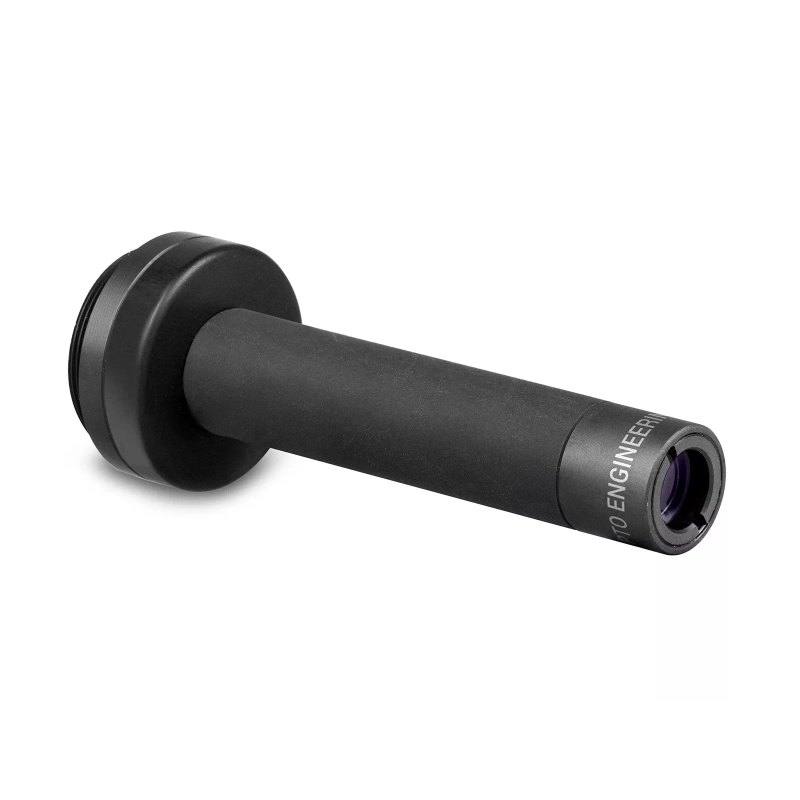
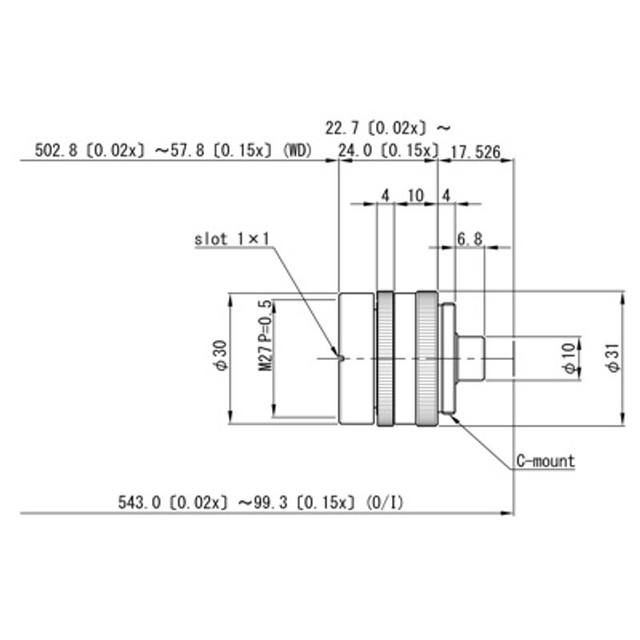
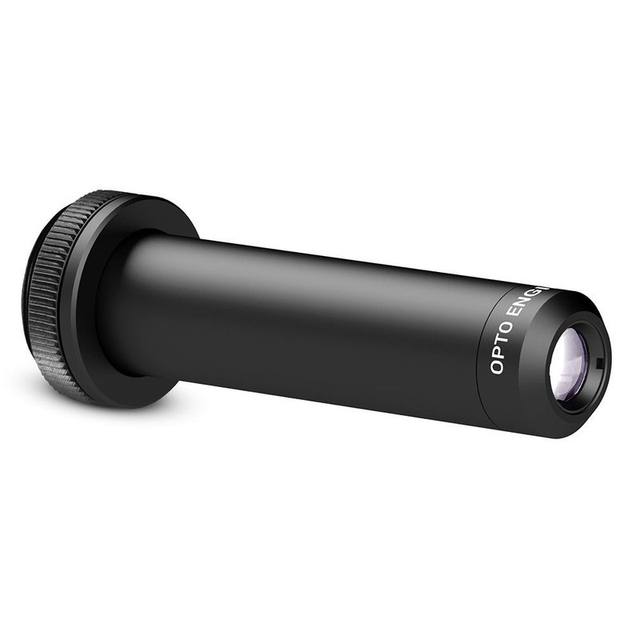
The Opto Engineering MC200X is a C-mount macro lens with a 28 mm focal length, a marked aperture of F5.3 and 2.000× magnification. Its Ø 11.0 mm image circle covers sensors up to 2/3″, and the manufacturer describes the MC series as nearly zero distortion macro lenses. At 2.000×, the object field is half the sensor dimensions, so the image is enlarged two times on the sensor and the frame covers a very small area of the part for close examination.
The 32.5 mm working distance is a very close stand-off, so the lens, lighting and any fixture must be arranged in a tight envelope, and mechanical clearance is the first design check. The working f-number of 16 is much higher than the marked F5.3, meaning the effective aperture is strongly closed and the depth of field is greater than the marked value suggests. The same closure admits much less light, so strong illumination is needed to compensate.
Pair the lens with a C-mount camera whose sensor is up to 2/3″. Lighting must reach the part from within a 32.5 mm working distance and be sized for a working f-number of 16. The nearly zero distortion description supports measurement tasks where the image should represent the part's geometry faithfully.
Best for
Close examination at 2.000× magnification, where the object field is half the sensor size.
Dimensional checks of very small features, where the nearly zero distortion description of the MC series is relevant.
Stations that can accommodate a 32.5 mm working distance.
Setups with C-mount cameras and sensors up to 2/3″.
Applications with strong illumination available to offset a working f-number of 16.
Selection notes
Keep the sensor at 2/3″ or smaller so it stays within the Ø 11.0 mm image circle.
Verify the 32.5 mm working distance against the machine layout before selecting fixtures or lighting.
Size illumination for the working f-number of 16, not the marked F5.3, because much less light reaches the sensor at this setting.
Protect the front element from the process at this close stand-off.
Specifications: General
Brand
Opto Engineering
Specifications: Optical
Focal length
28 mm
Aperture (f-number)
F5.3
Lens mount
C-mount
Image circle / max sensor
Ø 11.0 mm (max sensor 2/3″)
Magnification
2.000×
Working distance
32.5 mm
Applications this product is commonly selected for. Open one to see the full recommended hardware and approach.
Matched automatically by: camera mount fits the lens mount · camera sensor is covered by the lens image circle — this lens: C-mount · Ø 11.0 mm (max sensor 2/3″) image circle.