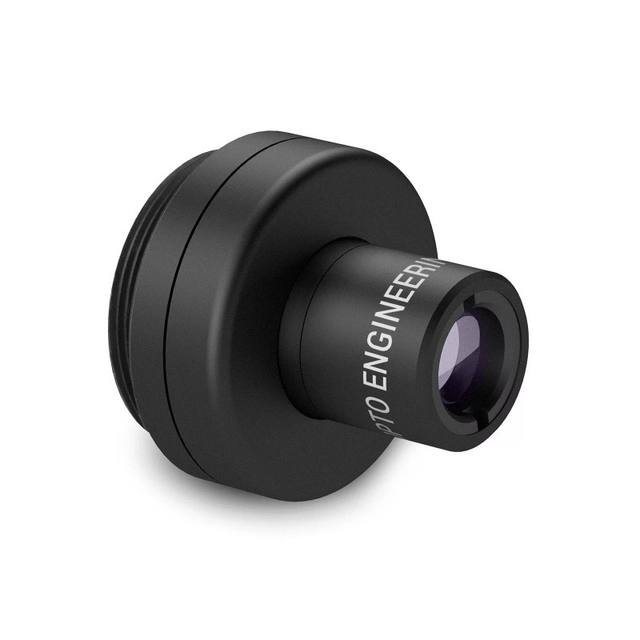
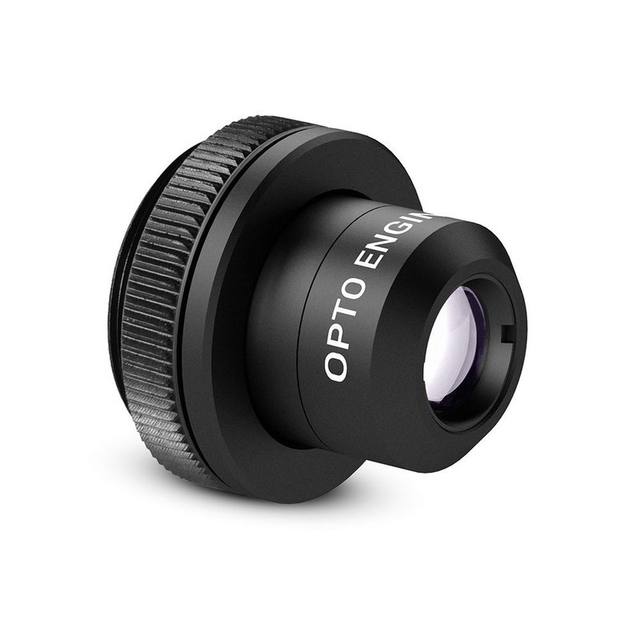
The Opto Engineering MC3-03X is a C-mount, multi-configuration macro lens with a 28 mm focal length and an F5.3 aperture, rated for sensors up to 2/3″. Its main feature is configurability: the listed magnification runs from 0.1× to 3.0× in 0.1× steps, and the working distance spans 7 – 275 mm depending on configuration. Magnification, working distance and working f-number all depend on configuration, so the application requirements (field of view, room between lens and part, and available light) should drive the configuration choice before the camera and illumination are sized.
The working f-number (wF/#) is listed as 6–21 by configuration, against the nominal F5.3. The effective aperture at the working distance is smaller than the nominal aperture, so a higher working f-number means less light reaches the sensor and depth of field is greater. Choosing the configuration therefore also sets the illumination budget: a configuration near wF/# 21 needs far more light and exposure time than one near wF/# 6, which passes more light and gives shallower depth of field.
The lens is described as a nearly zero distortion macro lens, a property that matters for dimensional measurement, and its 2/3″ coverage defines the sensor range. Use a C-mount camera body with a sensor no larger than 2/3″ so the image circle covers the full sensor. With a working distance as short as 7 mm, clearance around the part and the lighting layout must be planned carefully; at the longer end of the range (up to 275 mm) the camera can stand well back from the part.
Best for
Inspecting small features at magnifications up to 3.0× on sensors up to 2/3″
Dimensional measurement and gauging where nearly zero distortion supports geometric accuracy
Applications that need one lens to cover magnifications from 0.1× to 3.0× across different part sizes
Close-working inspections where a working distance as short as 7 mm is required
Setups with a longer standoff of up to 275 mm between lens and part
Selection notes
Select the configuration first. Magnification, working distance (7 – 275 mm) and wF/# (6–21) are linked, so the chosen setting fixes the mounting distance and how much light reaches the sensor.
Match the sensor to the image circle. The lens is rated for sensors up to 2/3″, so a larger sensor falls outside its rated coverage.
Budget illumination for high working f-number settings. Near wF/# 21 the sensor receives far less light than at the nominal F5.3, so plan for stronger lighting or longer exposure.
Confirm the camera body is C-mount to match the lens mount.
Measure the space between lens and part before committing to a configuration, because the working distance can range from 7 mm to 275 mm.
Matched automatically by: camera mount fits the lens mount · camera sensor is covered by the lens image circle — this lens: C-mount · 2/3″ max sensor image circle.