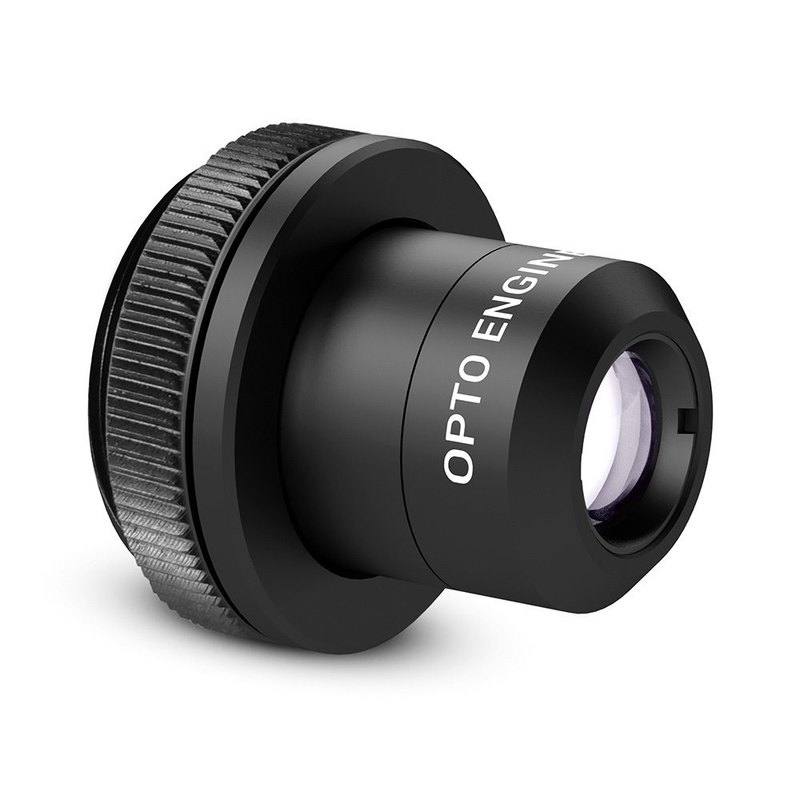
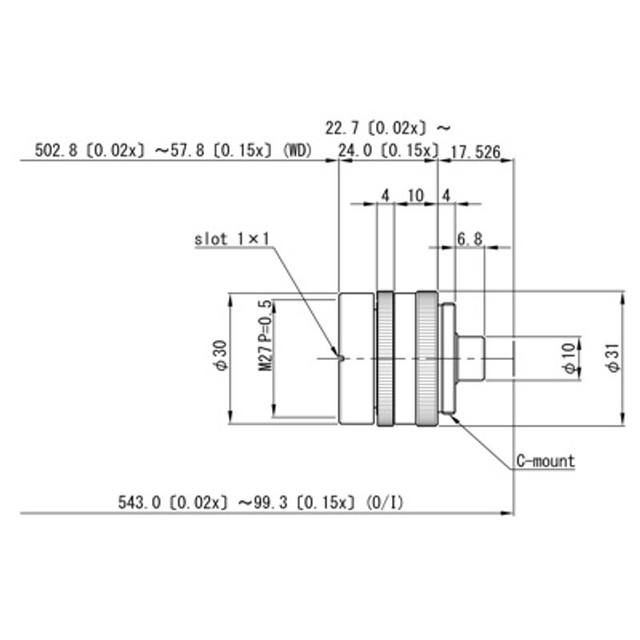
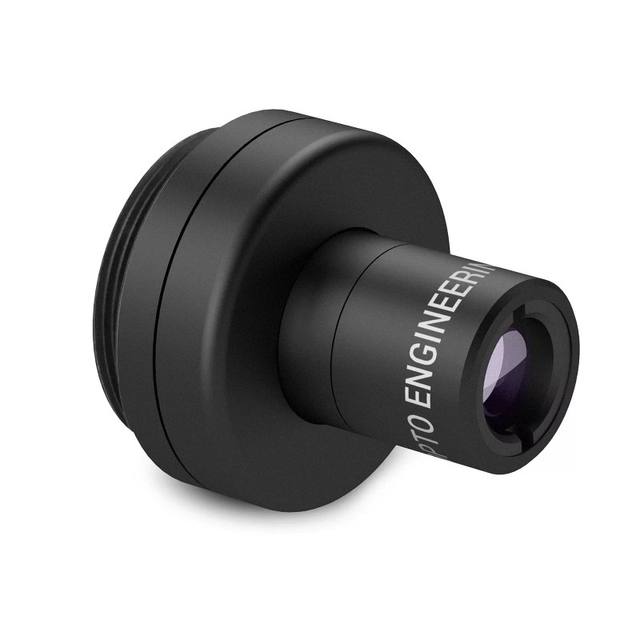
The Opto Engineering MC3M020X is a C-mount macro lens with a 32 mm focal length and an F5 aperture, rated at 0.200× magnification. Its Ø 17.6 mm image circle covers sensors up to 1.1″. At 0.200× the object is imaged at one fifth of its actual size on the sensor, which gives a field of view considerably larger than the sensor and suits mid-size parts. The working distance is 187.2 mm, so the camera stands well back from the object.
The working f-number of 6 is close to the nominal F5, so the loss of effective aperture caused by magnification is modest. A working f-number of 6 passes a useful amount of light for a macro setup and gives moderate depth of field, which allows some tolerance to height variation on the part. Illumination should be sized to cover the full field at the 187.2 mm standoff, and focus should be set and locked for consistent results.
The lens is described as a nearly zero distortion macro lens, which supports geometric measurement within the 1.1″ image circle. For installation, pair it with a C-mount camera whose sensor is 1.1″ or smaller, plan the 187.2 mm standoff into the fixture or enclosure, and calibrate the scale with a known target before measurements are taken.
Best for
Inspecting mid-size parts at 0.200× on sensors up to 1.1″
Setups with a 187.2 mm working distance that keep the camera clear of the part
Gauging with nearly zero distortion across a Ø 17.6 mm image circle
Applications with moderate height variation, where wF/# 6 gives moderate depth of field
Selection notes
Verify the camera sensor is no larger than 1.1″, since the image circle is Ø 17.6 mm.
Fix the 187.2 mm working distance in the mechanical design so focus and scale remain stable.
Light the full field evenly. At 0.200× the imaged area is large, so plan a light source that covers it uniformly.
Use a C-mount camera body to match the lens mount.
Calibrate the image scale with a known reference at 0.200× before taking dimensional measurements.
Specifications: General
Brand
Opto Engineering
Specifications: Optical
Focal length
32 mm
Aperture (f-number)
F5
Lens mount
C-mount
Image circle / max sensor
Ø 17.6 mm (max sensor 1.1″)
Magnification
0.200×
Working distance
187.2 mm
Applications this product is commonly selected for. Open one to see the full recommended hardware and approach.
Matched automatically by: camera mount fits the lens mount · camera sensor is covered by the lens image circle — this lens: C-mount · Ø 17.6 mm (max sensor 1.1″) image circle.