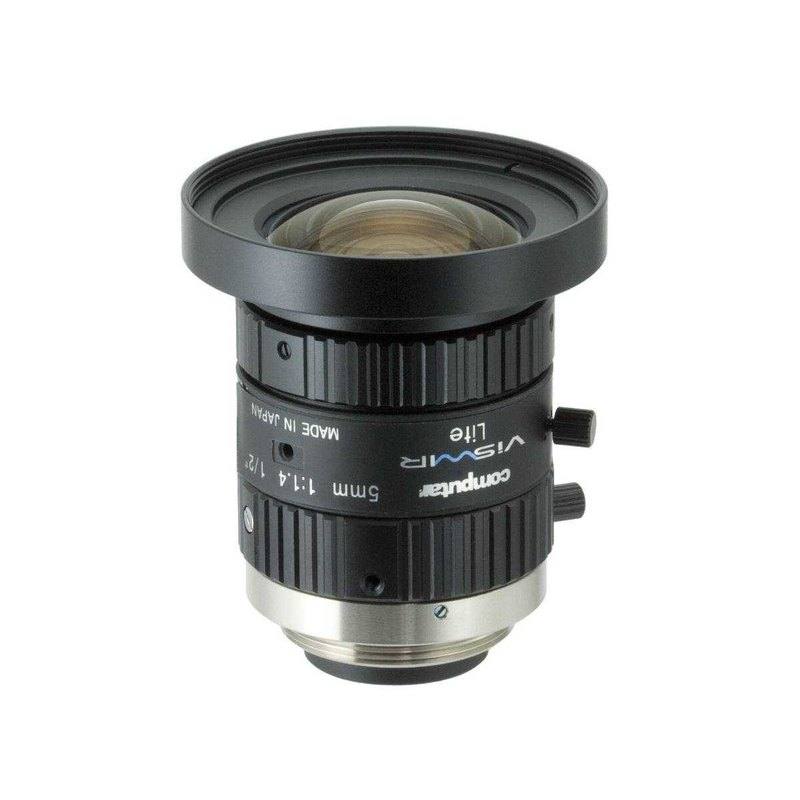
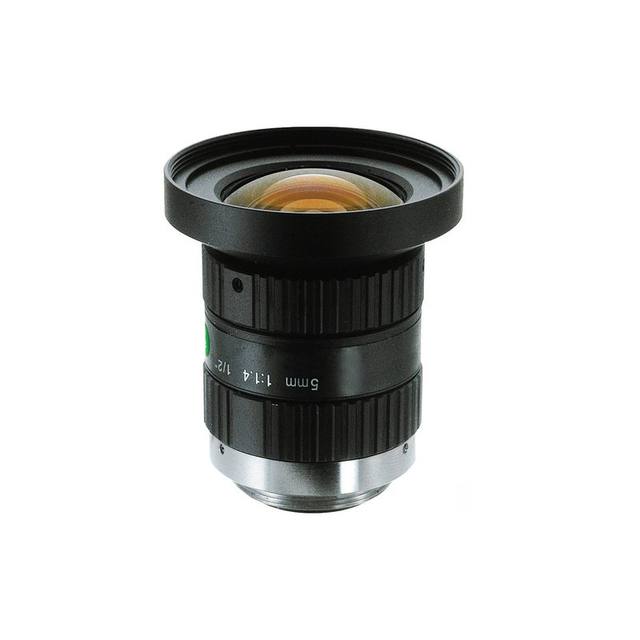
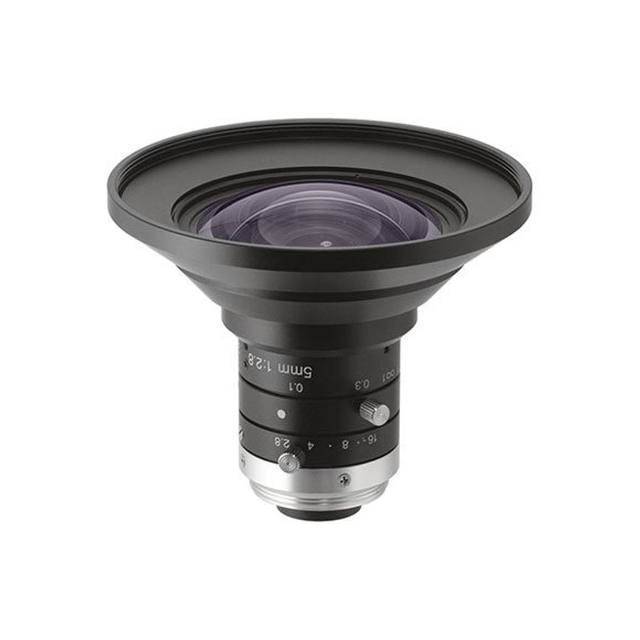
The RT-H0514-VSW is a VIS-SWIR lens covering 400-1700 nm, part of the ENVIS-SWIRMP series and built for 1/2″ sensors with an Ø 8.2 mm image circle. Its 5 mm focal length sets a broad field of view on that format. The aperture is listed as F1.4–closed, so exposure can be controlled from the wide-open F1.4 setting through to the closed end of the range. Because the band spans visible light and short-wave infrared, one lens can image in both regions, provided the sensor and illumination respond in the same band.
The working distance is listed as 100 – 900 mm. That is a range rather than a minimum with focus to infinity, so the object distance should fall within that band when the camera is mounted. The mounting position inside the range also sets the field of view, which should be calculated from the sensor width and the chosen distance before the layout is fixed.
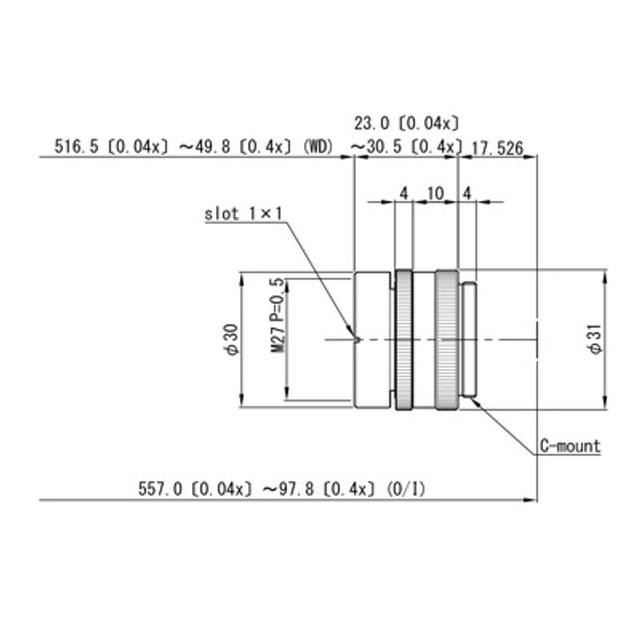
Mechanically the lens uses a C-mount with an M43 × 0.75 thread. The 1/2″ image circle is the format limit, so a sensor larger than 1/2″ falls outside the rated format. For SWIR work the camera sensor must respond across 400-1700 nm, because the lens does not add wavelength response to a sensor that lacks it.
Best for
Imaging across visible and short-wave infrared wavelengths (400-1700 nm) on 1/2″ sensors
Inspections where the object distance varies anywhere within 100 – 900 mm
Projects that want one lens to cover both visible and SWIR work
C-mount camera setups using a 1/2″ format and a 5 mm focal length
Selection notes
Confirm the camera sensor responds across 400-1700 nm; the lens band does not extend the sensor's own response.
Mount the camera so the object sits between 100 mm and 900 mm from the lens.
Match illumination to the wavelength you need to image, since the lens passes the full band but the contrast depends on the source.
Keep sensors within 1/2″ to stay inside the rated image circle.
Check the M43 × 0.75 thread and C-mount flange against the camera and accessories.
Specifications: General
Brand
Opto Engineering
Specifications: Optical
Focal length
5 mm
Aperture (f-number)
F1.4–closed
Lens mount
C-mount
Image circle / max sensor
Ø 8.2 mm (max sensor 1/2″)
Working distance
100 – 900 mm
Specifications: Mechanical
Thread / filter size
M43 × 0.75
Applications this product is commonly selected for. Open one to see the full recommended hardware and approach.
Matched automatically by: camera mount fits the lens mount · camera sensor is covered by the lens image circle — this lens: C-mount · Ø 8.2 mm (max sensor 1/2″) image circle.