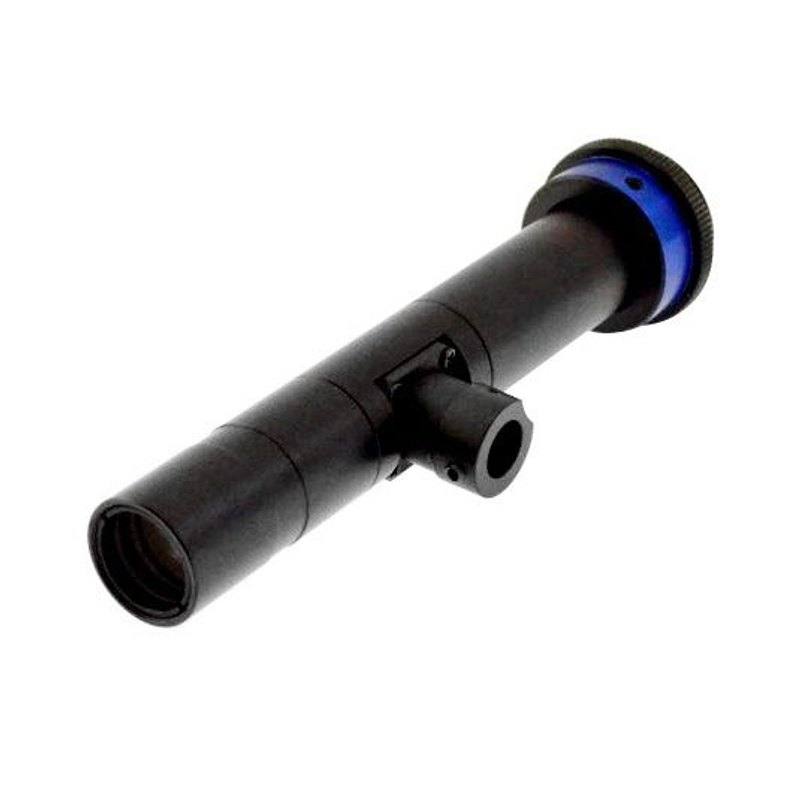
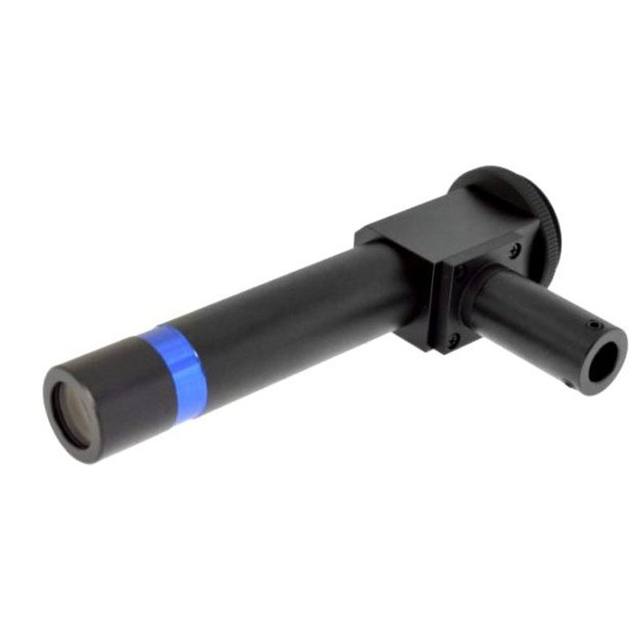
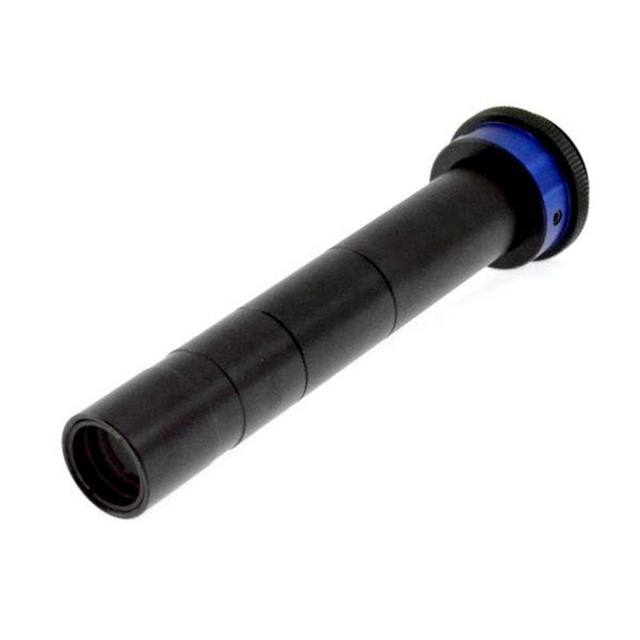
The RT-HR-6F-110 is a telecentric lens with 6.000× magnification, a C-mount and an Ø 11.0 mm image circle for detectors up to 2/3″. It is part of the TCCXHM series of high magnification coaxial telecentric lenses for sensors up to 2/3″, and it has built-in coaxial illumination. The combination of high magnification and coaxial light suits small, flat or reflective features that need to be imaged in fine detail.
Telecentric imaging keeps magnification relatively constant when the object moves slightly in depth, which reduces perspective error in gauging. The working distance of 110.0 mm is the lens-to-object spacing at focus, which leaves clearance above the part for fixtures, handling equipment or nearby hardware.
The working f-number (wF/#) is 55.6, a small aperture. That increases depth of field but reduces the light reaching the sensor. Because the coaxial illumination is built into the lens, the light source is part of the optical assembly, but exposure and brightness still need to be checked with the chosen camera and the surface being inspected.
Best for
Coaxial inspection of flat or reflective surfaces where light needs to travel along the optical axis.
High-magnification imaging of small holes, marks or edges at a 110.0 mm working distance, where clearance above the part is useful.
Dimensional measurement of small features on a sensor up to 2/3″ at 6.000×.
Close inspection of small components where a 6.000× field and built-in coaxial light are both needed.
Selection notes
Confirm a C-mount camera with a sensor up to 2/3″, matching the Ø 11.0 mm image circle.
Set the 110.0 mm working distance in the mechanical layout so the object sits at the correct focus position.
With a wF/# of 55.6 the light level is limited, so allow for longer exposure or brighter illumination and check the result on the actual part.
Keep the camera square to the object plane, since telecentric gauging depends on a consistent view for repeatable readings.
Specifications: General
Brand
Opto Engineering
Specifications: Optical
Lens mount
C-mount
Image circle / max sensor
Ø 11.0 mm (max sensor 2/3″)
Magnification
6.000×
Working distance
110.0 mm
Telecentric
Yes
Applications this product is commonly selected for. Open one to see the full recommended hardware and approach.
Matched automatically by: camera mount fits the lens mount · camera sensor is covered by the lens image circle — this lens: C-mount · Ø 11.0 mm (max sensor 2/3″) image circle.