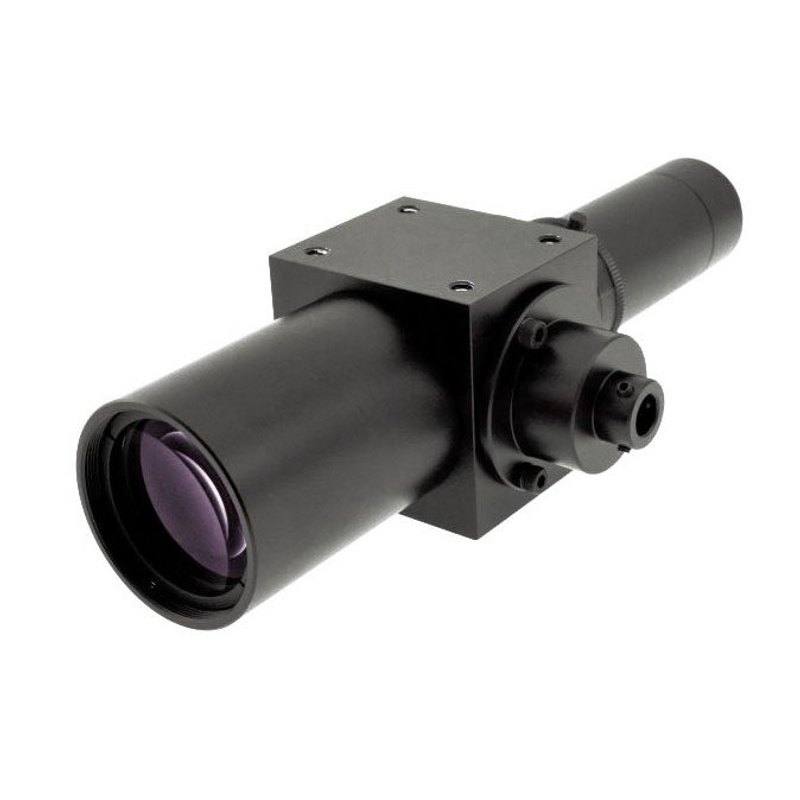
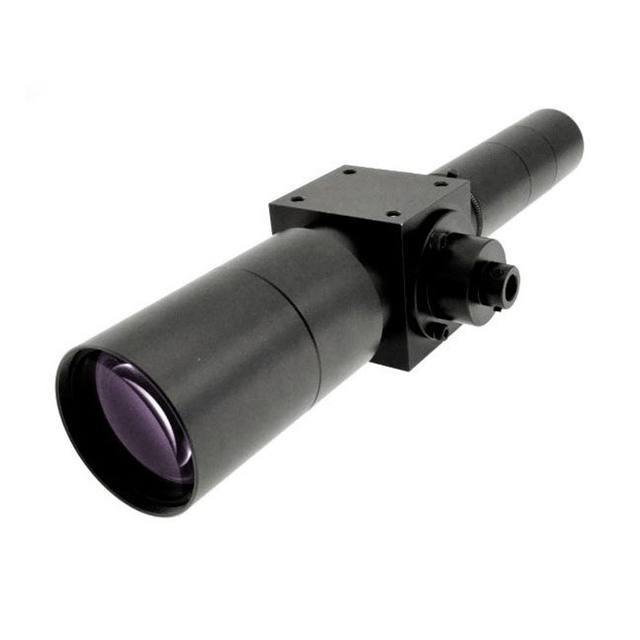
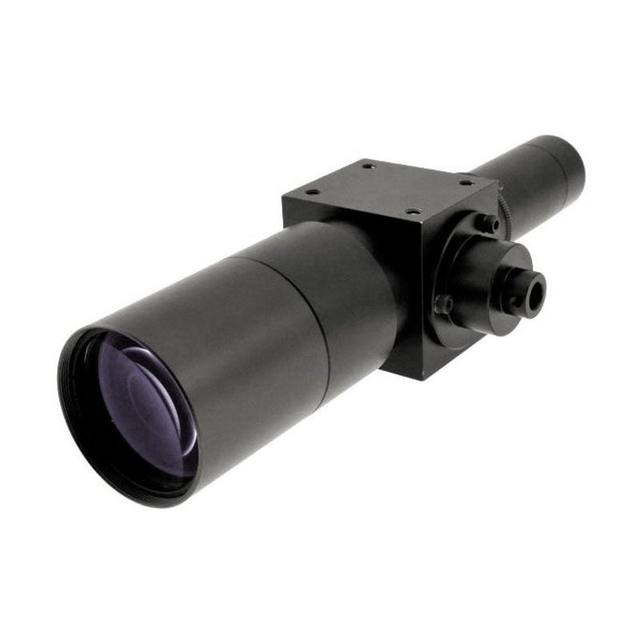
The RT-TCL0400-F is a telecentric lens with 0.400× magnification, so the sensor records objects at 0.400 times their true size. Its image circle is Ø 11.0 mm, rated for a maximum sensor of 2/3″, and it uses a C-mount. It belongs to the TCCXHM series, described as high magnification coaxial telecentric lenses for sensors up to 2/3″.
The 78.5 mm working distance keeps the lens relatively close to the part. Telecentric imaging keeps magnification nearly constant across a small change in object distance, which supports dimensional measurement when parts sit at slightly different heights. The working f-number range of wF/# 8-40 lets you trade light for depth of field: lower values admit more light, while higher values deepen focus at the cost of brightness.
The built-in coaxial illumination sends light down the optical axis onto the part, which suits flat, reflective surfaces such as machined faces or printed marks, where the surface returns light into the lens. Keep the sensor within the Ø 11.0 mm image circle, since a larger format would lose coverage at the corners. Because the illumination is integrated, the lens and light are positioned together as one inspection head.
Best for
Dimensional measurement of small features on flat parts with a 2/3″ camera.
Inspection of flat, reflective surfaces where built-in coaxial illumination keeps the light on the optical axis.
Printed mark inspection on flat parts at a 78.5 mm working distance.
Setups that need a short 78.5 mm working distance together with telecentric measurement.
Selection notes
Choose a 2/3″ or smaller sensor so it fits within the Ø 11.0 mm image circle.
Set the working aperture within wF/# 8-40 to balance light against depth of field across the expected part height variation.
Allow for the 78.5 mm working distance when laying out the mount and fixtures.
Validate the coaxial illumination on representative parts, since its effect depends on the reflectivity of the surface.
Specifications: General
Brand
Opto Engineering
Specifications: Optical
Lens mount
C-mount
Image circle / max sensor
Ø 11.0 mm (max sensor 2/3″)
Magnification
0.400×
Working distance
78.5 mm
Telecentric
Yes
Applications this product is commonly selected for. Open one to see the full recommended hardware and approach.
Matched automatically by: camera mount fits the lens mount · camera sensor is covered by the lens image circle — this lens: C-mount · Ø 11.0 mm (max sensor 2/3″) image circle.