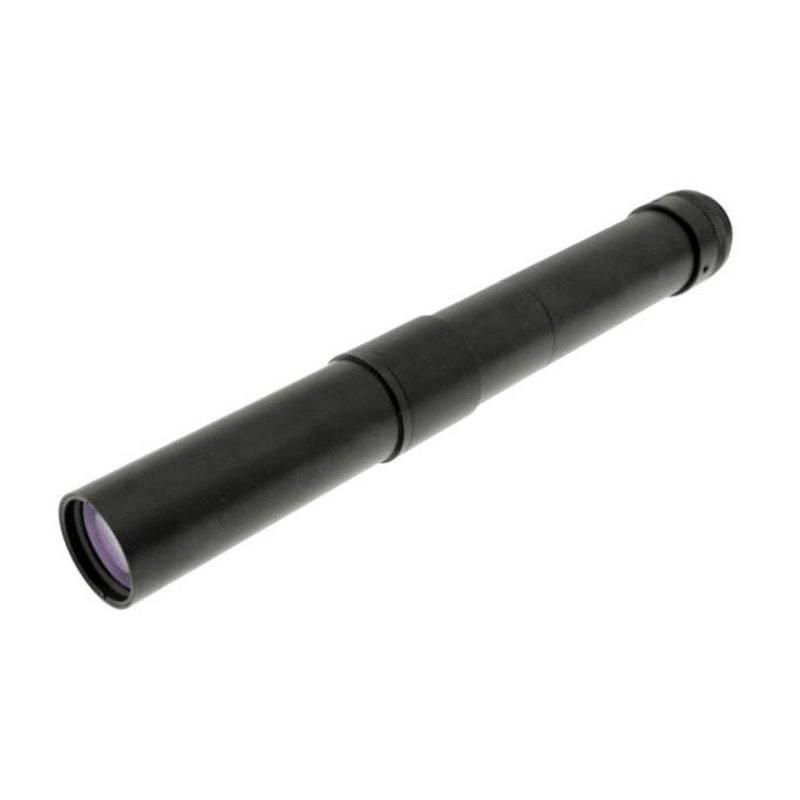
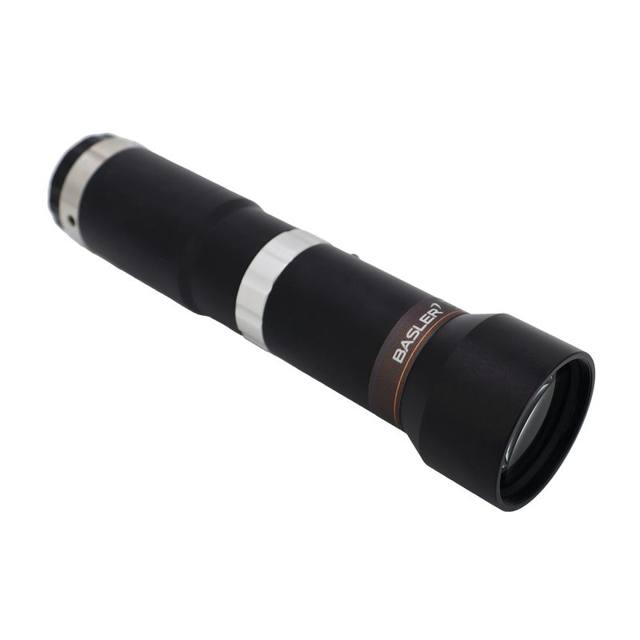
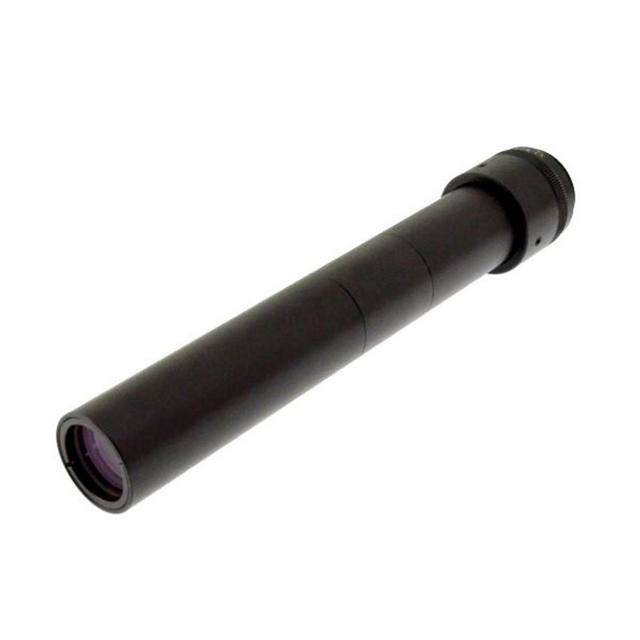
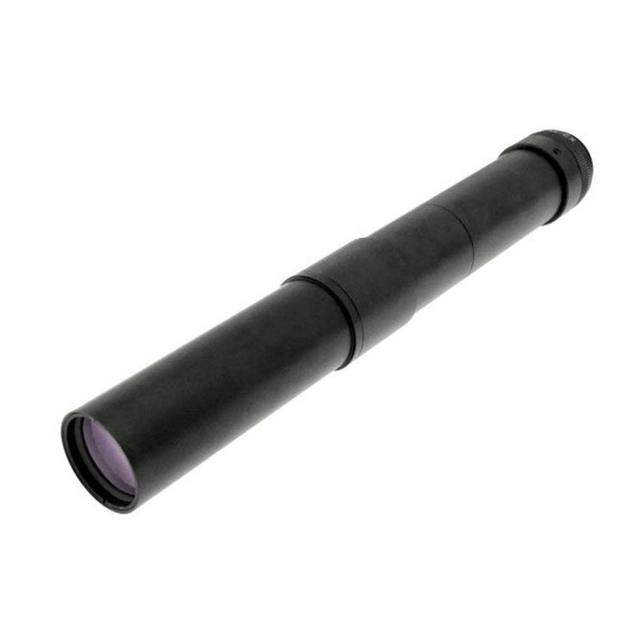
The Opto Engineering RT-TV-2M-220 is a very long working distance telecentric lens with 2.000× magnification and a 218.2 mm working distance. Its image circle is Ø 8.0 mm (max sensor 1/2″), so it is listed for detectors up to 1/2″. At 2.000× the imaged area is a small portion of the part, which suits close examination of small features, while the 218.2 mm working distance gives a practical gap between the optics and the part for fixtures or handling equipment.
The telecentric design is listed as Yes, so magnification is intended to stay consistent over small changes in the distance between lens and object. The working f-number is wF/# 33.0. A working f-number of 33.0 generally gives more depth of field than lower values, which helps when the part sits at slightly different distances, but it also reduces the light reaching the sensor, so the illumination has to be sized for the 218.2 mm working distance.
The C-mount provides a direct mechanical connection to C-mount camera bodies. The 8.0 mm image circle is the coverage limit: sensors larger than 1/2″ fall outside the stated coverage, so the camera format should be confirmed before the optical layout is fixed. Because the field is small at 2.000×, the part should be held in a repeatable position relative to the object plane.
Best for
Gauging of small features at 2.000× where the camera has to sit 218.2 mm from the part.
Inspections where a working f-number of 33.0 and its greater depth of field help tolerate small depth variation.
Setups that need clearance between the lens and the part, such as fixtures or handling arms.
Telecentric C-mount imaging with 1/2″ sensor cameras.
Selection notes
Choose a camera with a sensor no larger than 1/2″ to remain within the Ø 8.0 mm image circle.
Plan illumination for wF/# 33.0 at 218.2 mm, and confirm that the light covers the field.
Fix the object plane at 218.2 mm and keep fixtures out of the working space.
Confirm the camera body is C-mount before ordering.
Specifications: General
Brand
Opto Engineering
Specifications: Optical
Lens mount
C-mount
Image circle / max sensor
Ø 8.0 mm (max sensor 1/2″)
Magnification
2.000×
Working distance
218.2 mm
Telecentric
Yes
Applications this product is commonly selected for. Open one to see the full recommended hardware and approach.
Matched automatically by: camera mount fits the lens mount · camera sensor is covered by the lens image circle — this lens: C-mount · Ø 8.0 mm (max sensor 1/2″) image circle.