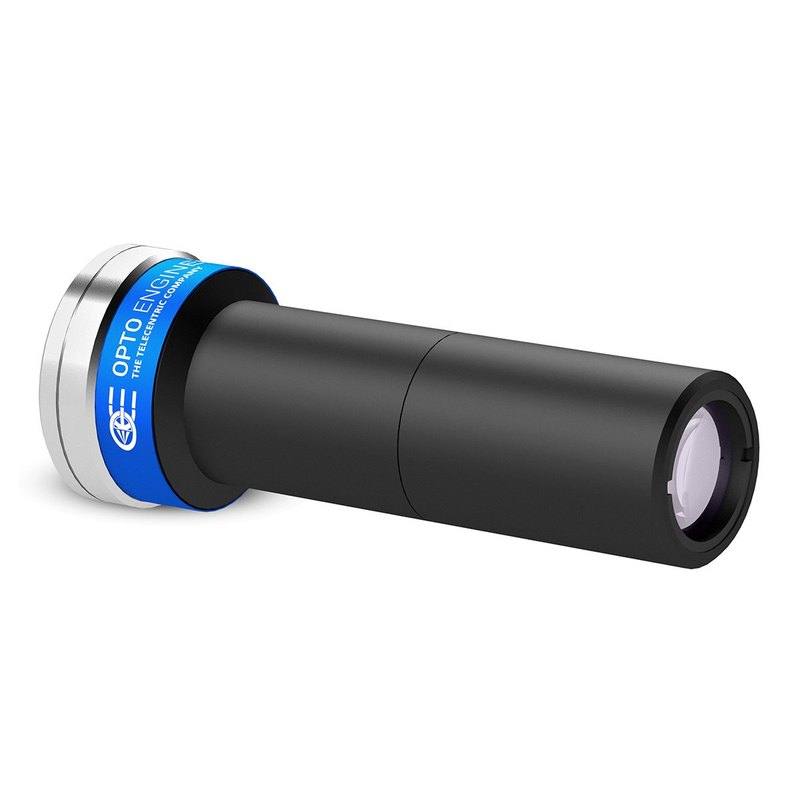
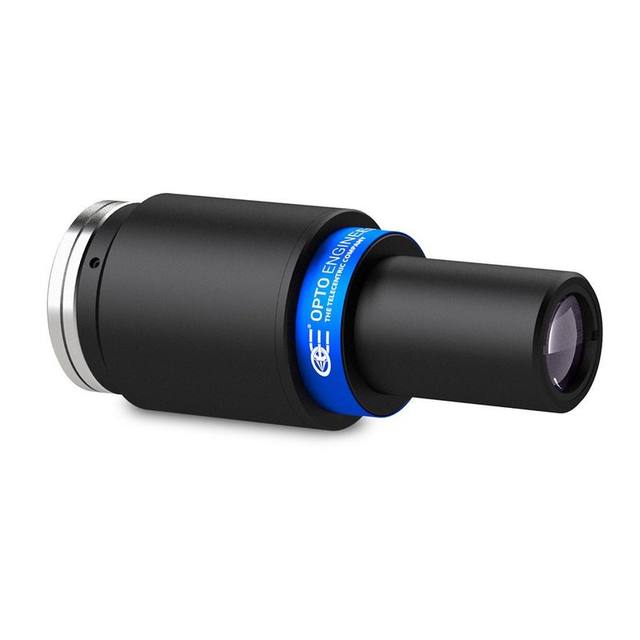
The Opto Engineering TC23004 is a bi-telecentric lens with a C-mount and a magnification of 2.000×. Its Ø 11.0 mm image circle is the manufacturer's stated maximum for a 2/3″ sensor, so the lens is built for that format. At 2.000× the object is magnified two times on the sensor, so the field of view is smaller than the sensor itself. That makes the lens suited to dimensional checks on small features where the area being measured is limited.
The 56.0 mm working distance places the object close to the front of the lens. As a bi-telecentric design, the lens is telecentric on both the object and image sides, which helps keep the image scale stable as the object shifts within the depth of field. Telecentricity is listed below 0.08° typical and 0.10° maximum, and distortion below 0.04% typical and 0.08% maximum. Those are the figures to carry into the accuracy budget for gauging small parts.
The working f-number of 11 gives a stopped-down aperture with greater depth of field and less light reaching the sensor, so the lighting must be bright enough for short exposure times. Pair the lens with a C-mount camera whose sensor is 2/3″ or smaller, and hold the object at 56.0 mm so it lies in the plane the lens is designed to image.
Best for
Dimensional measurement of small features at 2.000× magnification
Gauging of small parts presented at a 56.0 mm working distance
Telecentric measurement where a stable image scale matters
Inspection on C-mount cameras with 2/3″ sensors
Selection notes
Use a sensor no larger than 2/3″, as the Ø 11.0 mm image circle is the stated maximum.
Hold the object at 56.0 mm with a rigid, repeatable fixture, since the design depends on that object plane.
Plan illumination for a working f-number of 11, which adds depth of field but lowers the light reaching the sensor.
Carry the distortion (below 0.04%, maximum 0.08%) and telecentricity (below 0.08°, maximum 0.10°) figures into the uncertainty budget.
Specifications: General
Brand
Opto Engineering
Specifications: Optical
Lens mount
C-mount
Image circle / max sensor
Ø 11.0 mm (max sensor 2/3″)
Magnification
2.000×
Working distance
56.0 mm
Telecentric
Yes
Applications this product is commonly selected for. Open one to see the full recommended hardware and approach.
Matched automatically by: camera mount fits the lens mount · camera sensor is covered by the lens image circle — this lens: C-mount · Ø 11.0 mm (max sensor 2/3″) image circle.