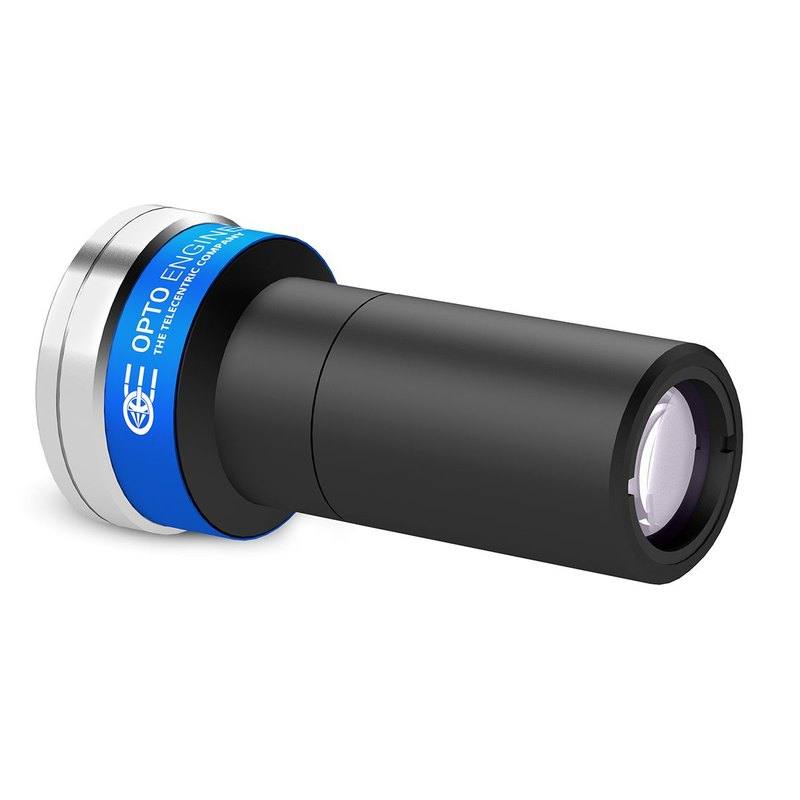
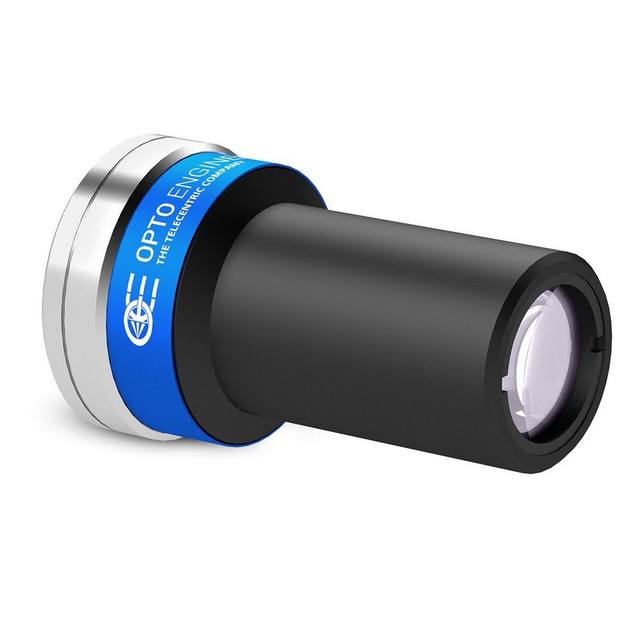
The Opto Engineering TC23007 is a bi-telecentric lens with a C-mount and a magnification of 1.333×. Its Ø 11.0 mm image circle is the stated maximum for a 2/3″ sensor, which sets the format for the camera choice. At 1.333× the object is enlarged on the sensor, so small features occupy more of the sensor than they would at a lower magnification, which supports detailed measurement of small parts.
The 60.1 mm working distance places the object close to the lens. Because the design is bi-telecentric, both the object and image sides keep their chief rays close to parallel to the optical axis, which helps the image scale remain steady as the object moves within the depth of field. The manufacturer lists telecentricity below 0.08° typical and 0.10° maximum, and distortion below 0.03% typical and 0.08% maximum. Those values form the optical part of the measurement error budget.
A working f-number of 11 gives greater depth of field, with less light reaching the sensor, so lighting should be sized for short exposure times. Mount the lens on a C-mount camera with a 2/3″ or smaller sensor and hold the object at 60.1 mm so it lies in the plane the lens is designed to image.
Best for
Measuring small features at 1.333× magnification on a 2/3″ sensor
Gauging of small parts presented at a 60.1 mm working distance
Telecentric measurement where a steady image scale across part height matters
Inspection with C-mount cameras and a fixed object plane
Selection notes
Use a sensor of 2/3″ or smaller, since the Ø 11.0 mm image circle is the stated maximum.
Fix the object at 60.1 mm with a repeatable fixture so it stays in the designed plane.
Plan illumination for a working f-number of 11, which adds depth of field but lowers the light at the sensor.
Carry distortion (below 0.03%, maximum 0.08%) and telecentricity (below 0.08°, maximum 0.10°) into the measurement uncertainty budget.
Specifications: General
Brand
Opto Engineering
Specifications: Optical
Lens mount
C-mount
Image circle / max sensor
Ø 11.0 mm (max sensor 2/3″)
Magnification
1.333×
Working distance
60.1 mm
Telecentric
Yes
Applications this product is commonly selected for. Open one to see the full recommended hardware and approach.
Matched automatically by: camera mount fits the lens mount · camera sensor is covered by the lens image circle — this lens: C-mount · Ø 11.0 mm (max sensor 2/3″) image circle.